Fire extinguisher buying guide
A fire extinguisher buying guide has one job: match the label to the fuel in that room, then check the mark and the size before the price. This page is from the Products Compared editorial team. We compared four amazon.co.uk listings captured on 19 October 2026, at about £11.99, about £14.28, about £19.99 and about £23.42, and we did not run a lab fire test. A qualifying purchase can earn us a commission at no extra cost to you. The [fire extinguisher comparison](/hub/fire-protection/fire-extinguisher) ranks those four listings. Here you get the checks that decide whether any of them belongs in the basket.
A fire extinguisher buying guide has one job: match the label to the fuel in that room, then check the mark and the size before the price. This page is from the Products Compared editorial team.
A fire extinguisher buying guide has one job: match the label to the fuel in that room, then check the mark and the size before the price. This page is from the Products Compared editorial team. We compared four amazon.co.uk listings captured on 19 October 2026, at about £11.99, about £14.28, about £19.99 and about £23.42, and we did not run a lab fire test. A qualifying purchase can earn us a commission at no extra cost to you. The fire extinguisher comparison ranks those four listings. Here you get the checks that decide whether any of them belongs in the basket.
Our top picks
| Badge | Product | Stated classes | Fire rating | Standard on the listing | Note | Price | Offer |
|---|---|---|---|---|---|---|---|
| Best overall |  Unbranded 2 kg ABC powder with brackets | A, B and C | n/a | BS EN3-7:2004+A1:2007; Kitemark EN3 | 7.5 | about £19.99 | View offer |
 Ogniochron Ogniochron 1 kg ABC powder | 8A 34B and C-class | 8A 34B | CE approved EN 3; RINA; MED | 7.8 | about £23.42 | View offer | |
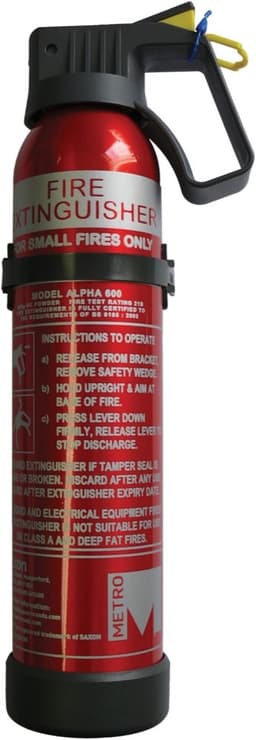
| Alternative |  Metro Metro HG 098-00, 600 g | B and C | n/a | BSI certified to BS616 2002 and Kitemarked | 4.8 | about £14.28 | View offer |


On this page
What the label has to show
Marks that mean a test, and marks that do not
Size and agent for the room
Home basket versus a workplace install
Common questions
Is a CE mark enough?
Is 1 kg enough, or do I want 2 kg?
Which agent for a garage, and which for a chip pan?
Does a private home have to buy a British Standard cylinder?
What does 8A 34B mean in plain terms?
Related pages
Sources
Public UK sources for this comparison, checked on 20 October 2026. Prices are amazon.co.uk shelf prices from 19 October 2026.
- Regulatory Reform (Fire Safety) Order 2005, article 6 (retrieved 20 October 2026)
- Fire safety in the home, GOV.UK (retrieved 20 October 2026)
- Fires in the home, GOV.UK Prepare (retrieved 20 October 2026)
- BAFE: how often to service fire extinguishers (retrieved 20 October 2026)
- BAFE: extinguisher type for live electrical equipment (retrieved 20 October 2026)
- Hereford and Worcester Fire and Rescue Service: fire extinguishers (retrieved 20 October 2026)
- Hampshire and Isle of Wight Fire and Rescue Service: fire safety equipment (retrieved 20 October 2026)
- Firesafe.org.uk: portable fire extinguisher general (retrieved 20 October 2026)