Independent comparisons. We may earn from shop links. More info

How to use a fire extinguisher

Updated: 20 October 2026

How to use a fire extinguisher is a short drill for a small fire, with the exit already behind you, after you have called 999. If the room is filling with smoke, the drill does not start. This page is from the Products Compared editorial team. We used public UK fire-service guidance and the labels on four amazon.co.uk listings captured on 19 October 2026. We did not run a practice burn. A qualifying purchase can earn us a commission at no extra cost to you. Product choice stays on the [fire extinguisher comparison](/hub/fire-protection/fire-extinguisher).

How to use a fire extinguisher is a short drill for a small fire, with the exit already behind you, after you have called 999. If the room is filling with smoke, the drill does not start.

Our top picks

On this page

When you should not start

The default from GOV.UK’s Prepare campaign, and from Devon and Somerset Fire and Rescue Service, is to get out, stay out and call 999. Smoke can overcome you in two or three breaths. You might use an extinguisher if the fire is very small, or if it is blocking your exit, and only if you will not put yourself in danger. Call 999 before you pull the pin. The escape plan for a private house is on the fire extinguisher for the home page. Hampshire and Isle of Wight Fire and Rescue Service say you do not put an extinguisher on a chip pan. Turn the heat off only if you can do it without reaching across the flames, and get out if the oil keeps burning.

PASS in full sentences

PASS is the memory hook: pull, aim, squeeze, sweep. Pull the pin, and point the nozzle away from you for a short test burst. Aim at the base of the fire, not at the flames above it. Squeeze the handles together. Sweep across the base until the flames are out, and keep going until the cylinder is empty. Stand well back. Kidde UK’s FAQ gives about 1.5 to 2 metres. The Fire Protection Association’s water method says about 3 metres. Neither figure is a measurement we took. The Ogniochron 1 kg listing prints a 4 m discharge range as a product claim, not a safe standing distance. If the fire grows, stop and leave. A half-used cylinder needs a competent recharge.

Moves that spread the fire

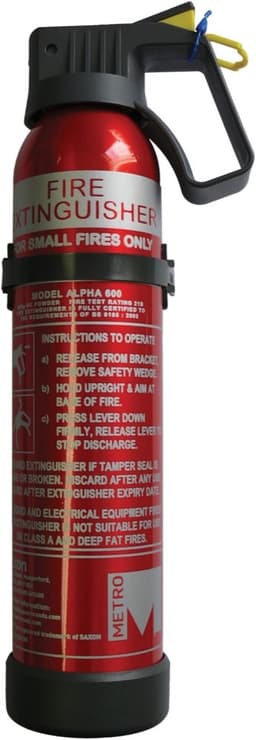
Hereford and Worcester Fire and Rescue Service say powder is not for a chip pan. If you have the 1 kg or 2 kg powder listing, that limit still applies in your kitchen. Powder in a small room knocks flame down and then fills the air. The Fire Protection Association, citing BS 5306-8:2012, says powder should generally not be specified indoors. If the room whites out, you leave. Hampshire says you do not hold a CO2 horn. The gas leaves it extremely cold. This comparison does not include a CO2 cylinder. Agent choice is on the powder vs CO2 fire extinguisher page. The Metro 600 g bullets claim classes B and C, not Class A, so sweeping it at a sofa is the wrong fuel.

After you stop

Leave once the attempt is over, whether the flame is out or not. Stay out. Tell the fire service what you discharged and where the cylinder is. If you used powder, say so. Do not remount a used cylinder. A used or partly used unit needs a competent recharge. On a pressure-gauge model such as the Ogniochron, a needle that has left the green is the same message. A Metro review that describes a partial discharge with the pin still in is a reason to retire that can.

Common questions

How far back should I stand?
Kidde UK’s FAQ says about 1.5 to 2 metres, and that is one manufacturer’s guideline. The Fire Protection Association’s water method says about 3 metres. Use the distance printed on your own cylinder if it has one. The 4 m figure on the Ogniochron listing is a stated discharge range, not a measured safe distance from this project. Stand so you can still reach the door without turning your back on the fire for long.
Should I call 999 before I pull the pin?
Yes. Call 999 first, give the address, and say there is a fire. Then use the extinguisher only if the fire is still very small and your exit is clear. Devon and Somerset and the Prepare campaign both put getting out and calling 999 ahead of any technique. If the call is delayed because you are fighting the fire, the service loses the minutes that matter.
What if one extinguisher does not put it out?
Leave. One cylinder that has not killed the fire is the stop, not the cue to search the house for another. Get out, stay out, and tell the firefighters what you already discharged. A second untrained attempt in thickening smoke is how people are overcome. Devon and Somerset’s line that smoke can overcome you in two or three breaths is the limit, not a slogan.
Can I use it on a chip pan if it is small?
No. Hampshire says you do not use an extinguisher on a chip pan, and Kidde UK’s FAQ says the same. A small pan is still oil. Powder, water and foam can spread it. If it is safe to turn the heat off without leaning over the pan, do that, and use a fire blanket if you have one and the flames are still contained. If the oil keeps burning, get out and call 999. Do not carry the pan anywhere.
Why must I not hold a CO2 horn?
The horn becomes extremely cold as the gas discharges, and it can frost-burn the skin. Hampshire tells you not to hold it. Use the handle. This comparison does not include a CO2 cylinder, so the warning is for a unit you might buy elsewhere. CO2 also displaces oxygen, so you do not empty one in a sealed cupboard and stay there to watch.

Related pages

Sources

Public UK sources for this comparison, checked on 20 October 2026. Prices are amazon.co.uk shelf prices from 19 October 2026.

  1. Regulatory Reform (Fire Safety) Order 2005, article 6 (retrieved 20 October 2026)
  2. Fire safety in the home, GOV.UK (retrieved 20 October 2026)
  3. Fires in the home, GOV.UK Prepare (retrieved 20 October 2026)
  4. BAFE: how often to service fire extinguishers (retrieved 20 October 2026)
  5. BAFE: extinguisher type for live electrical equipment (retrieved 20 October 2026)
  6. Hereford and Worcester Fire and Rescue Service: fire extinguishers (retrieved 20 October 2026)
  7. Hampshire and Isle of Wight Fire and Rescue Service: fire safety equipment (retrieved 20 October 2026)
  8. Firesafe.org.uk: portable fire extinguisher general (retrieved 20 October 2026)