Independent comparisons. We may earn from shop links. More info

How to apply slow release fertiliser, step by step

Updated: October 2026

You have a jar on the potting bench and a row of baskets that need charging before they go outside. How to apply slow release fertiliser is one measured spring job, watered in, at the rate on the pack you hold. A website average is a rule of thumb only. The [slow release fertiliser comparison](/hub/fertiliser-soil-and-bark-mulch/slow-release-fertiliser) names the seven listings. This page is the method: when, mix or top-dress, how much, and the mistakes that look like a failed formula. A purchase through our links may earn a commission. This is not a laboratory test.

You have a jar on the potting bench and a row of baskets that need charging before they go outside. How to apply slow release fertiliser is one measured spring job, watered in, at the rate on the pack you hold.

Our top picks

On this page

When to apply

In the UK, apply a six-month garden granule from March to May, once compost is moist and nights are no longer freezing. Warm weather releases more food. Cold weather slows it. Roots take nutrients only from moist soil, so a six-month claim is a manufacturer window, not a promise for a cold Scottish spring. Do not spread on frozen, snow-covered or waterlogged soil, and skip a nitrogen-heavy granule on outdoor plants in late autumn. The ericaceous Westland 900 g wants a dose at the end of March and again at the end of June. Basket litres are on slow release fertiliser for pots. Plant group is on the slow release fertiliser buying guide. Wear gloves. Store the tub away from children, pets and feedstuffs. Many packs say harmful to aquatic life with long lasting effects.

Mix, top-dress, then water

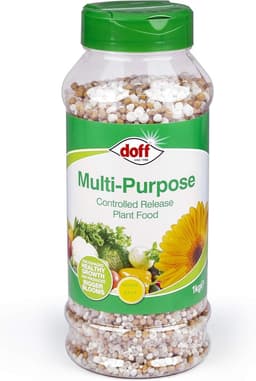
Base dressing means mixing the granules through compost before planting. Top dressing means scattering them on the surface around an established plant, then watering in. Topline’s bullets print premix with compost or topsoil, a planting hole, or a top dressing, and they say water in to activate. Westland Boost reviews mention a measuring spoon. Doff names a shaker bottle and prints no grams on the listing. Keep granules off stems, crowns and the neck of a plug. Water the compost first if it is dry. A coated granule sitting in dust does not release, and the first heavy rain can then dump salt onto roots. Water again after you apply. Do not hose surplus granules into a drain or a pond overflow. For a 30 cm basket in April, mix the printed grams through the compost, plant, then water until it runs through. Do not leave dry pellets against the stems. On a border rose, scratch the granules in under the drip line. Do not dump a heap against the graft.

How much

The pack in your hand beats any website average. SimplySeed’s generic 3–4 g per litre and 50–100 g per square metre is a rule of thumb, not the brand rate on these listings. Westland Boost’s brand page prints 30 g per 30 cm pot, 20 g per 10 litres of compost, 50 g per square metre, and a handful of about 40 g. An older Miracle-Gro label prints 25–50 g per 10 litres, 75 g per square metre, and a handful of about 25 g. Those two handfuls are not the same weight. Do not average them. Doff and both Goulding jars leave grams blank on the amazon listing. Do not invent a Goulding rate from a Westland page. Topline warns that overdosing can damage plants. Ericaceous Westland’s brand page prints 40 g per square metre and 30 g per 30 litres of compost, with granules kept off stems.

Mistakes that look like it does not work

Applying in February on cold, dry compost looks like a dead product. The coat has not warmed and the roots are not drinking. Feeding in late autumn looks like lush growth that then sits in wet, short days. Stacking a full liquid can on a full granule rate is a salt problem, not extra insurance. Young plugs are the other miss. Doff’s thin review file includes an experienced gardener who burned plug-plant roots in hanging-basket work. Use a lower dose on seedlings, or wait until they are established. A cracked tub is a delivery complaint, not proof the formula failed. Westland Boost and Topline both have split-plastic reviews. For a patio basket, the job is still one measured spring application, watered in, at the printed rate. Call a professional if a child or pet has eaten the product.

Common questions

When do I apply it in the UK?
March to May is the typical window for a six-month garden granule, once soil or compost is moist and not frozen. Skip late-autumn nitrogen on outdoor plants. The ericaceous Westland jar wants a second dose around the end of June.
Do I mix it in or sprinkle it on top?
Both are used. Mix through compost at potting, or top-dress established plants and water in. Topline prints premix, planting hole, or top dressing. Keep granules off stems.
How much per pot or per square metre?
Use the pack you hold. Westland Boost’s brand page is 30 g per 30 cm pot, 20 g per 10 litres, and 50 g per square metre. An older Miracle-Gro label is 25–50 g per 10 litres and 75 g per square metre. Doff and Goulding have no grams on the amazon listing.
Do I water it in?
Yes. Roots take nutrients from moist soil. Water before if the compost is dry, then water after. Dry pellets sit inert, or they burn when the first storm hits.
Can I add more if I see no change in a week?
No. A week is too soon for a coated granule. Adding a second full rate is how plugs burn. Wait, keep the compost moist, and check you used the printed grams.
Is it safe around children and pets after application?
Store the tub away from children and pets. As directed is not a chew test. Many packs still carry aquatic-harm and storage warnings. Sweep spills.
What if the tub arrived split?
That is a delivery and quality issue, not proof the formula failed. Westland Boost and Topline reviews both describe cracked tubs and loose granules. Decant what you can keep dry.

Related pages

Sources

Public UK and maker sources used for this page in October 2026. Prices, stars and review counts are from the seven amazon.co.uk listings. A maker-page NPK is not the amazon card. There is no laboratory test and no Which? winner among these jars.

  1. RHS, fertilisers (retrieved October 2026)
  2. RHS, fertiliser labels explained (retrieved October 2026)
  3. Fertilisers Regulations 1991 (retrieved October 2026)
  4. GOV.UK, rules to prevent water pollution (retrieved October 2026)
  5. Gardeners' World, which fertiliser to use (retrieved October 2026)
  6. Love The Garden, plant feeding application (retrieved October 2026)
  7. Westland Boost granules (retrieved October 2026)
  8. Which?, controlled-release fertilisers (retrieved October 2026)