Independent comparisons. We may earn from shop links. More info

Slow release fertiliser for pots and hanging baskets

Updated: October 2026

You are filling peat-free hanging baskets in April, and the compost bag’s own feed will not last the summer. Slow release fertiliser for pots is a compost charge at potting, at the printed grams, then watered in. A pot is not a border. The [slow release fertiliser comparison](/hub/fertiliser-soil-and-bark-mulch/slow-release-fertiliser) holds the seven jars. This page stays on baskets, tubs and houseplants: why they starve, how to mix, which rates you can quote, and the special cases of plugs and acid-lovers. A purchase through our links may earn a commission. This is not a laboratory test.

You are filling peat-free hanging baskets in April, and the compost bag’s own feed will not last the summer. Slow release fertiliser for pots is a compost charge at potting, at the printed grams, then watered in.

Our top picks

On this page

Why pots need a charge

Which? notes that compost’s own base feed lasts about three to four weeks. After that, a hanging basket is a closed volume of peat-free mix that dries fast, leaches when you water, and has nowhere else to draw from. The RHS treats containers as the main reason to feed at all. A border can coast. A 30 cm pot cannot. Peat-free mixes dry at the rim, then take water badly, so a coated granule in a dry shoulder does not release until you soak the pot. Rain through an open basket also washes dissolved feed out of the drainage holes. Charge at potting rather than hoping a weekly can will catch up in June. Westland Boost reviews treat one mix-in as a summer-long basket job. Doff’s file includes a plug-burn caution. The Miracle-Gro listing is a six-jar case, not a single 900 g pot jar. Season and safety lines sit on how to apply slow release fertiliser.

How to mix it in

Mix the granules through the compost before you plant, at the grams for that litre volume. A heap under the rootball is a hot pocket. A surface sprinkle on a new pot does not move down evenly. Topline allows premix, a planting-hole addition, or a top dressing, then water in to activate. For a new basket, premix is the cleaner route. Keep granules off stems and off the neck of a plug. Water if the mix is dry, then water again until it runs through. A 10 litre trough gets 20 g of Westland Boost on the brand page, not a handful guessed from a 2 kg tub. Mark the scoop once on a kitchen scale. Sweep spills. Many packs still say harmful to aquatic life. Top-dress later only if you missed the mix-in, or if a three-month ericaceous jar is due again in June. Keep pellets off the stem and water. Do not add a second full rate because the plant looks tired in week two.

Rates you can actually quote

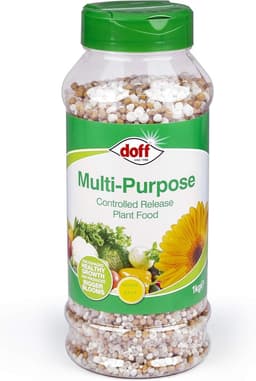
Quote brand figures as brand figures. Westland Boost’s page is 30 g per 30 cm pot and 20 g per 10 litres of compost. An older Miracle-Gro label prints 25–50 g per 10 litres, with a lower dose over 20 litres or for impatiens and young plants, and a handful of about 25 g. Boost’s handful is about 40 g. Use grams. Doff’s listing names a shaker and no grams. Both Goulding jars leave dosage blank. Do not invent a Goulding rate from another brand page. If the jar has no rate, read the lid.

Special pots

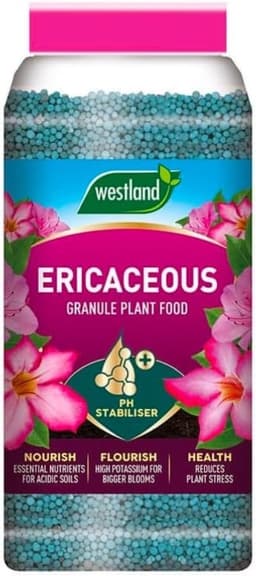
Young plugs are not established plants. Doff’s review file includes burnt roots on plug plants in hanging-basket work. Use a lower dose, or wait until the plug has rooted through. Impatiens appear on the older Miracle-Gro label as a lower-rate group. Topline warns that overdosing can damage plants. Acid-lovers in pots need ericaceous compost plus a matching feed. Westland’s 900 g jar is the three-month ericaceous granule, titled for rhododendrons, with reviews that also name camellia, blueberry, azalea and hydrangea. An all-purpose tub is the wrong chemistry in a lime-hating pot. Plan a second dose around the end of June. Houseplants only if the pack allows it. Boost reviews and the Topline title mention them. A six-month outdoor claim is not a licence to charge a dry windowsill in November. If you are still choosing, use the slow release fertiliser buying guide.

Common questions

How much per hanging basket?
Use the litres of compost, not the basket name. Westland Boost’s brand page is 20 g per 10 litres, or 30 g per 30 cm pot. An older Miracle-Gro label is 25–50 g per 10 litres. Doff and Goulding have no grams on the amazon listing.
Do I mix it through the compost or put it under the plant?
Mix it through. A heap under the rootball is a burn pocket. Topline also allows a planting hole or a top dressing. For a new basket, premix is cleaner. Water in.
Can I use it on houseplants?
Only if the pack names indoor use. Boost reviews and the Topline title mention houseplants. A six-month outdoor claim is not a winter windowsill programme. Keep granules off stems and do not feed dry compost.
What about young plugs?
Use a lower dose or wait until they are established. One Doff review describes burnt plug-plant roots in hanging-basket work. Topline warns that overdosing can damage plants.
When do I add liquid as well?
When the charge fades, often late summer, and only as a light top-up on moist compost. Do not stack a full can on a full granule rate. Which? discusses an optional late-season liquid. Quote that as Which?, not as this site’s trial.
Ericaceous pot or all-purpose jar?
Camellia, blueberry, azalea and rhododendron need the Westland 900 g ericaceous jar and ericaceous compost. Geraniums and mixed bedding take an all-purpose six-month granule.
Will rain wash it out of a basket?
Rain leaches dissolved feed through drainage holes, which is why you charge at potting and water to activate rather than leaving dry pellets on the surface. A coated granule still needs moist compost. It is not waterproof storage.

Related pages

Sources

Public UK and maker sources used for this page in October 2026. Prices, stars and review counts are from the seven amazon.co.uk listings. A maker-page NPK is not the amazon card. There is no laboratory test and no Which? winner among these jars.

  1. RHS, fertilisers (retrieved October 2026)
  2. RHS, fertiliser labels explained (retrieved October 2026)
  3. Fertilisers Regulations 1991 (retrieved October 2026)
  4. GOV.UK, rules to prevent water pollution (retrieved October 2026)
  5. Gardeners' World, which fertiliser to use (retrieved October 2026)
  6. Love The Garden, plant feeding application (retrieved October 2026)
  7. Westland Boost granules (retrieved October 2026)
  8. Which?, controlled-release fertilisers (retrieved October 2026)