Independent comparisons. We may earn from shop links. More info

Deer proof vegetable garden UK

Updated: October 2026

The runner beans are gone to the second set of leaves and the beetroot tops are shredded. A deer proof vegetable garden, on a small UK plot, is a closed bed, not a woodland grant fence and not a bird net thrown over the row. This page stays on crops, layout, and what the three amazon.co.uk rolls have been used for. Heights and hole maxima are on the [deer fence buying guide](/hub/fencing-and-wire/deer-fence/sub/deer-fence-buying-guide). The main table is the [deer fence comparison](/hub/fencing-and-wire/deer-fence). Updated in October 2026 by Peter F. from listings, reviews, and public UK sources. No lab test.

The runner beans are gone to the second set of leaves and the beetroot tops are shredded.

Our top picks

On this page

What deer take from a UK plot

The Royal Horticultural Society lists runner bean, beetroot, blackberry, raspberry, strawberry, roses, and new plantings among plants deer often damage, with more browsing on autumn fruit. A row can be stripped between dusk and morning. Naming the crop does not protect it. Roe and muntjac are the usual visitors. Tree tubes guard a trunk, not a bed of beans. Loose net on the crop is what the National Allotment Society warns can tangle wildlife.

A closed bed, not a drape

Measure the bed as a box: four sides, a return for the gate, and a hem on the soil. Roe and muntjac use a gap under about 15 cm, so daylight under a raised bed has not closed the plot. A drape fails when wind lifts a corner and a muntjac pushes the slack. A hurdle left open is the entrance. On a watched bed, the closed box is what these rolls can still do. The lap and the gate are on how to install deer netting.

Fruit bushes and a bird roof

Raspberries, currants, and strawberries draw deer and birds. Knowle Nets sells 19 mm fruit-cage mesh so bees can get in while birds stay out. UK reviews of the 19.8 m MEKKAPRO net describe that sort of cage, and chickens kept off a raised bed. A bird roof is not a deer fence if the sides stop short of a pegged base. Take a light roof off in snow, as cage makers advise for their own structures. The UK height figures are the RHS ones, not American 7 ft rules.

What the three listings add

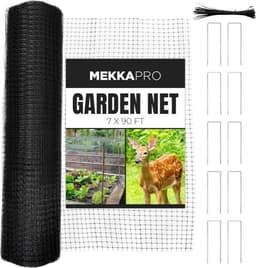
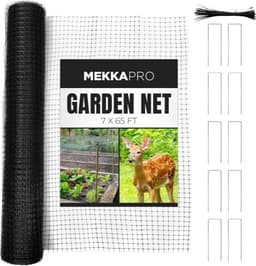
Feitore, 2.1 m by 30 m at about £14.59, prints a 1.9 cm mesh. Reviews mention fruit trees, roses, tomatoes, and raised beds. One UK note says deer stayed out. Another says deer ripped it. It is the best value if you add posts and accept that split. The 19.8 m MEKKAPRO net at about £29.99 is the top pick for a small cage you can walk, because UK reviews mention fruit cages and the box claims pegs. One of those reviews rejects it for muntjac and roe. The 27.4 m roll has no UK review in the extract. The comparison is on best deer netting. Skip all three if the deer are numerous. A purchase through a link on this page can earn a commission at no extra cost to you.

Common questions

Will a net around one bed stop roe or muntjac?
It can only if the bed is a closed box: tall enough for the species, pegged so there is no gap under about 15 cm, and shut at the gate. A drape over the crop is not that box. These rolls are light polypropylene. One UK Feitore review says deer ripped the net, and one UK MEKKAPRO review refuses it for muntjac and roe. A watched short run is the limit of the claim.
Which crops are they actually eating?
The RHS names runner bean, beetroot, blackberry, raspberry, strawberry, roses, and new plantings, plus autumn fruit, as often damaged. Your bed may differ. A plant list of things deer tend not to eat, including rhubarb on the RHS page, does not replace a fence. Tree tubes at about 1.2 m or 1.6 m protect stems, not a row of beans.
Can I use the same net as a fruit-cage roof?
UK reviewers have used the 19.8 m MEKKAPRO net on fruit cages, and the holes they measure are in the same region as 19 mm bee-friendly bird mesh. The listing does not state that hole. A roof keeps birds off if it is tight on a frame. Take a light roof off when snow is forecast, as cage makers advise for their own structures. That snow note is not a measured result for these ASINs.
Is a bird-mesh fruit cage a deer fence?
Not by itself. Bird mesh around 19 mm to 22 mm can stop birds and admit bees. Deer are stopped by height, a closed base, and a material they do not push through. If your cage sides are the same light net and the hem is loose, you have a bird cage. The National Allotment Society warns that loose net on the ground tangles wildlife. Pin it, or take it down.
What about an allotment rule on fencing?
Check the site. The National Allotment Society says deer fencing is often over 1.8 m to 2 m, and that gates and corners fail, but each association sets its own rules on structures. There is no national ban and no national permission to infer from these rolls. A permanent post line may need consent even when a seasonal cage does not.
Should I rely on plants deer do not eat?
No. The RHS treats a resistant list as weaker than exclusion, and it says even those plants are not a guarantee. Protect new plantings until they establish. If deer are already on the beans and the fruit, a planting scheme without a fence leaves the next row open. Use the list to choose what sits outside the bed, not instead of the bed.

Related pages

Sources

Public UK sources and the amazon.co.uk listings used for this comparison, October 2026.

  1. RHS, Deer (retrieved 20 October 2026)
  2. British Deer Society, deer in gardens (retrieved 20 October 2026)
  3. British Deer Society, fencing and muntjac (retrieved 20 October 2026)
  4. GOV.UK, Countryside Stewardship FG9 deer fencing (retrieved 20 October 2026)
  5. Forest Research, Forest Fencing (retrieved 20 October 2026)
  6. Town and Country Planning (General Permitted Development) (England) Order 2015, Class A (retrieved 20 October 2026)
  7. Deer Act 1991 (retrieved 20 October 2026)
  8. amazon.co.uk deer-net listings (Feitore and MEKKAPRO) (retrieved 20 October 2026)