Independent comparisons. We may earn from shop links. More info

How to mount a DIN rail

Updated: October 2026

You have a short slotted rail and a separate enclosure on the bench, and the ends may already be sharp. This is how to mount a DIN rail in that box: prove the enclosure is dead, screw the rail down, square and deburr any cut, wipe the filings off, then hook the device and close the clip. The sequence stops if the box is a consumer unit. The shelf rows are on the [DIN rail comparison](/hub/electrical-equipment/din-rail). The steps follow HSE isolation guidance and the clip motion on a Hager device sheet, not a lab trial of these amazon.co.uk packs. A qualifying purchase can earn us a commission at no extra cost to you.

You have a short slotted rail and a separate enclosure on the bench, and the ends may already be sharp.

Our top picks

On this page

Only a dead separate enclosure

The packs in this set are 100 mm to 300 mm slotted offcuts for a small control box or a doorbell transformer in its own case. Before you drill or clip, the enclosure has to be dead, and you have to be able to show that. If you are not competent to check that the power is off, ask someone who is. HSE's working-dead sequence is to identify the supply, disconnect it, secure the isolation, put notices on, and prove dead. If you cannot prove the box is dead, stop and call an electrician. If the enclosure is the household consumer unit, this page is the wrong sequence. That job is the DIN rail consumer unit page.

Fix the rail before you clip anything

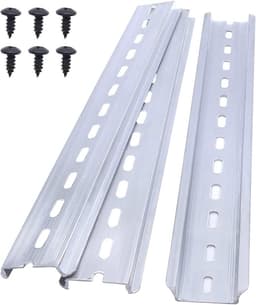
Screw the rail to the back of the box before any device goes on. These packs are slotted, so the slots are the fixing holes. The screws in the bag, where a bag has them, hold the rail to the enclosure. They do not fasten the module to the hat. The module clips on. HUATEEN states 12 M4 screws. Taiss states six. CKANDAY states 20. The other packs do not state screws, or they mention screws only in a highlight, so you supply fixings that match the slots.
Bigxin Bigxin 8-piece 300 mm rail

Testsieger

Bigxin Bigxin 8-piece 300 mm rail
8.4/10about £10.99

Cut square and deburr

Most of these pieces are already short. 100 mm, 200 mm, 250 mm and 300 mm are the listed lengths, so you often need no cut at all. Cut only when the enclosure is shorter than the piece you have. Mark the length, clamp the rail, and cut on the waste side of the line so the finished piece is not shy. File the burr and wipe the filings off before any component goes on. The reviews are why the file matters even when you do not cut. Taiss, JJL, Bigxin and Finehenchi notes mention sheared, poor or rough ends. A device that still rocks after a square, deburred rail is a thin section, and that judgement belongs on best DIN rail.

Clip the device and stop

On a 35 mm top-hat, open the bottom clip of the device, hook the fixed jaw over one lip of the rail, seat the device, and close the clip. That motion is the fitting step on a Hager device sheet. Tug the device along the rail and away from it. It should not walk off in your hand, and it should not rock. No kept pack states end stops. Stop when the next step is a new circuit, a bathroom or similar special location in England and Wales, or a design that earths through the rail. Earth through the rail is on aluminium versus steel DIN rail.

Common questions

What do I do with a sheared or sharp end?
File it. Taiss, JJL, Bigxin and Finehenchi reviews mention rough, sheared or sharp ends. Take the burr off and wipe the filings out of the enclosure before you clip anything. A sharp end cuts hands and stops the device sitting square. Do not butt two rough ends together and treat the joint as one rail.
Which screws fix the rail, and which packs include them?
The screws fix the rail to the box. HUATEEN includes 12 M4, Taiss includes six, and CKANDAY includes 20. Chsoejuf claims screws in a highlight only. The other four packs do not state screws, so you supply them. The clip on the device, not those screws, holds the module on the hat.
How does a device clip onto a 35 mm top-hat?
Open the bottom clip, hook the device over one lip of the rail, press it home and close the clip. Then check it does not rock or slide off. That is the clip motion, not a busbar installation. If the device will not close, look at a thin or rough rail before you force the plastic.
Do I need end stops, and does any pack include them?
You need them if a device can walk off the open end. None of the eight packs states end stops. A 100 mm piece holds a couple of modules only after you have left room for those stops. Buy stops separately, or leave a fixed device at the end that cannot slide.
How do I know the enclosure is dead before I drill or clip?
Identify the supply, disconnect it, lock the isolation off, and confirm it is the only feed you can find. Prove the tester, test at the point of work, and prove the tester again. If you are not competent to do that, ask someone who is. A listing mark on the rail is not a substitute for that check.
Can I use the same steps inside a home consumer unit?
No. This sequence is for a separate enclosure you have proved dead. Opening a home consumer unit, adding a way, or replacing the board is a different job, and in England and Wales it is notifiable. Stop as well if you cannot prove the box is dead, if you are adding a new circuit, or if the work is in a bathroom or similar special location.

Related pages

Sources

Public UK sources from the research digest. Shelf prices and star lines are the amazon.co.uk figures in the display file. Listings do not show BS EN 60715, UKCA or BS 7671 compliance.

  1. RS DIN rails guide (retrieved 22 October 2026)
  2. Weidmüller UK: DIN rails and mounting rails (retrieved 22 October 2026)
  3. Weidmüller brochure: DIN rails and electrical busbars (retrieved 22 October 2026)
  4. Techna DIN rail datasheet (retrieved 22 October 2026)
  5. IEC 60715:2017 (retrieved 22 October 2026)
  6. GOV.UK: Approved Document P (retrieved 22 October 2026)
  7. Electricity at Work Regulations 1989 (retrieved 22 October 2026)
  8. HSE: Electricity at Work Regulations 1989, HSR25 (retrieved 22 October 2026)