Independent comparisons. We may earn from shop links. More info

DIN rail buying guide

Updated: October 2026

You are fitting a few modules into a separate enclosure, and the amazon.co.uk results are short slotted bars rather than the metre lengths a wholesaler keeps on the rack. This DIN rail buying guide is the order to use before you open the comparison: profile, then length, then a metal the reviews do not contradict, then screws, then price. A star line does not settle a listing that prints two heights. The eight packs, from £4.79 to £10.99, stay on the [DIN rail comparison](/hub/electrical-equipment/din-rail). Figures are the saved amazon.co.uk listings, not a lab measurement of clip force. A qualifying purchase can earn us a commission at no extra cost to you.

You are fitting a few modules into a separate enclosure, and the amazon.co.uk results are short slotted bars rather than the metre lengths a wholesaler keeps on the rack.

Our top picks

On this page

What these packs are

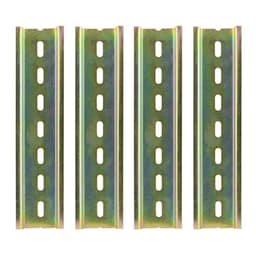
These eight listings are short pieces of 35 mm top-hat rail, the profile catalogues still call TS35. RS describes that top-hat at 7.5 mm and at 15 mm depth, slotted or plain. Every kept pack is slotted, and none is stated as 15 mm deep. A 100 mm to 300 mm amazon offcut is a different purchase from a 0.5 m, 1 m or 2 m trade bar, even when both are called DIN rail. IEC 60715 names the mounting-rail profiles, and these listings do not show compliance with it. If your module drawing asks for TS15, a G-rail or 15 mm depth, this set is the wrong shelf.

Length, pieces and depth

Chsoejuf and CKANDAY are 100 mm. HUATEEN, Finehenchi, CHENYU and JJL are 200 mm. Taiss is 250 mm, three pieces. Bigxin is 300 mm, eight pieces. A breaker module is about 18 mm wide as a rule of thumb. 100 mm is a couple of modules once you leave room for end stops, and none of these packs states end stops. 300 mm, on Bigxin, is the longest continuous piece in the set. HUATEEN, Taiss, CHENYU and CKANDAY state 7.5 mm. Bigxin and JJL do not state a height. Which of those packs the UK notes support is on best DIN rail.
Bigxin Bigxin 8-piece 300 mm rail

Testsieger

Bigxin Bigxin 8-piece 300 mm rail
8.4/10about £10.99

Metal and the lines to ignore

Aluminium, or aluminium alloy, is the title metal on HUATEEN, Taiss, CHENYU, Chsoejuf and CKANDAY. Finehenchi says C45 steel. Bigxin says zinc-plated iron. JJL says galvanised iron. Two UK reviews of the CHENYU pack say the pieces were steel and magnetic. RoHS on Taiss, and a CE tick on Finehenchi, are not BS EN 60715, UKCA or BS 7671. When the rail is asked to carry earth, use aluminium versus steel DIN rail.

Screws, end stops and price

Screws fix the rail to the box. They do not clip the module to the hat. HUATEEN states 12 M4 screws. Taiss states six. CKANDAY states 20, named MXU-DIN-100. Chsoejuf mentions screws in a highlight and then lists only the ten rails as included. Finehenchi, Bigxin, CHENYU and JJL do not state screws. No pack in the set states end stops. The shelf band on these ASINs is £4.79 to £10.99, VAT as Amazon displayed it. Taiss is £8.99 for three 250 mm rails, about £1.20 per 100 mm. Bigxin is £10.99 for eight 300 mm rails, about £0.46 per 100 mm.

Common questions

Is 7.5 mm or 15 mm the rail I need?
For modules in a small enclosure, 7.5 mm top-hat is the usual depth, and RS treats 15 mm as the deeper top-hat of the same 35 mm width. None of these eight packs is stated as 15 mm deep. Bigxin and JJL do not state a height, and Finehenchi and Chsoejuf print two figures. If the device datasheet asks for 15 mm, buy a trade length that says so.
Will a 100 mm piece hold a row of breakers?
A breaker module is about 18 mm wide, and that width is a rule of thumb, not a figure on these listings. Once you allow for end stops, which none of these packs includes, 100 mm is a couple of modules. Chsoejuf and CKANDAY are the 100 mm packs. A six-way run needs a 200 mm to 300 mm piece, or a wholesaler bar you cut yourself.
Why do two sizes appear for height on one listing?
Finehenchi's feedback says 8 mm high and the same listing says 6 mm thickness. One UK review measured about 6 mm and said the picture was wrong. Chsoejuf's title says 7.5 mm and the dimensions line says 1.9 cm. Bigxin and JJL leave height blank. Treat two numbers as unknown. A consistent 7.5 mm line, as on HUATEEN, Taiss and CKANDAY, is the listing you can compare with a datasheet.
Does a high star rating mean the metal matches the title?
CHENYU is listed as aluminium and shows 4.5 from 218 reviews, and two UK reviews say the rails were steel and magnetic. Taiss shows 4.5 from 1,005 reviews while UK text describes a thin, loose, roughly cut rail. CKANDAY's 5.0 from 15 has no UK review text in the file. Read the metal against the review bodies, then the star line.
Is a 1 m wholesaler bar the same purchase as these packs?
Europa stocks 0.5 m, 1 m and 2 m. These amazon packs are 100 mm to 300 mm offcuts, several to a bag. The digest's iLECSYS and Weidmüller prices belong to those longer bars, not to HUATEEN or Bigxin. You buy the short pack when the enclosure is already small. You buy the bar when you need one straight length.
Can I treat RoHS or a CE tick as BS EN 60715?
Taiss puts RoHS in the title. Finehenchi shows a CE tick. Neither line is BS EN 60715, UKCA or BS 7671, and none of the eight packs shows those. IEC 60715 is the profile identifier. A mark you cannot tie to a number does not prove the hat is 35 mm by 7.5 mm, and it does not make the rail a consumer-unit part.

Related pages

Sources

Public UK sources from the research digest. Shelf prices and star lines are the amazon.co.uk figures in the display file. Listings do not show BS EN 60715, UKCA or BS 7671 compliance.

  1. RS DIN rails guide (retrieved 22 October 2026)
  2. Weidmüller UK: DIN rails and mounting rails (retrieved 22 October 2026)
  3. Weidmüller brochure: DIN rails and electrical busbars (retrieved 22 October 2026)
  4. Techna DIN rail datasheet (retrieved 22 October 2026)
  5. IEC 60715:2017 (retrieved 22 October 2026)
  6. GOV.UK: Approved Document P (retrieved 22 October 2026)
  7. Electricity at Work Regulations 1989 (retrieved 22 October 2026)
  8. HSE: Electricity at Work Regulations 1989, HSR25 (retrieved 22 October 2026)