Independent comparisons. We may earn from shop links. More info

Combi drill buying guide

Updated: 22 October 2026

You are on amazon.co.uk with a row of cordless combi drills, and the titles are shouting 18 V, 21 V, newton metres and star ratings at the same time. A combi drill buying guide is the order of checks before any of that becomes a basket: the job, then hammer mode, then the chuck and the gears, then the torque claim, then the batteries and the platform, and only then the stars. The [combi drill comparison](/hub/drilling-and-accessories/combi-drill) holds the eleven kits, the October 2026 shelf prices and the cells that disagree with the bullets. This page does not crown a winner. Prices move, and a qualifying purchase can earn us a commission at no extra cost to you.

You are on amazon.co.uk with a row of cordless combi drills, and the titles are shouting 18 V, 21 V, newton metres and star ratings at the same time.

Our top picks

On this page

Start with the job, not the voltage

The first question is what the hole and the screw actually are. A combi drill drills, drives screws through a slipping clutch, and adds a hammer mode for ordinary brick and block, using a normal keyless chuck. That covers flat-pack, pilot holes in timber, and a small plug for a shelf in a soft internal wall. It does not cover concrete, engineering brick, a hole that stalls and heats, chasing, or chiselling. Those jobs are a different tool class, and the combi drill vs SDS drill page is where that split is made. Voltage does not settle it. An 18 V body and a 21 V sticker can both be the wrong machine if the wall is a concrete lintel. A curtain pole on a 1930s internal brick wall, with two 6 mm plugs, is a combi job if hammer mode is really in the listing. A row of 12 mm holes through an engineering-brick pier is not. A retailer rule of thumb, not a lab, puts light DIY under about 40 Nm, general home use around 40–70 Nm, and heavier trade claims above about 70 Nm. Those bands describe the seller’s newton-metre claim. They do not measure the wall.

Hammer mode, chuck and gears

Hammer mode has to be in the title or the bullets. A combi word in a title that then says the tool is not a hammer drill is a drill-driver, and this page does not apply to it. In this set the BLACK+DECKER BCD700 bullets do state screw driving, drilling and hammer drilling, and they state 21,000 blows per minute. That is one listing’s figure. Do not copy it onto the other ten. The chuck is the next limit you can see. A 13 mm keyless chuck takes the usual plug bits. A 10 mm chuck is at its stated limit on a 10 mm bit. Both Bosch EasyImpact 18V-40 kits, the Ryobi R18PD3, the Einhell TE-CD 18/44 and the DeWalt DCD799 state 13 mm. The EasyImpact 18V-38, both LEEIKOO kits and the Ginour CD1308 state 10 mm. The BCD700’s chuck field says 0.5 inches, and the row never states millimetres. The DeWalt DCD778’s chuck, wood and metal fields all say 6.35 mm, and the bullets do not state a chuck size. Do not silently replace that with a 13 mm figure from a different DCD778 kit. Low gear is the slow, stronger one for screws and large bits. High gear is for small bits and for typical hammer drilling. How you set the collar sits on the how to use a combi drill page. This set runs from 10 clutch settings on the BLACK+DECKER to 25 on the LEEIKOO kits. A 5 on one collar is not a newton metre.

Torque, batteries and platform

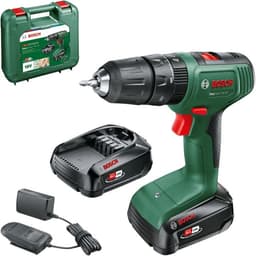
Read the newton-metre figure as the seller’s claim, then see whether the listing agrees with itself. The EasyImpact 18V-40 prints 40 Nm in both torque fields, with a 13 mm chuck. The Ryobi R18PD3 prints 50 Nm in the bullet and the torque field, with two 1.5 Ah ONE+ packs. The DCD799 bullets say up to 74 Nm, which is the heavier-trade side of the same rule of thumb, but only if you also print the 26 Nm in the maximum-torque field. Amp-hours are runtime, not torque. Two 5 Ah packs will keep you working longer than one 1.5 Ah pack. They do not make a stalled masonry bit into an SDS drill. Bosch 18 V, Ryobi ONE+, Einhell Power X-Change and DeWalt XR do not share packs. If you already own one of those, stay on it. The Ginour bullets claim a Makita 18 V connector. That fit is not tested in this file, so do not buy it as a proven Makita spare. A 21 V sticker, on both LEEIKOO kits here, is often a peak-voltage label rather than a bigger system than 18 V. A kit with one battery stops when the pack is on the charger. A kit with two is the same drill with a spare in the box. Brushless is a listing word. In this set it is stated on the DeWalt DCD778, the DeWalt DCD799 and the Ginour CD1308. A weekend of shelves does not require it. If you already know the checks and want them applied to two named kits, the best cordless combi drill page does that.

When the listing disagrees with itself

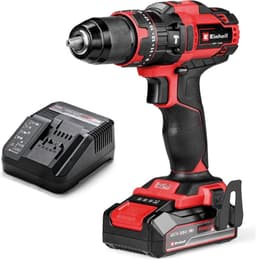
Several rows print two versions of the same fact. The BCD700 bullets do not state newton metres, and the torque field says 1 inch pound, with a maximum-power field of 1,800 W that you should not treat as a motor rating you can compare. The DCD799 prints 74 Nm and 26 Nm. The Einhell title and bullets say 44 Nm, and the maximum-torque field says 14 Nm. The EasyImpact 18V-40 one-battery kit names a 1.5 Ah PBA pack, and the battery-type field says CR2032. Show both. Do not correct the cell because one of the two looks more likely. The DCD799 is 4.8 from 15 reviews. The DCD778 is 4.8 from 12,389 reviews. Those are not equal evidence. If a kit arrives faulty, the Consumer Rights Act 2015 gives you 30 days to reject it, and an online order also has 14 days to cancel. Check that the charger is a UK 13 A plug when the box arrives. This file does not certify that every kit’s plug was inspected, and it does not claim that any listing meets BS EN 62841-2-1.

Common questions

What should I check before I buy a combi drill?
Check the job first, then whether hammer mode is in the title or the bullets, then the chuck size, then the torque claim against itself, then which batteries are in the box and which platform they belong to. Stars come after that. A 13 mm chuck and two batteries are useful for home plugs and a spare pack. They do not fix a listing that prints two torque figures, and they do not turn the tool into an SDS drill for concrete.
How much torque do I need for shelves and flat-pack?
For shelves, flat-pack and small plug holes, UK retailer guides talk about under about 40 Nm for light DIY and about 40–70 Nm for general home use. That is a rule of thumb for the number the seller prints, not a lab method, and brands do not measure newton metres the same way. The EasyImpact 18V-40’s agreed 40 Nm and the Ryobi’s agreed 50 Nm sit in that home conversation. A higher printed figure does not help if the other torque field contradicts it.
Is 21 V better than 18 V?
Not as a rule. A 21 V sticker is often peak voltage, which is a label rather than a larger platform or a proof of more torque. The LEEIKOO kits in this set are 21 V and do not name a shared brand system. Bosch, Ryobi, Einhell and DeWalt here are 18 V systems that do not share packs with each other. Match the pack you already own, or buy a kit whose battery and charger are in the box.
Do I need a 13 mm chuck?
You need a 13 mm chuck if the plug bit or the hole saw shank you intend to use is larger than 10 mm. Usual red and brown wall plugs sit on 6 mm and 7 mm bits, which a 10 mm chuck can hold. A 10 mm chuck, as on the EasyImpact 18V-38, the LEEIKOO kits and the Ginour, is at its stated limit on a 10 mm bit. If the listing’s chuck field conflicts with the bullets, do not guess. Check the chuck you will actually receive.
Is brushless worth it if I only drill at weekends?
Only if the listing says brushless and you were going to buy that kit for other reasons. Weekend shelves do not require it. In this set the word appears on the two DeWalt kits and the Ginour, not on the Ryobi, the Einhell or the Bosch EasyImpact rows. Seller lines that claim a multiple of battery life or a percentage less noise are claims. They are not a measurement of these tools.
Should the kit include two batteries?
Two batteries let you keep drilling while one pack charges. One battery is enough for a short session of screws and a couple of plug holes, and it is what the £44 Einhell and the single-pack Bosch and LEEIKOO kits give you. Amp-hours still describe runtime, not drilling power. Two 1.5 Ah packs are not the same afternoon as two 5 Ah packs, even when both cartons say two batteries.
Will this pack fit the brand I already own?
Only when the listing says so, and even then a claimed fit is not a test. Bosch 18 V, Ryobi ONE+, Einhell Power X-Change and DeWalt XR do not interchange in this set. The Ginour bullets claim a Makita 18 V connector, which this file has not measured. If you already own packs, the cheaper stranger kit is often the dearer route once you add a second charger and a second battery system.

Related pages

Sources

Public UK sources from the research digest for this comparison, retrieved 22 October 2026. Shelf prices, stars and review counts are the amazon.co.uk figures in the stored listings.

  1. HSE, vibration duties (retrieved 22 October 2026)
  2. HSE INDG175, hand-arm vibration (retrieved 22 October 2026)
  3. HSE CN3, silica from drilling masonry (retrieved 22 October 2026)
  4. Control of Noise at Work Regulations 2005, regulation 4 (retrieved 22 October 2026)
  5. GOV.UK, Supply of Machinery (Safety) Regulations 2008: Great Britain (retrieved 22 October 2026)
  6. BSI, BS EN 62841-2-1, hand-held drills and impact drills (retrieved 22 October 2026)
  7. GOV.UK, accepting returns and giving refunds (retrieved 22 October 2026)
  8. ToolStore UK, combi drill torque bands (retailer guide) (retrieved 22 October 2026)