Independent comparisons. We may earn from shop links. More info

Spring vs pneumatic door closer

Updated: October 2026

The door either slams into the latch or stops short of it, and both boxes say automatic. Spring vs pneumatic door closer is a choice about what slows the leaf. A spring stores energy and lets it go. A pneumatic tube meters air on the way back. Neither becomes a fire-door closer because the title says so. If the door is a fire door, read the [fire door closer regulations UK](/hub/door-and-window-security/mini-door-closer/sub/mini-door-closer-fire-door) page before you fit either. Prices are on the [mini door closer comparison](/hub/door-and-window-security/mini-door-closer). Peter F. used the amazon.co.uk notes from 19 October 2026, plus MB Direct’s oil-versus-air explanation and the GAI guide to BS EN 1154. A qualifying purchase can earn a commission at no extra cost to you.

The door either slams into the latch or stops short of it, and both boxes say automatic. Spring vs pneumatic door closer is a choice about what slows the leaf. A spring stores energy and lets it go.

Our top picks

On this page

What each mechanism does

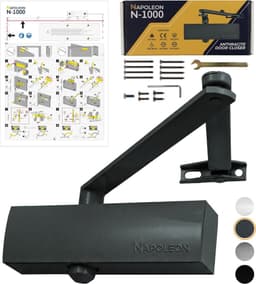
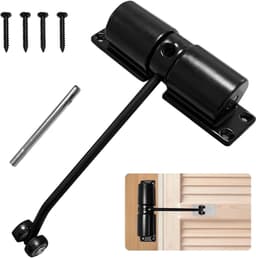
A surface spring is a coil you tension and then release. PCKOBEVER and Vurlexat are that pattern. The energy of opening is what pulls the door shut. There is an adjuster for how hard the pull is, and there is not a separate brake for the last few centimetres. The GAI guide treats a closer as controlled when it checks the close. Spring hinges that do not check sit outside BS EN 1154. A domestic spring with a nut is still a spring. A pneumatic closer is a tube of air. A screw changes how quickly air escapes as the door shuts. YUOIP, GINTON and CASONNIK are the tubes in this set. MB Direct describes air closers as faster than oil closers, more affected by temperature, and a better match for lighter doors. That is their explanation of the type, not a temperature test of these three listings. One air screw is one adjustment. If the last part of the swing is still a bang, the screw has not given you a second speed. A hydraulic closer meters oil. The top pick, Napoleon’s N-1000, has one valve for the sweep and one for the latch. HBL' also claims two valves and does not name BS EN 1154. Oil is the third option when a spring is too crude and a single air screw will not separate the slam from the latch. Kaaeiccr’s title calls the kit at about £7.59 a spring, and the included line calls it hydraulic. The listing does not resolve that, so it does not sit cleanly in either column. Two reviews are not enough to decide it from use. Use a spring for a light internal door or a gate that is not a fire door. Use a pneumatic closer for a light screen, shed or summer-house door if you accept the shorter life in the reviews. Use a valved hydraulic closer when you want two speeds.

When a spring is the better fit

Choose a spring when the door is a light internal leaf, or a gate, and you only need it to return. The best value is the PCKOBEVER at about £8.59, stated for 20–30 kg, and 4.4 from 225 reviews. On a bedroom door, reviewers get a quiet close once the arm is set. It failed a corrugated door at maximum, and one cylinder was too big for the frame. A bullet names fire doors without a BS EN code. Skip it for a fire door, and skip it when the leaf is heavier than the stated band. Vurlexat at about £12.99 is the spring reviewers put on outside gates, stated for 20–50 kg, 3.9 from 62 reviews. Force turns anticlockwise. On a 50 kg door the spring came loose inside the canister at the fourth hole. Another door inside the stated mass still felt under-powered. Skip the spring if you are already at the top of the kilogram line, or if a child cannot open the door once you have wound it far enough to latch. A spring does not meter the last 300 mm the way an air screw claims to. Who should buy the PCKOBEVER, and who should leave it, is on the best mini door closer page.

When a pneumatic closer is the better fit

Choose a pneumatic tube when the door is a screen, a shed, a summer house or a light storm door, and you want an air brake. YUOIP at about £9.80 states up to 50 kg and 1000 mm, and is 3.6 from 121 reviews. The air screw is supposed to cushion the stage the listing calls 300–0 mm. Reviewers still say the door bangs into the lock, and at least two report the tube failing, including on the first opening. A bang in the reviews is the reason not to buy a pneumatic closer only because you hope it will be quiet. GINTON at about £8.66 is the side-mounted unit, stated at 30–60 kg, 3.9 from 14 reviews. One parcel arrived without the hold-open washer. CASONNIK at about £13.99 is the screen closer, 4.1 from 383 reviews. Some buyers get a damped last swing. Others report snapped welds after about six weeks. The printed weights of 1 g and 0.4 g are not real. Skip a pneumatic closer when the door is a fire door. Fitting is on the how to fit a mini door closer page.

When neither is enough

Choose the hydraulic closer when you want two adjustments. Napoleon’s N-1000 is about £49.90, size 3, stated for 20–60 kg, with a template and 4.5 from 503 reviews. It is the only listing that names BS EN 1154. The PCKOBEVER at about £8.59 does not include that body. On a light bedroom door that is not a fire door, the spring is the proportionate buy, and the hydraulic unit can be hard for young children to push. On a screen, the pneumatic tube matches the job if you accept the shorter lives in the reviews. On a door labelled FD, neither the spring nor the tube is the answer, and Napoleon’s named standards are still not a certificate. One reviewer could not latch an 835 mm fire door with it. DODUOS, the adhesive cable, pulls hard and does not let you turn that pull down, so leave it out of this choice.

Common questions

What is the difference between a spring closer and a pneumatic closer?
A spring stores the energy of opening and releases it. A pneumatic closer pushes air through a passage so the return is metered, usually by one screw. PCKOBEVER is the spring example, the best value at about £8.59 for a stated 20–30 kg door. YUOIP is the tube, at about £9.80, stated up to 50 kg. The spring has no air brake. The tube has no second valve for the latch.
Which one stops a slam?
The one that can slow the last part of the swing. A pneumatic screw is meant to do that, and YUOIP reviewers still report a bang at the lock, so the type does not guarantee a quiet latch. A hydraulic closer with a separate latching valve, such as the Napoleon top pick, is the listing that gives you two speeds. A spring is the least able of the three to tame a slam on its own.
Which one is more likely to latch a light door?
A spring set for a light timber door, such as the PCKOBEVER on a bedroom door inside 20–30 kg, is what reviewers describe as a reliable return once the arm is adjusted. If that setting is too strong for a child to open, it is still the wrong result.
Does a pneumatic closer work outside?
Reviewers fit YUOIP on shed doors and GINTON on a summer house, so people do use them outside. MB Direct says air closers are more affected by temperature than oil closers. Check the speed again when the weather changes. That note is about the type, not a temperature test of these listings.
Is a spring closer a fire-door closer?
Unchecked springs sit outside BS EN 1154. PCKOBEVER names fire doors in a bullet and prints no BS EN code. A fire door needs a controlled closer with evidence for that door. The regulations page is where that shut test is set out.
When is a hydraulic closer the better of the three?
When you need separate closing and latching speeds, and you will pay about £49.90 for the Napoleon, which names BS EN 1154 and has 4.5 from 503 reviews. It is a poor default on a light bedroom door, and it is not a certificate if the door is a fire door.

Related pages

Sources

Public UK guidance and trade sources from the research digest, used for this page in October 2026. Prices, stars and review counts are the amazon.co.uk figures dated 19 October 2026. A listing claim of BS EN 1154 is not treated as a certificate for your door.

  1. The Fire Safety (England) Regulations 2022, regulation 10 (retrieved 19 October 2026)
  2. GOV.UK: Fire Safety (England) Regulations 2022, fire door guidance (retrieved 19 October 2026)
  3. Approved Document B: fire safety frequently asked questions (retrieved 19 October 2026)
  4. BSI: BS EN 1154:1997 controlled door closing devices (retrieved 19 October 2026)
  5. Firesafe: coding system for fire door closers in BS EN 1154:1997 (retrieved 19 October 2026)
  6. GAI door closer safety checklist (retrieved 19 October 2026)
  7. Code of Practice: hardware for fire and escape doors (retrieved 19 October 2026)
  8. MB Direct: hydraulic versus pneumatic door closers (retrieved 19 October 2026)