Independent comparisons. We may earn from shop links. More info

Vertical vs horizontal wind turbine

Updated: October 2026

You are looking at amazon.co.uk titles that say vertical, and you want to know whether that solves the problem of wind changing direction. It does not, by itself, give you more energy. This page compares a vertical vs horizontal wind turbine for a UK home: what each axis is for, what a roof adds, and what these nine listings actually print. Peter F. used the Energy Saving Trust, the Local Government Association's examples, and the rows in the [wind turbine comparison](/hub/diy-supplies/wind-turbine) on 16 October 2026. No power coefficient was measured, and noise was not tested. A qualifying purchase can earn a commission at no extra cost to you.

You are looking at amazon.co.uk titles that say vertical, and you want to know whether that solves the problem of wind changing direction. It does not, by itself, give you more energy.

Our top picks

On this page

Direction is not yield

A horizontal-axis turbine is a propeller that has to face the wind. A vertical-axis turbine uses an upright shaft and does not need to yaw. The Energy Saving Trust treats the horizontal layout as the familiar, more efficient default. Vertical machines can take wind from any direction, and the Trust says they tend to be less efficient. Omnidirectional is not the same claim as more kilowatt-hours. The Trust's pole-mounted example is about 6 kW. Their building-mounted example is about 2 kW, and they describe the building-mounted layout as less efficient. That pole-versus-building choice is the mount, not the axis. A vertical kit on a roof is still a roof, with the wind the roof actually gets.

Yaw, roofs, and noise claims

A horizontal machine needs a way to turn into the wind. On a small turbine that is a tail vane or a yaw bearing, and it is one more part that can stick. A vertical rotor skips that yaw drive because the shaft is already upright. The Local Government Association notes that vertical rotors can place the generator low, which is one reason they are discussed for roofs. A low generator does not remove turbulence. Air over a ridge, a parapet, or the neighbour's roof is gusty, and the Trust already treats building-mounted machines as the less efficient case. Listings in this set sometimes imply a quieter machine. That is a sales line. The Energy Saving Trust does not give a decibel figure that would make vertical turbines quieter as a fact, and we did not measure one.
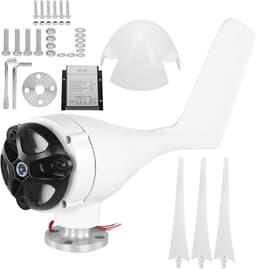
n/a 1,200 W 3-blade 12 V kit

Testsieger

n/a 1,200 W 3-blade 12 V kit
6.7/10about £203.31

What these nine rows actually say

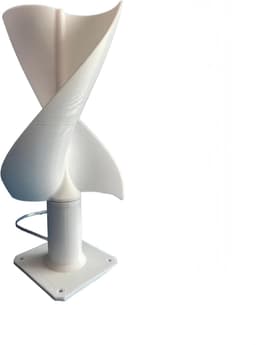
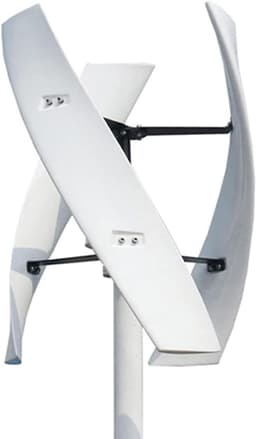
DECAKE, MLYYYDSS, and HUIZHITENGDA state a vertical axis. FIRETIDE is a vertical spiral as well, and it is a 100 mm teaching model, not a roof turbine. The unbranded three-blade kit, B0BFJ7TCGD, says three blades and 12 V and does not state the axis, so you cannot file it as horizontal just because many propellers have three blades, and you cannot file it as vertical either. AECEVAN states both: included components say vertical magnetic levitation, and a bullet says a horizontally rotating coreless generator. Both lines are on the listing. A buyer cannot tick one axis from that page. None of the nine prints a swept area, so you cannot compare rotors by the area the planning rules care about. Britwind's H5 page describes a horizontal 5 kW machine with a 5.5 m rotor. That is the size of a rated horizontal domestic machine, not the size of these parcels.

When to pick which

Choose horizontal when the site is exposed, you can give the rotor a clear approach, and you are buying a rated machine on the Energy Saving Trust path rather than a marketplace title. That path is an MCS installer and a mast or building mount you can document. Choose a vertical title in this set only when the page actually says vertical, you accept the efficiency caveat, and you are not treating the watt number as household output. DECAKE, MLYYYDSS, and HUIZHITENGDA meet that test and still fail as house turbines for the reasons on the buying guide. Leave AECEVAN until the axis lines agree. Leave B0BFJ7TCGD off both sides of this choice. The best-of page says who each row is for. How far you may bolt any of them down is on the install page.

Common questions

Which axis is more efficient?
The Energy Saving Trust treats horizontal-axis machines as the more efficient default, and vertical-axis machines as less efficient, even though vertical rotors accept any wind direction. That is a layout point, not a test of these amazon.co.uk kits. No listing here prints a measured output at a stated wind speed, so you cannot rank them by efficiency from the title.
Do I need a yaw bearing on a vertical turbine?
A vertical-axis rotor does not yaw to face the wind, because the shaft is upright and the machine is built to take any direction. A horizontal machine does need a tail or a yaw bearing. If the listing contradicts itself, as the AECEVAN rows do, you do not yet know which of those parts you are supposed to have.
Are vertical turbines better on a roof?
They are discussed for roofs because the generator can sit lower and the rotor need not yaw. The Energy Saving Trust still treats building-mounted turbines as less efficient than a pole in open wind, at about 2 kW in their example against about 6 kW on a pole. Turbulence and vibration remain. A vertical title does not cancel either.
Is a three-blade kit horizontal?
Not from this file. B0BFJ7TCGD says three blades and 12 V and does not state the axis. Three blades are common on horizontal machines, and they are not proof. Put that kit on neither side until the listing names one axis.
Does omnidirectional mean it works in a town?
No. Catching wind from any direction still needs wind. The Trust matches turbines to exposed ground, not to a sheltered street. A vertical rotor in a calm courtyard will not outproduce a horizontal rotor that also has no wind. Check the site before you choose the axis.
When do I still pick vertical?
Pick a vertical description when you want a kit that states that axis, you accept lower efficiency than a proper horizontal machine, and you are not connecting it as a house supply. In this set that is a reading of DECAKE, MLYYYDSS, or HUIZHITENGDA, with their watt titles still unverified. It is not a reason to prefer them over an exposed-site horizontal install outside this table.

Related pages

Sources

Energy Saving Trust, legislation.gov.uk (GPDO 2015, SI 2025/560, ESQCR 2002 and the Consumer Rights Act 2015), the Planning Portal, Ofgem and National Grid. Prices and stars are the amazon.co.uk listings on 16 October 2026. Prices move.

  1. Energy Saving Trust, wind turbines (retrieved 16 October 2026)
  2. GPDO 2015, Schedule 2, Part 14 (retrieved 16 October 2026)
  3. SI 2025/560, MCS Planning Standards (retrieved 16 October 2026)
  4. Planning Portal, stand-alone wind turbines (retrieved 16 October 2026)
  5. Ofgem, Smart Export Guarantee (retrieved 16 October 2026)
  6. National Grid, G98 microgeneration (retrieved 16 October 2026)
  7. ESQCR 2002, regulation 27 (retrieved 16 October 2026)
  8. Consumer Rights Act 2015, section 11 (retrieved 16 October 2026)