Independent comparisons. We may earn from shop links. More info

Small wind turbine UK: which listing fields to trust

Updated: October 2026

You have seen a vertical kit on amazon.co.uk for about £200 and, the same week, a domestic quote nearer £35,000. Those are not two prices for one machine. This page is the order of checks for a small wind turbine UK buyer: what the object is for, whether the site has wind, what a watt line without a wind speed means, then voltage, frequency, and the box list. The [wind turbine comparison](/hub/diy-supplies/wind-turbine) is the table of the nine listings we kept. Peter F. read those amazon.co.uk pages and the public sources below on 16 October 2026. If you buy through our link, a qualifying purchase can earn a commission at no extra cost to you.

You have seen a vertical kit on amazon.co.uk for about £200 and, the same week, a domestic quote nearer £35,000. Those are not two prices for one machine.

Our top picks

On this page

Two prices, two products

A shelf price in this comparison runs from £35.99 to £305.49. The generator kits start at £173.00. The Energy Saving Trust puts a 6 kW pole-mounted system at about £35,000 installed: a machine, a mast, and the work around it, not a parcel of about 8 kg to 12 kg. FIRETIDE B0FXG3GRVZ, at £35.99, is a 100 mm rotor weighing 300 g, sold as a teaching model. It is not a cheap copy of that installed system. A box near 12 kg that prints 10,000 W or 20,000 W is still a marketplace kit. The larger number does not turn it into the Trust's 6 kW example.

Site before hardware

The Energy Saving Trust matches small wind to exposed, windy ground, and not to a built-up or sheltered garden. Their pole-mounted example is about 6 kW. Their building-mounted example is about 2 kW, and they describe that layout as less efficient. A screening figure used with that advice, on a Northern Ireland page that cites the Trust, is an annual average of at least 5 m/s and a clear approach to the rotor. You cannot read that average off an Amazon bullet. The vertical or horizontal comparison takes the axis choice after the site.
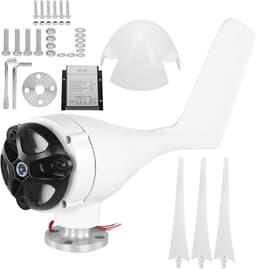
n/a 1,200 W 3-blade 12 V kit

Testsieger

n/a 1,200 W 3-blade 12 V kit
6.7/10about £203.31

What the watt line is not

MIS 3003 defines small-wind output at 11.0 m/s. None of the nine listings prints a wind speed next to its watt claim, and none prints a swept area. MLYYYDSS B0GCS6KZJF is the clearest contradiction: the title says 10,000 W/12,000 W, several watt fields say 10,000 W, and the output-wattage field says 3,000 W, on an 11 kg unit. You cannot average those into a household output. Other titles say 20,000 W, 14,000 W, or 4,000 W, still with no wind speed. Do not add review counts across rows that share a main image.

Voltage, frequency, and the box list

Great Britain's public supply is 50 Hz at a declared 230 V, under regulation 27 of the Electricity Safety, Quality and Continuity Regulations 2002. A colour field of 12 V, 24 V, 48 V, or 220 V is the label for that ASIN, not proof of several outputs in one box. The MLYYYDSS title also lists 12 V, 24 V, 48 V, and 220 V while the colour field reads 10000w, so the figure you would wire is still unsettled. Count a controller only when a contents line names it. MLYYYDSS and HUIZHITENGDA list a wind controller. The 1,200 W file lists neither. None of the ASINs shows an MCS number.

When this comparison is the wrong shop

If you want a turbine on a house or a mast that can export to the grid, this table is the wrong shop. MCS certification is what the consumer guidance and the Smart Export Guarantee route expect, and these listings do not show it. The MCS consumer notes illustrate pole-mounted machines at about 3–15 kWh a day against roughly 8 kWh of household use, and building-mounted machines nearer 1–2 kWh. A grid-parallel connection uses EREC G98 only when the device is fully type tested and within 16 A per phase. Above that, or without a type test, EREC G99 means you apply first. Consent in England is the planning permission page. Who each row is for sits on the best small wind turbine page.

Common questions

How much does a small wind turbine cost in the UK?
In this amazon.co.uk set the shelf runs from £35.99 for a 100 mm teaching model to £305.49, with generator kits from £173.00. That is not an installed domestic turbine. The Energy Saving Trust's figure for a 6 kW pole-mounted system is about £35,000. Maintenance of about £100–£200 in the MCS notes is not included in these parcel prices.
What wind speed does a home need?
The Energy Saving Trust points small wind at exposed, windy ground rather than a sheltered garden. A screening figure cited with that advice is an annual average of at least 5 m/s, plus a clear approach. A bullet that says the blades start at 2 m/s is a claimed start, not that annual average, and not the 11.0 m/s output reference in MIS 3003. None of these listings gives you your own site average.
Is a 10 kW kit in a 12 kg box the same as a 6 kW domestic turbine?
No. The Trust's 6 kW example is an installed pole-mounted system at about £35,000. MLYYYDSS, at 11 kg and £203.00, prints both 10,000 W and an output field of 3,000 W, with no wind speed. A 20,000 W title in this set is the same kind of claim. A title is not a measured yield.
Why does one listing say 60 Hz?
HUIZHITENGDA B0D4YQMJT4 has 60 Hz in the frequency field and 220 V on the colour label. Great Britain's public supply is 50 Hz at a declared 230 V. A 60 Hz figure is a reason to stop if you meant to connect to the mains. It is not a setting for the consumer unit, and the listing does not show a type-test number that would clear it.
Can I trust a star rating from one review?
One review is one person's text, not a test. In this set that can be a 1.0 that calls the kit rubbish, a 5.0 with no text, or a single Netherlands comment about parts fitting. The largest file is six reviews at 3.2, and those texts already disagree. Do not merge stars across ASINs that share a photograph.

Related pages

Sources

Energy Saving Trust, legislation.gov.uk (GPDO 2015, SI 2025/560, ESQCR 2002 and the Consumer Rights Act 2015), the Planning Portal, Ofgem and National Grid. Prices and stars are the amazon.co.uk listings on 16 October 2026. Prices move.

  1. Energy Saving Trust, wind turbines (retrieved 16 October 2026)
  2. GPDO 2015, Schedule 2, Part 14 (retrieved 16 October 2026)
  3. SI 2025/560, MCS Planning Standards (retrieved 16 October 2026)
  4. Planning Portal, stand-alone wind turbines (retrieved 16 October 2026)
  5. Ofgem, Smart Export Guarantee (retrieved 16 October 2026)
  6. National Grid, G98 microgeneration (retrieved 16 October 2026)
  7. ESQCR 2002, regulation 27 (retrieved 16 October 2026)
  8. Consumer Rights Act 2015, section 11 (retrieved 16 October 2026)