Independent comparisons. We may earn from shop links. More info

How to install a domestic wind turbine in the UK

Updated: October 2026

You have an English manual in a marketplace box, or a bullet that says installation is easy, and you want the order of work before anyone digs a hole. This page is that sequence for a domestic turbine in the UK: ask the council, treat the mast as its own job, then split a battery charger from anything that meets the public network. It is not a wiring diagram. Peter F. set this against National Grid Electricity Distribution, the Energy Networks Association, and the listings in the [wind turbine comparison](/hub/diy-supplies/wind-turbine) on 16 October 2026. No turbine was installed for this page. A qualifying purchase can earn a commission at no extra cost to you.

You have an English manual in a marketplace box, or a bullet that says installation is easy, and you want the order of work before anyone digs a hole.

Our top picks

On this page

Ask before you dig

In England, permitted development for a single turbine is a stack of limits, including an MCS planning standard, not a blanket yes. Wales and Northern Ireland need planning permission. Scotland is a local check. The measurements and the blocks, including an existing air-source heat pump, are on the planning permission page. Ask the council before the mast goes up. If the site is a sheltered terrace, stop. The Energy Saving Trust matches turbines to exposed ground, and a kit on a calm patio will not become productive because the manual was short.

The mast is not in the bullet easy installation

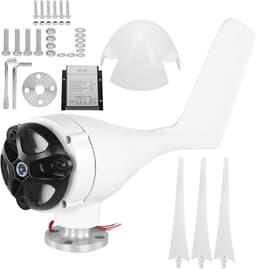
Several titles in this set say installation is straightforward, or they include an English manual. HUIZHITENGDA lists that manual and then says English is not guaranteed. None of the nine listings prints a foundation design, a mast section, a swept area, or a type-test number. Easy installation on those bullets means the parts they claim to pack, such as blades, a generator, and sometimes a controller. It does not mean a pole that can take the load, and it does not mean a roof structure that can take vibration. If you cannot show what the mast is, who designed the base, and how the machine stays within the planning limits, a competent installer takes over. Do not pour a pad from a marketplace sentence. The buying guide is where you check whether the box list matches the title before you start.
n/a 1,200 W 3-blade 12 V kit

Testsieger

n/a 1,200 W 3-blade 12 V kit
6.7/10about £203.31

Off-grid battery or the public network

A 12 V charger that stays on a battery, with no link to the consumer unit, is not an EREC G98 connection. The unbranded kit is the row that actually says 12 V, boat, marine, home, and off-grid, and it does not list an inverter. You still need a charge path that matches that voltage. If the title says an on-grid inverter, you are no longer in battery-charger territory. DECAKE's titles use that grid-tied wording. A phrase in a title is not a type-tested inverter, and it is not permission to parallel the mains. Which listing is a 12 V experiment, rather than a vertical watt title, is on the best-of list.

G98, G99, and the new circuit

EREC G98 is the fit-and-notify route for fully type-tested microgeneration at or below 16 A per phase, which is 3.68 kW on a single phase. You tell the distribution network operator within 28 days after commissioning. If the device is larger, or it is not fully type tested, EREC G99 means you apply before you connect. The Energy Networks Association states that split. None of these amazon.co.uk listings shows a type-test number, so you cannot assume the 28-day path is open. A new circuit in a dwelling in England is notifiable building work under Part P, and the installation should comply with BS 7671. Great Britain's public supply is 50 Hz at a declared 230 V, so a 60 Hz frequency field is a reason to stop. Call an electrician before any parallel connection or any mast you cannot prove.

Common questions

Can I install a small turbine myself?
You can assemble parts the listing actually includes, such as blades on a generator, if you are comfortable with that mechanical job and the planning position is already settled. You should not design a mast from a bullet, parallel the mains, or add a new circuit in the house. Those steps belong to a competent installer and an electrician. A short manual does not change that line.
Do I tell the network operator before or after?
For a fully type-tested device within 16 A per phase, G98 is fit and notify: you tell the distribution network operator within 28 days of commissioning. If it is not fully type tested, or it sits above that limit, G99 is apply first, before connection. These listings do not show a type-test number, so do not start on the 28-day assumption.
What is 16 A per phase in kilowatts?
On a single-phase supply, 16 A is 3.68 kW. That is the G98 ceiling National Grid Electricity Distribution and the Energy Networks Association describe for the notify route. A title that says 10,000 W or 20,000 W is already above that ceiling as a claim, and the claim is not a measurement. Above 3.68 kW, or without type testing, the route is G99.
Does an off-grid 12 V charger use G98?
No. G98 is about generation connected to the distribution network. A 12 V battery charger that never meets the mains is outside that form. The moment an inverter parallels the house supply, you are in G98 or G99 territory, and you need the type-test evidence these kits do not print. Off-grid in a title is not a certificate that the inverter is absent.
Is a new circuit in a house notifiable?
Yes, in England. A new circuit is notifiable under Part P, and the work should meet BS 7671. That notification is separate from the network operator's G98 or G99 paperwork. Opening the consumer unit to land a turbine feed is the point where you stop and use an electrician. This page does not give terminal positions or a consumer-unit recipe.
When do I call an electrician instead of opening the consumer unit?
Call before you open it. Any parallel connection, any new domestic circuit, and any doubt about earthing or isolation is electrician work. Add a wind installer when the mast, the foundation, or the MCS paperwork is part of the job. A 60 Hz frequency field is another stop: do not try to correct it at the board.

Related pages

Sources

Energy Saving Trust, legislation.gov.uk (GPDO 2015, SI 2025/560, ESQCR 2002 and the Consumer Rights Act 2015), the Planning Portal, Ofgem and National Grid. Prices and stars are the amazon.co.uk listings on 16 October 2026. Prices move.

  1. Energy Saving Trust, wind turbines (retrieved 16 October 2026)
  2. GPDO 2015, Schedule 2, Part 14 (retrieved 16 October 2026)
  3. SI 2025/560, MCS Planning Standards (retrieved 16 October 2026)
  4. Planning Portal, stand-alone wind turbines (retrieved 16 October 2026)
  5. Ofgem, Smart Export Guarantee (retrieved 16 October 2026)
  6. National Grid, G98 microgeneration (retrieved 16 October 2026)
  7. ESQCR 2002, regulation 27 (retrieved 16 October 2026)
  8. Consumer Rights Act 2015, section 11 (retrieved 16 October 2026)