Independent comparisons. We may earn from shop links. More info

How to use a spokeshave for a clean, controlled cut

Updated: October 2026

Learning how to use a spokeshave begins with a blade that barely projects and a stroke that follows the grain. Whether you push or pull is secondary: both directions work when the cutter travels with the fibres rather than lifting them. Test the setting on scrap of similar grain before the finished component. The [spokeshave comparison](/hub/diy-supplies/spokeshave) identifies which listed tools use a named flat or round sole. This guide assumes the shave is already in your hands. Peter F. set the steps from public guidance and listings checked on 15 October 2026. A qualifying purchase can earn a commission at no extra cost to you.

Learning how to use a spokeshave begins with a blade that barely projects and a stroke that follows the grain.

Our top picks

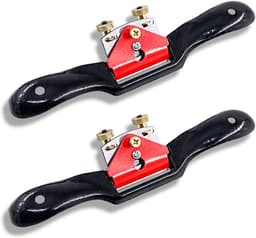
Swpeet Swpeet 10 inch pair

Preis-Tipp

Swpeet Swpeet 10 inch pair
8.6/10about £4.44
Swpeet Swpeet 10 inch flat

Rank 3

Swpeet Swpeet 10 inch flat
9.0/10about £8.99
On this page

Set a light cut before you blame the wood

Secure the work so both hands can control the handles. Sight along the sole and look for the narrowest possible line of cutter. Retract a large visible band before the first stroke, because a deep setting can dig in or tear fibres. On a twin-screw shave, move one adjuster at a time. Bring the cutter forward until it appears parallel, then test both sides at equal pressure. A slight deliberate skew gives you a finer side and a heavier side. The spokeshave buying guide distinguishes useful adjusters from screws that fail to hold. Some tools have one locking screw rather than two adjusters. Reviewers of the Spear & Jackson SSCON describe placing the blade and then clamping it, sometimes with a flat screwdriver. Do not apply twin-screw instructions to every shave merely because the product is called adjustable. Test on scrap, then advance or retract from what the shaving shows. None of the twelve listings states a bed angle, so do not call them low-angle shaves.

Push or pull, but always read the grain

A spokeshave can cut in either direction. Fine Woodworking's practical rule is to work with the grain whether you push or pull. For a push stroke, place your thumbs behind the blade area and use your index fingers to guide the front of the tool. For a pull, move the index fingers behind the action to provide power while the thumbs steady the front. If the grain rises towards the cutter, reverse your travel so the cut descends with it. On a convex arch, start near the crown and work towards an end, one side at a time. Do not run from one low end over the crown in a single forced stroke. If fibres tear or the cutter dives, reverse direction or reduce projection. Direction is a choice. Cutting against the grain is the fault to avoid.

Start the stroke skewed and tilt a round sole

Presenting the tool slightly skewed lets one part of the cutter enter first, reducing abrupt contact. Ease the blade into the work rather than striking the timber square-on. Once it engages, keep the sole supported. Speed does not rescue a blunt cutter or a hungry setting. A flat sole suits straight, convex and gentle hollow surfaces. On a tight concave, its ends may bridge. Do not compensate with more blade. The flat versus round guide explains this limit. With a round sole, Wonkee Donkee advises tilting forwards onto the front of the sole to engage the cutter. Use a light touch because a small angle change alters the depth. Establish a short shaving, then follow the hollow without rocking deeply from one handle to the other.

Stop when the shave is not the right next step

Stop and hone when a correctly presented cutter will not take a fine shaving. Inexpensive blades frequently need preparation, and four supplied cutters do not remove that requirement. Do not copy an angle from an unrelated blade and call it your tool's specification. Stop if an adjuster or locking screw moves during the cut. A screw that will not remain secure is a product fault. A dropped door, a moved frame or a fire-rated doorset is not fixed by a heavier cut. The sticking-door guide gives the checks before a local shaving. Hand the job to a joiner when the frame is distorted, hinges have pulled from damaged timber, safety-critical door gaps are involved, or you need to remove more than a skim.

Common questions

How far should the blade project?
Start with the narrowest visible line of cutter and test on scrap. Both sides should take a fine shaving under similar pressure. If nothing cuts, advance the blade in very small increments. A large projection at the outset makes digging, chatter and tear-out more likely.
Should you push or pull a spokeshave?
Either is valid. Push when that gives you better control and access. Pull when it gives a steadier stance. In both cases, travel with the grain. Do not treat always-pull, or pull downhill and push uphill, as a universal rule for every surface.
What does cutting downhill mean on a curve?
On a convex arch, start near the crown and work towards the lower end so the cutter follows the fibres rather than lifting them. Complete one side, then approach the other from the crown. Grain can change direction, so reverse the stroke if the surface begins to tear.
How do you adjust twin screws?
Move one screw at a time until the cutter looks parallel to the sole, then test both sides at equal pressure. Correct the heavier side with a tiny movement. You may retain a slight deliberate skew for two cutting depths, but an accidental large skew will make one corner dig in.
Why does a spokeshave chatter or dig in?
Common causes are too much blade projection, a blunt edge, a loose clamp, an uneven setting or poor support of the work. Retract and inspect rather than adding force. On a hollow, a flat sole may also be bridging the curve, in which case the correct solution is different geometry.
When should you call a joiner?
Get professional help when a frame has moved, hinge fixings have failed in damaged timber, a fire-rated doorset is involved or the job requires more than a light local correction. Those conditions need diagnosis and controlled refitting, not a deeper spokeshave pass.

Related pages

Sources

Public sources named in the research digest for this spokeshave comparison. Listing prices and star counts are amazon.co.uk figures from that digest. Prices move. Sources checked 15 October 2026.

  1. Common Woodworking, Buying a spokeshave (retrieved 15 October 2026)
  2. Paul Sellers, spokeshave Q&A (retrieved 15 October 2026)
  3. Fine Woodworking, low-angle vs standard-angle spokeshaves (retrieved 15 October 2026)
  4. Fine Woodworking, spokeshaves can be pushed or pulled (retrieved 15 October 2026)
  5. HSE, PUWER overview (retrieved 15 October 2026)
  6. Consumer Rights Act 2015, section 9 (retrieved 15 October 2026)
  7. MoneyHelper, consumer rights (retrieved 15 October 2026)
  8. Tooled-Up, Record A151 flat spokeshave (retrieved 15 October 2026)