Independent comparisons. We may earn from shop links. More info

Flat vs round spokeshave: which sole fits the curve?

Updated: October 2026

The flat vs round spokeshave decision depends on whether the sole can stay supported while the cutter reaches the timber. A flat sole handles straight edges, convex shapes and many gentle hollows. A round sole earns its place when a tighter concave curve makes the flat tool bridge over the cut. A concave-and-convex blade set is a third design, not one flat shave plus one round-bottom shave. You can see the twelve tools and captured GBP prices in the [spokeshave comparison](/hub/diy-supplies/spokeshave). Peter F. compared the named soles on 15 October 2026. A qualifying purchase can earn a commission at no extra cost to you.

The flat vs round spokeshave decision depends on whether the sole can stay supported while the cutter reaches the timber. A flat sole handles straight edges, convex shapes and many gentle hollows.

Our top picks

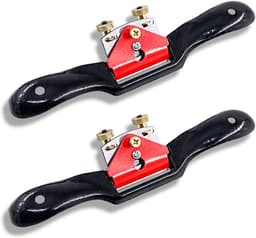
Swpeet Swpeet 10 inch pair

Preis-Tipp

Swpeet Swpeet 10 inch pair
8.6/10about £4.44
Swpeet Swpeet 10 inch flat

Rank 3

Swpeet Swpeet 10 inch flat
9.0/10about £8.99
On this page

What a flat sole can reach

A flat sole gives the spokeshave a stable reference immediately before and after the cutter. On a straight door edge, a chamfer or the outside of a broad curve, that contact helps prevent the blade diving into one short area. Flat does not mean straight lines only. Melbourne Tool Company describes flat soles as suitable for flat and convex work as well as gentle hollows. The limit comes when both ends contact high points while the blade remains above the low point. More cutter depth then makes the edges aggressive without helping the sole enter. Swpeet B0773LKJ5Y names a flat cast-iron base and a 46 mm cutter. The £4.44 Swpeet pair and the £12.99 Glarks pair also state flat bases. If you have no specific deep hollow, the spokeshave buying guide explains why flat normally comes first. Popular Woodworking notes that a tight-mouthed flat metal sole struggles in a deep concave cut.

What a round sole is for

A round-bottom spokeshave has a sole curved from front to back. The shorter effective contact lets you tilt the tool into a concave surface and bring the cutter to timber that a flat sole bridges. Paul Sellers says he owns round-bottom shaves but rarely uses them because most arches are easier with a flat sole. His practical threshold describes tight arches of less than about a 6-inch radius. Common Woodworking uses different wording, saying a round bottom is needed for radiuses of less than 6 inches, or 152 mm, in diameter. Radius and diameter are not interchangeable, so read them as two authors' descriptions. Test the work itself. If a lightly set flat sole stays supported and produces a continuous shaving, continue. If its ends touch while the cutter cannot reach, use a round sole rather than deepening the blade. Spear & Jackson SSROUND B0H2Z5N6SS is the named round option. Its listing describes a curved shoe and an adjustable carbon-steel blade, but gives no sole radius. It costs £13.33 and is one tool. The guide to using a spokeshave covers the forward tilt used to present a round sole.

A curved blade is not a round sole

Spear & Jackson SSCON B0H2YW8WKL contains concave and convex blade profiles. They are not the same arrangement as a conventional straight cutter housed in a sole curved from front to back. A Stanley- or Record-style 151 is the flat-bottom idea, while a 151R is its round-bottom counterpart. SSCON is not a 151 plus 151R. SSCON costs £26.74 and holds 4.5 stars from 106 ratings. Reviewers describe one locking screw, and one UK buyer estimated about a 5 cm radius. That estimate is not a manufacturer specification. Choose SSROUND for a round sole, SSCON for shaped cutters, and a flat sole for a door edge or broad convex rail. The best spokeshave guide applies those distinctions to the listed models.

Which of these twelve tools is which?

Five listings name a flat sole: both Swpeet tools, Lumanious B0FZ964N29, Glarks B07PT43VJS and Wjelet B0DK2VMLRW. Wjelet's 54 g weight and corded-electric fields are catalogue errors. SSROUND is the one named round shoe. SSCON is the separate concave-and-convex blade set. That leaves Voskilon B0H2DLNL1P, Wjelet B0DT6XB176, GIONAR B0H19VHQCW, MHYMX B0DSC4FJXH and the Glarks eight-piece G2657 with no stated sole shape. Do not convert an absent specification into probably flat. The £16.99 G2657 bundles two shaves, four blades, a plane and a rasp, but it does not become a documented flat-and-round set.

Common questions

Can a flat spokeshave cut a curve?
Yes. A flat sole works well on convex surfaces and can enter a broad, gentle hollow because its contact points remain close enough to the cutter. It reaches its limit when the hollow is so tight that the sole bridges across high points and holds the blade away from the low area.
When do you need a round-bottom spokeshave?
Use one when a concave curve is too tight for a lightly set flat sole to reach. Authors differ on a numerical threshold, so judge the actual surface rather than relying on one radius. A round sole is normally a specialist second tool, not a better choice for straight edges.
Is under 6 inches a radius or a diameter?
Paul Sellers describes tight arches of less than about a 6-inch radius. Common Woodworking's live wording says less than 6 inches, or 152 mm, in diameter. Those are materially different curves. Keep each statement attributed to its source and do not combine them into a single specification.
Is SSCON the same as a flat and round pair?
No. Spear & Jackson SSCON uses concave and convex blade profiles. A flat-and-round pair would change the sole geometry while retaining a conventional cutter arrangement. For a named round shoe in this comparison, look at the separate Spear & Jackson SSROUND listing.
Which sole is right for a sticking door?
A flat sole is right for a straight timber door edge, provided the problem genuinely requires a light shaving. A round sole and the SSCON curved cutters are the wrong geometry. Check hinges, seasonal swelling and the frame before removing any timber.
Does a round sole require different sharpening?
The sole changes how the tool contacts the work, but it does not create a special blade-steel rule. Paul Sellers describes shaping the bevel using the same principle as a chisel or plane iron. Follow the maker's cutter geometry and avoid inventing a honing angle that the listing does not state.

Related pages

Sources

Public sources named in the research digest for this spokeshave comparison. Listing prices and star counts are amazon.co.uk figures from that digest. Prices move. Sources checked 15 October 2026.

  1. Common Woodworking, Buying a spokeshave (retrieved 15 October 2026)
  2. Paul Sellers, spokeshave Q&A (retrieved 15 October 2026)
  3. Fine Woodworking, low-angle vs standard-angle spokeshaves (retrieved 15 October 2026)
  4. Fine Woodworking, spokeshaves can be pushed or pulled (retrieved 15 October 2026)
  5. HSE, PUWER overview (retrieved 15 October 2026)
  6. Consumer Rights Act 2015, section 9 (retrieved 15 October 2026)
  7. MoneyHelper, consumer rights (retrieved 15 October 2026)
  8. Tooled-Up, Record A151 flat spokeshave (retrieved 15 October 2026)