Independent comparisons. We may earn from shop links. More info

2mm edge banding trimmer

Updated: 23 October 2026

A roll of 2 mm ABS and a hand trimmer in the basket is a mismatch. A 2mm edge banding trimmer, as a flush cut with the tools in this set, is the wrong search. Do not iron that roll the way you iron thin tape. The way it goes on is a machine, hot air or a contact adhesive, then a router or a panel shop. Captured prices stay on the [edge band trimmer comparison](/hub/diy-supplies/edge-band-trimmer). Peter F. did not cut a sample. A qualifying purchase can earn a commission at no extra cost to you.

A roll of 2 mm ABS and a hand trimmer in the basket is a mismatch. A 2mm edge banding trimmer, as a flush cut with the tools in this set, is the wrong search. Do not iron that roll the way you iron thin tape.

Our top picks

On this page

What the two thicknesses are for

Cutwrights uses 0.8 mm and 1.0 mm ABS where the core colour should show less, and 2.0 mm on fronts, doors and desks that take a hit. Lawcris stocks 0.4 mm, 0.8 mm and 2 mm. The thicker roll is not the same iron job. A UK Workshop thread says 0.4 mm can be ironed with care. At 2 mm the face melts before the glue softens. Cutlist Lab says thick ABS does not pass iron heat through. A 0.8 mm roll can still be a hand-trimmer conversation, and it is already above Ney’s 0.6 mm AU93 cap. It is not a licence to treat 2 mm as a bit more of the same.

Two published caps, and they do not match

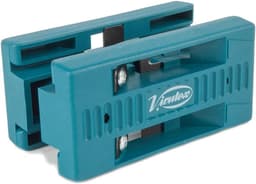
Ney’s PDF states 0.6 mm for the AU93, and 40 mm when both sides are trimmed together. Ostermann’s en_GB text groups it up to 1 mm and sends 2 mm to a router. The amazon bullets print the 40 mm width, not either cap. The shapes are on the edge band trimmer buying guide. Do not copy 0.6 mm onto every trimmer. Neither source says the AU93 flush-cuts 2 mm. An 18 mm door can sit inside 40 mm of width and still carry a tape the tool is not stated for. CBJ says a radius bigger than the tape thickness damages the face.

Listings that look like a 2 mm promise

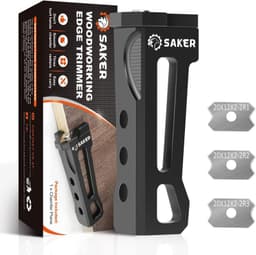
The Saker says R1 for 0.8–2 mm and R2 for 1.5–2.0 mm. The ranges overlap. UK reviews, inside 3.9 from 304 ratings, describe a chamfer and a ripped band, not a measured flush cut of 2 mm ABS. A box short of three blades does not contain the range the title named. The ANTREATU, at £20.99, states 2.6 mm. One UK review still could not set it for 2 mm plastic. The star line is 2.7 from 6. The Uadme cutting-width field of 100 mm is not a tape thickness, and a pneumatic bullet sits against a Manual power field.

Router or a workshop

UK Workshop’s method for 2 mm lipping is a bearing-guided flush cutter, or a pencil-round once the edge is flush. This set does not include a router bit. The hand-tool table ends when the tape is too thick for the published AU93 caps. Cutwrights’ machine banding runs from £0.50 to £2.00 per metre. On kitchen doors that is often less trouble than a trimmer the sources do not state for the roll. A 0.4 mm shelf is a different job. A run of 2 mm fronts belongs with a workshop. Keep a V-notch for the next thin carcass.

Common questions

Can I iron 2 mm ABS?
Not in the way you iron thin pre-glued tape. UK Workshop’s experience is that the face melts before the glue softens, and the glue stays soft. Cutlist Lab says thick ABS does not pass iron heat through. A hotter iron makes the face worse. Use a method meant for that thickness, or buy the doors already banded. Thin tape, around the 0.4 mm end, is the iron-on case.
Will the AU93 flush-cut 2 mm?
The amazon bullets do not say so. Ney states 0.6 mm. Ostermann groups the AU93 up to 1 mm and sends 2 mm to a router. Use those published caps, and do not let a seller’s claim of up to 2 mm on a different tool overwrite them. The 40 mm figure is the width of the edge, so an 18 mm door is not proof the tape thickness is allowed.
What is 0.8 mm for, if 2 mm is tougher?
Cutwrights uses 0.8 mm and 1.0 mm when you want the core colour to show less, and 2.0 mm on fronts, doors and desks that take knocks. The 0.8 mm roll can still be a hand-trimmer conversation. It is already above Ney’s 0.6 mm AU93 cap, so check which ceiling you are willing to trust. It is not a stepping stone that makes 2 mm ironable.
Is 40 mm on the AU93 the same as 2 mm?
No. Forty millimetres is the simultaneous trimming width in the bullets and in Ney’s PDF. Two millimetres is the thickness of the plastic. A narrow door can be well inside 40 mm and still carry a tape the trimmer is not stated for. Tape width on the packet, often something like 22 mm, is a third number, the width that has to cover the board.
The Saker says R1 up to 2 mm. Does that count?
It counts as the listing’s range for a radius blade, and the R2 range overlaps it. UK reviews describe a chamfer and a poor flush cut, and they say you still need a flush trimmer first. It does not count as evidence that this set flush-cuts 2 mm ABS. Missing blades in the box are a separate reason not to trust the three-range title on the day it arrives.
When is it cheaper to pay a panel shop?
When the run is doors and fronts rather than one shelf. Cutwrights’ service sits between £0.50 and £2.00 per metre. Set that beside your time, a router you may not own, and a hand trimmer the sources do not state for 2 mm. A single 0.4 mm edge is the case for doing it yourself.

Related pages

Sources

Public UK sources and the amazon.co.uk listings compared on this page. Updated 22.10.2026.

  1. Virutex AU93 spare parts (retrieved 22.10.2026)
  2. SL Hardwoods: Virutex AU93 (retrieved 22.10.2026)
  3. Ostermann: manual processing of edgings (retrieved 22.10.2026)
  4. Cutwrights: edge banding (retrieved 22.10.2026)
  5. CBJ: edge banding explained (retrieved 22.10.2026)
  6. Lawcris: decorative edging (retrieved 22.10.2026)
  7. HSE: PPS12(rev1) knife safety (retrieved 22.10.2026)
  8. Cutlist Lab: edge banding (retrieved 22.10.2026)