Independent comparisons. We may earn from shop links. More info

Polythene sheet vs damp proof membrane

Updated: 23 October 2026

You are about to put plastic under a floor, or behind insulation, and the product in your hand is called polythene. Polythene sheet vs damp proof membrane is a question of job and paperwork, not of the polymer name. A dust sheet, a temporary roll, a damp-proof membrane, and a vapour control layer can all be polyethylene, and they are not interchangeable. If the floor must resist ground moisture, use a membrane specified for that, or another design accepted for the building. Do not use the five sheets in our [construction film comparison](/hub/diy-supplies/construction-film). Peter F. read Approved Document C, manufacturer datasheets, and those listings. A qualifying purchase can earn a commission at no extra cost to you.

You are about to put plastic under a floor, or behind insulation, and the product in your hand is called polythene. Polythene sheet vs damp proof membrane is a question of job and paperwork, not of the polymer name.

Our top picks

On this page

Three different sheets

A plastic dust sheet is a cover for paint. That job is on the plastic dust sheets for painting page, and it has no role under a slab. A damp-proof membrane is the sheet on the ground side of the floor, loose-laid on a bed that will not puncture it, with joints sealed and the layer carried to the wall damp-proof course. A vapour control layer is on the warm side of insulation, to limit vapour from the room. Warmup treats about 500 gauge as a vapour control layer and 1200 gauge as a damp-proof membrane. The vapour control layer may not stand in for the membrane. A decorating sheet from this comparison answers neither request.

The thickness figure and the argument around it

Approved Document C, paragraph 4.8, is England's guidance for a ground-supported concrete floor. It describes polyethylene at least 300 micrometres, which is 1200 gauge, with sealed joints, on a bed that will not damage the sheet, continuous with the wall damp-proof courses. Scotland, Wales, and Northern Ireland publish their own guidance. Approved Documents are guidance for England, not a product catalogue. NDC Polipak describes 1000 gauge, 250 micrometres, as meeting the regulatory minimum, with a CE mark to EN 13967. Visqueen lists 0.25 mm, 0.3 mm, and 0.5 mm sheets to EN 13967:2017, and says a 0.25 mm sheet needs the stakeholders to confirm it. Ask for the declaration and who has accepted the design.

What a listing has to show

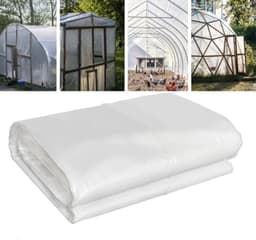
A listing you can treat as a damp-proof membrane shows the standard and, where it has one, the certificate. Visqueen's damp-proof membrane cites EN 13967:2017 and BBA certificate 94/3009. Black dye does not create the certificate, and a millimetre bullet on its own does not either. None of the five listings here cites EN 13967, EN 13984, or a BBA number. Zhiyu666, at £8.99, is 2 m by 3 m and the bullets say 0.3 mm. That is the Approved Document figure as a number, and it is the whole of the claim. VOGANLL states 0.12 mm with a PVC and polyethylene conflict. The builders' polythene sheeting page unpacks those gauges.

Water pressure is a different product

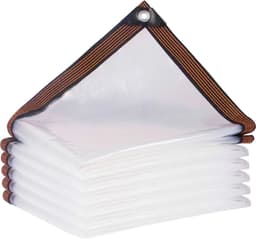
A damp-proof membrane resists moisture rising from the ground in the floor that was designed for it. It is not a tanking system. Newton Waterproofing places basement waterproofing in BS 8102 territory, with a design for the water pressure. Visqueen's datasheet excludes hydrostatic pressure. A thicker polythene roll does not cross that line. Building control looks at the deposited design, not at a 300 micrometre bullet on a 6 m² clear sheet. Leave these five sheets for paint and for a short cover.

Which sheet belongs under the floor

Use a named damp-proof membrane, with sealed joints and continuity with the wall damp-proof course. In England, Approved Document C's example is polyethylene of at least 300 micrometres. A vapour control layer stays on the warm side of insulation. Leave every sheet in this comparison for paint or a short cover.

Common questions

Is any polythene under a slab a damp-proof membrane?
No. A damp-proof membrane is a sheet specified for that position, with a declared standard such as BS EN 13967, sealed joints, and continuity with the wall damp-proof course. Approved Document C's example for England is polyethylene of at least 300 micrometres. None of the five listings here carries EN 13967 or a BBA number, so putting one of them on a blinding does not create a membrane.
Why do some sellers say 250 micrometres is enough when the Approved Document says 300?
Approved Document C, paragraph 4.8, gives 300 micrometres, 1200 gauge, as the example for polyethylene below a ground-supported floor in England. NDC describes 1000 gauge, 250 micrometres, as meeting the regulatory minimum and cites EN 13967. Visqueen says its 0.25 mm sheet needs stakeholder confirmation. Ask whoever is responsible for the floor which declared sheet they have accepted. Do not choose 250 or 300 micrometres from this page.
Can the Zhiyu sheet, which says 0.3 mm, go under concrete?
The bullets say 0.3 mm, which matches the Approved Document figure as a number, on a 2 m by 3 m sheet at £8.99. UK reviews dispute that the film feels extra thick. The listing does not cite EN 13967, a BBA certificate, or a jointing system. Six square metres is a small patch before laps. Keep it for a light cover you can inspect. For concrete, use a named membrane someone has specified.
Will a membrane stop water pressure in a basement?
A damp-proof membrane is not a waterproofing system for water under pressure. Newton Waterproofing places that job in BS 8102 territory, not with a DPM rolled out as tanking. Visqueen's datasheet excludes hydrostatic pressure and says the sheet is not radon-accredited. If the space is below ground, stop and get a design. A thicker general polythene roll does not change that boundary.
Who signs off the floor?
On a building project in England, building control or an approved inspector checks the work against the design that was deposited. They are looking at a specified membrane, its joints, and its continuity with the damp-proof course, not at a title that says heavy duty. Scotland, Wales, and Northern Ireland use their own routes. Bring the datasheet. Do not bring one of these five listings as the floor design.

Related pages

Sources

Public UK sources and the amazon.co.uk listings compared on this page. Prices captured 20 October 2026. Updated 22.10.2026.

  1. Approved Document C, GOV.UK (retrieved October 2026)
  2. Approved Document C PDF, paragraph 4.8 (retrieved October 2026)
  3. HSE CIS36 Construction dust (retrieved October 2026)
  4. HSE Asbestos Essentials em3 (retrieved October 2026)
  5. Visqueen DPM (retrieved October 2026)
  6. Visqueen Vapour Barrier (retrieved October 2026)
  7. Bath and North East Somerset building control, loft ventilation (retrieved October 2026)