Independent comparisons. We may earn from shop links. More info

Builders' polythene sheeting

Updated: 23 October 2026

You have a clear sheet in the basket and a title that only says heavy duty. Builders' polythene sheeting is sold for paint, rubble, and floors, and those jobs do not share a thickness. This page turns the gauge number into micrometres, then checks what the five listings in our [construction film comparison](/hub/diy-supplies/construction-film) actually print. Prices are amazon.co.uk shelf figures in GBP from 20 October 2026. Peter F. compared those listings with public UK guidance. We did not measure a film in a lab, and a qualifying purchase can earn a commission at no extra cost to you.

You have a clear sheet in the basket and a title that only says heavy duty. Builders' polythene sheeting is sold for paint, rubble, and floors, and those jobs do not share a thickness.

Our top picks

On this page

What the gauge number means

Merchants in the UK still sell polyethylene by gauge. A workable conversion, used on More Polythene's thickness table, is that 100 gauge is about 25 micrometres, so you divide the gauge by four. Five hundred gauge is about 125 micrometres (0.125 mm). One thousand gauge is about 250 micrometres (0.25 mm). Twelve hundred gauge is 300 micrometres, which is 0.3 mm. NPF Packaging prints the same three rows. A printed micrometre beats a nickname, because a mil conversion is sometimes rounded. Decorator's film sits far below that scale. Trade sheets that state a thickness often print 7 to 15 micrometres. That is a splash cover, not a rubble sheet. The word heavy does not move you up the table. It is not a British Standard and not Approved Document C.

Match the sheet to the job

Start with the job, then the number. If you are keeping paint off a sofa for an afternoon, a thin clear film and some tape are enough, and you should expect to throw the sheet away. The walk-on choice is on the plastic dust sheets for painting page. If you are hiding a rubble pile for a few days, temporary builders' polythene is often around 500 gauge, about 125 micrometres, with a fixing that does not tear the film. A ground-supported concrete floor in England is another product. Approved Document C says polyethylene below that floor should be at least 300 micrometres (1200 gauge), with sealed joints, on a bed that will not puncture it, and continuous with the wall damp-proof course. Scotland, Wales, and Northern Ireland publish their own guidance. This set stops at decorating sheets and small clear covers.

What these amazon.co.uk listings leave out

Five listings were kept, from £7.85 to £17.24. Zhiyu666 at £8.99 prints 0.3 mm on a 2 m by 3 m sheet. United Kingdom reviews say it felt thinner than the extra-thick title. VOGANLL at £17.24 states 0.12 mm, puts PVC in the title and polyethylene in the material line, and adds eyelets. ZHXGO, SuQurtom, and Skdqiee state no thickness. Skdqiee also has no material and no reviews in the capture. If the listing has no micrometres, treat the thickness as unknown. Do not fill the gap with heavy duty. The best heavy duty polythene sheet page ranks only these five boxes.

Clear, black, and eyelets

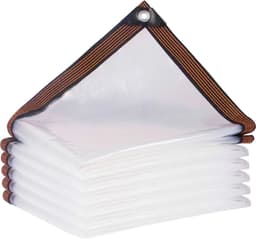
Colour does not set the thickness. Black polythene is common on damp-proof rolls because you can see it on a blinding, not because the dye adds micrometres. The Skdqiee line of 32.8 ft by 9.8 ft is about 10 m by 3 m. Measure the room in metres, including the turn-up. Eyelets turn a film into a cover you can tie. On the VOGANLL sheet they are about a metre apart, and they concentrate the pull. A 0.12 mm film with a hole in it tears in a gust. If the plastic is going under a floor, you need a declared membrane, not a colour or a row of eyelets.

Which number for which job

If the job is paint for an afternoon, a thin sheet and tape are enough. If it is a few days over rubble, look for about 500 gauge and a fixing that does not tear the sheet. If it is a ground-supported floor in England, you are outside this set: the example thickness is at least 300 micrometres, with a declaration these listings do not carry. A missing micrometre figure means the thickness is unknown.

Common questions

What is 500 gauge in millimetres?
Five hundred gauge is about 125 micrometres, or 0.125 mm, if you divide the gauge by four. That is the row on merchant charts such as More Polythene and NPF Packaging. It is not half a millimetre. Half a millimetre would be 500 micrometres. If both figures are printed and they disagree, check the arithmetic.
Is heavy duty thicker than 1200 gauge?
No. Heavy duty is a sales word, and merchants do not share one meaning for it. One seller treats 400 to 500 gauge as medium. Another calls 1000 gauge extra heavy. Twelve hundred gauge is 300 micrometres, the Approved Document C example for polyethylene under a ground-supported floor in England. Read the micrometres, or treat the thickness as unknown.
Can I buy a floor membrane in the £8 to £17 band of this comparison?
Not from the five listings kept here. That band runs from £7.85 to £17.24, and none of them cites EN 13967 or a BBA certificate. A black 1200-gauge sheet can appear on amazon.co.uk at a similar price, including about £13.99 for 3 m by 4 m on 20 October 2026, but it is outside this set and still needs its own declaration.
What should I do if the listing has no micrometres?
Treat the thickness as unknown. Do not guess from heavy duty or from the weight of the packet. ZHXGO, SuQurtom, and Skdqiee in this comparison all omit a thickness. Ask the seller for micrometres before you pay, or choose a listing that already prints them. A missing figure matters most if the sheet might go outdoors in wind or under a floor.
Is a 0.3 mm claim on a clear sheet the same as a BBA membrane?
No. Approved Document C uses 300 micrometres, which is 0.3 mm, as the example for polyethylene under a ground-supported floor in England. A membrane you can defend is a named sheet, often to BS EN 13967, sometimes with a BBA certificate, laid with sealed joints. Zhiyu666 prints 0.3 mm and nothing else a membrane needs, and United Kingdom reviews dispute how thick it feels.

Related pages

Sources

Public UK sources and the amazon.co.uk listings compared on this page. Prices captured 20 October 2026. Updated 22.10.2026.

  1. Approved Document C, GOV.UK (retrieved October 2026)
  2. Approved Document C PDF, paragraph 4.8 (retrieved October 2026)
  3. HSE CIS36 Construction dust (retrieved October 2026)
  4. HSE Asbestos Essentials em3 (retrieved October 2026)
  5. Visqueen DPM (retrieved October 2026)
  6. Visqueen Vapour Barrier (retrieved October 2026)
  7. Bath and North East Somerset building control, loft ventilation (retrieved October 2026)