Independent comparisons. We may earn from shop links. More info

Quiet pedestal fan for the bedroom

Updated: 21 October 2026

The room is already warm, the window is open as far as the street allows, and you want a breeze you can start from the pillow and forget. A quiet pedestal fan for the bedroom is the one whose lowest speed, beeps, and lights you can sleep beside, not the one with the smallest number in the title. This page stays on that night. The full price table is the [pedestal fan with remote control comparison](/hub/cooling/pedestal-fan-with-remote-control). If you buy through our amazon.co.uk links, we may earn a commission at no extra cost to you. Peter F. did not measure these fans with a sound meter. Review comments and the figures printed on each listing are the evidence.

The room is already warm, the window is open as far as the street allows, and you want a breeze you can start from the pillow and forget.

Our top picks

On this page

What quiet means on a listing

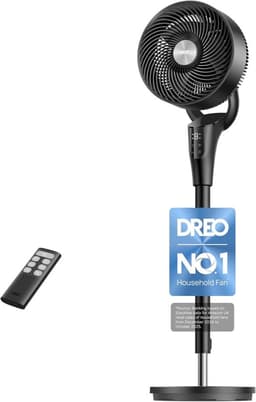
A single decibel claim is the quietest line the page will print, not always the speed you will hear at 1 a.m. Good Housekeeping’s tip is a low reading, ideally below 35 dB. That is their rule of thumb, not a British Standard, and not a measurement of these fans. Figures for a DREO TurboPoly 512 do not transfer to the DR-HPF013 or the DR-HPF002. On the black DREO page the bullet says 20 dB and the table says 28.2 dB. The PolyFan bullet says 20 dB and the table says 23 dB. Reviewers call the low speeds quiet enough for sleep and the high speeds loud. The ROVSUN states 40 dB. The Amazon Basics table states no decibel figure. The Shark table says 45 dB, and some reviews still praise a low speed overnight. If the low speed does not move enough air, a louder high speed will not become quiet because the box said 20 dB. Plug checks are on the buying guide.

Beeps, lights, and voice

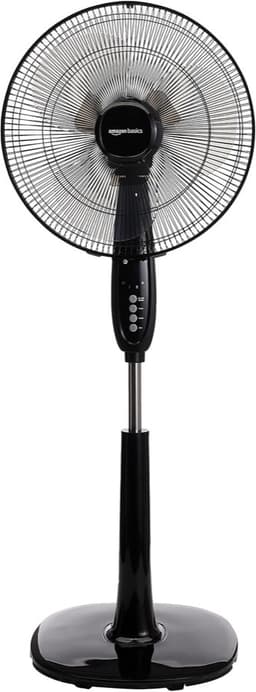
The noise that wakes people is often the handset. Amazon Basics reviews mention a beep on each press. DREO reviewers describe a mute from the remote, and buttons that glow. A bright LED facing the pillow is a night light you did not ask for. Dim it if you can. The Air Pro AP-P2, about £64.99 with 3.0 from 155 reviews, uses spoken prompts with no Wi-Fi. Several reviewers say the prompts continue after they try to mute them, including beeps while the fan is off. That is a poor match for a light sleeper. Amazon Basics and ROVSUN handsets need two AAA cells that are not in the box. Some people sleep through a sweep, and some wake on each pass. If the sweep is the problem, switch it off. Batteries and tilt are on the how to use a pedestal fan page.

Aim and timer

Point the air along the bed or across the foot, not into your face. GOV.UK says not to aim a fan straight at the body. The Amazon Basics fan adjusts from 115 to 135 cm. The ROVSUN is 115–130 cm. A DREO review says the head felt low for some beds. A lead one review puts at about 1.5 m will not cross a large bedroom, so the socket decides where the fan stands. Timers run to 7.5 hours on the Amazon Basics and ROVSUN fans, 8 hours on the DREO pages, and 12 hours on the Air Pro. Electrical Safety First still advises against leaving a fan on overnight. A timer does not cancel that advice. The NHS says fans can help below 35°C. They do not refrigerate the room. A slimmer column is a different shape, on the pedestal fan vs tower fan page.

Which of these listings to consider

For a night, start with reviews that mention a low speed and a remote you can silence. The black DREO at about £79.99, 4.7 from 8,743 reviews, is the one owners describe that way, with glow buttons and a mute. The table still says 120 V, a 2-pin connector, three speeds against an eight-speed bullet, and 28.2 dB against 20 dB. Confirm the live plug line before you treat it as a UK mains fan. The white listing shares that table. The silver PolyFan at about £99.99 agrees on eight speeds and still prints 120 V. If the page must state a UK plug, the Amazon Basics FS40-10BR at about £47.45 does, with no decibel number and a beep on each press. Skip the Air Pro if you cannot mute the voice. Skip the listing at about £34.99: there is no review line and no noise figure.

Common questions

Is 20 dB silent?
No. Twenty decibels is a very low printed claim, close to a quiet room in textbook scales, and these listings do not show that every speed sits there. On the DREO pages the bullet says 20 dB and the table says 28.2 dB or, on the PolyFan, 23 dB. Reviewers say the low speed is the quiet one and higher speeds sound like a fan. We have not measured any ASIN in this set, and figures published for other DREO models do not belong to these product pages.
Which speed should I sleep with?
The lowest speed that still moves air across the bed, with oscillation off if the sweep wakes you. On the Shark, the long battery claim is only for speed 1 without oscillation, which tells you the bottom step is the one the brand treats as the long, gentler run. On the DREO fans, reviews separate a quiet low end from a loud turbo. If the bottom speed does nothing useful, this fan is the wrong bedroom tool, and a higher speed will not become quiet.
Can I turn the beeps and the display off?
On DREO reviews, yes: owners describe a mute from the remote and buttons that glow, so you can find mute in the dark. On the Amazon Basics fan, reviews mention a beep on each press and do not describe a mute. On the Air Pro, several reviewers say the voice or the beeps continue after they try to silence them. Dim or face any pole display away from the pillow. A light you cannot dim is part of the noise budget, even though it is not a decibel.
Will oscillation keep me awake?
It can. The motor adds a repeating pass of air, and some ROVSUN owners are fine with that at night while others will want a fixed direction. A stall, which Air Pro reviewers describe, is worse than a steady sweep because the head needs a nudge. If you are a light sleeper, start with oscillation off, aim along the room, and add sweep only on a night you can still change it. A 180° Shark sweep is a lot of movement for a single bed pushed against a wall.
Should the fan blow on my face?
No. GOV.UK says not to aim a fan straight at your body. Aim along the bed or across the foot, with the head above mattress height so the air is not trapped in the duvet. People still like a little air on skin, which is how a fan helps below 35°C in NHS advice. Direct blast into your eyes and mouth is the part to avoid, especially for a full night.
Is it safe to use the timer all night?
Electrical Safety First advises against leaving a fan on overnight or while you are out, timer or not. The timers here run for many hours because the listings say so, not because a charity has cleared all-night use. If you use a timer, keep a low speed, keep the airflow off your face, and unplug if you smell burning or the plug is hot. If heat is making someone ill, follow NHS advice rather than extending the timer.

Related pages

Sources

Public UK sources below. Prices, stars and review notes are from the amazon.co.uk listings in this set. Page updated 20 October 2026. This is not a laboratory test.

  1. Electrical Equipment (Safety) Regulations 2016, regulation 35 (retrieved 20 October 2026)
  2. Plugs and Sockets etc. (Safety) Regulations 1994, Part II (retrieved 20 October 2026)
  3. Electrical Safety First: electric fans (retrieved 20 October 2026)
  4. NHS: heatwave, how to cope in hot weather (retrieved 20 October 2026)
  5. GOV.UK: beat the heat, keep cool at home (retrieved 20 October 2026)
  6. Ofgem: energy price cap unit rates and standing charges (retrieved 20 October 2026)
  7. Good Housekeeping UK: pedestal fans (retrieved 20 October 2026)
  8. TechRadar: pedestal fan vs tower fan (retrieved 20 October 2026)