Independent comparisons. We may earn from shop links. More info

Pedestal fan with remote control buying guide

Updated: 21 October 2026

A hot night in a British bedroom is usually one reachable socket and a fan you do not want to get out of bed to change. This pedestal fan with remote control buying guide is the checks before a model name: what the handset does, whether the quiet claim is the speed you will use, and whether the page shows a supply for a UK socket. Prices and stars are on the [pedestal fan with remote control comparison](/hub/cooling/pedestal-fan-with-remote-control). If you buy through our amazon.co.uk links, we may earn a commission at no extra cost to you. Peter F. used those listings and public UK sources. This is not a lab test.

A hot night in a British bedroom is usually one reachable socket and a fan you do not want to get out of bed to change.

Our top picks

On this page

What you are buying

A pedestal fan is a head on a pole and a floor base. A useful remote changes speed, oscillation, and a timer, rather than only switching the motor on. A tower is a slim column, covered on the pedestal fan vs tower fan page. You are buying a breeze you can aim. You are not buying a machine that refrigerates the room. NHS guidance is that a fan can help when it is below 35°C, and the GOV.UK heat checklist says not to point the airflow straight at your body. The checks below stay the same whichever row you open.

Noise, speeds, and oscillation

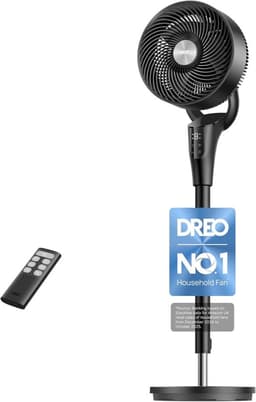
One decibel figure is a headline until you know which speed it belongs to. Good Housekeeping’s UK tip is a low reading, ideally below 35 dB. That is their buying tip, not a British Standard, and not a legal cap. On the black DREO listing the bullet says 20 dB and the table says 28.2 dB. Reviewers still call the low speed quiet and the higher speeds a fan. The PolyFan prints 20 dB in the bullet and 23 dB in the table. The ROVSUN states 40 dB. The Amazon Basics table states no noise figure. Three speeds are enough when the lowest is one you can sit beside. Extra speeds help only when the page agrees with itself: the DR-HPF013 bullet says eight and the table says three, while the PolyFan table agrees on eight. The ROVSUN prints 60–120° and the Shark prints 180°. A wide sweep in a box room washes the side of the bed you wanted left still. Night-time beeps are on the quiet pedestal fan for the bedroom page.

Height, timer, and the remote

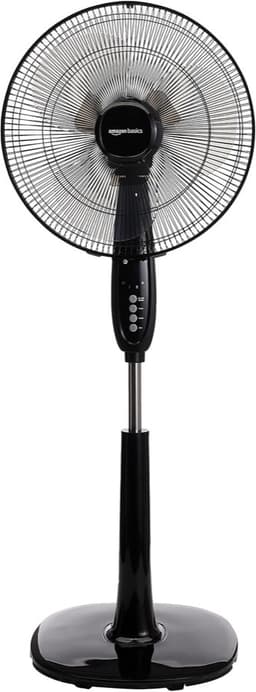
Height is about clearing a mattress or a sofa back. The Amazon Basics range is 115–135 cm, with tilt from 0° to 30°. The ROVSUN is 115–130 cm. DREO bullets say 38–42 inches and the table height is 105 cm. The PolyFan bullet says 35–40 inches while the dimension line is 66 cm, and those cannot both be the standing height. A black DREO review says the head sits a little low for some beds. The handset earns its place when you want a speed change from bed. Buttons on the pole still matter, because several remotes miss the first press. Amazon Basics and ROVSUN owners report two AAA batteries that are not in the box. Beeps on every press are the night-time cost. A timer of 7.5 or 8 hours covers a night on the clock. It does not match the overnight advice from Electrical Safety First, on the how to use a pedestal fan page.

Plug, voltage, and running cost

UK mains are nominally 230 V. When a product is meant for a BS 1363 socket, regulation 35 of the Electrical Equipment (Safety) Regulations 2016 requires a correctly fitted standard plug, or a compliant non-UK plug with a conversion plug and a BS 1362 fuse. Electrical Safety First says look for a UK 3-pin plug with a fuse. The Amazon Basics page states a standard UK plug and 230 V. The Air Pro states 240 V and does not name the plug shape. The ROVSUN states neither. Three DREO tables print 120 V and a 2-pin connector. The Shark table prints 50 V and micro USB, while the bullets describe a battery and a charging cable. If the table and the title disagree, wait for the live amazon.co.uk page. The star rating does not settle that. Ofgem’s average Direct Debit unit rate for 1 October to 31 December 2026 is 26.32 pence per kWh in England, Scotland and Wales. It is not a Northern Ireland rate and not a fixed tariff. At that average, 36 W for eight hours is about 7.6 pence, 65 W is about 13.7 pence, and 24 W is about 5.1 pence. A higher wattage is not a colder room.

Common questions

Is a remote worth it if the fan already has buttons?
It is worth it when you will change speed or set a timer from the bed or the sofa. Buttons on the pole are the backup, and you will use them. In this set, Amazon Basics and ROVSUN reviews say the handset needs two AAA batteries that are not supplied, and some owners have to press more than once. Buy the cells with the fan. A remote that only turns the motor on and off is a weaker reason to choose this category.
What does a 20 dB claim mean?
It means that number is printed, not that every speed is quiet. On the black and white DREO pages the bullet says 20 dB and the table says 28.2 dB. Reviews describe the low setting as the quiet one and the high settings as plainly audible. Good Housekeeping’s tip of a low reading ideally below 35 dB is a rule of thumb from that magazine, not a pass mark we measured, and not a legal limit.
Should I compare cubic feet per minute with cubic metres per hour?
No. They are different units, and this set prints both. The black DREO table says 1000 cubic feet per minute, and the white DREO table says 1444 m3/h. Treating those as the same kind of number will rank the wrong page. Use airflow only when two listings share a unit, and even then treat it as a printed claim. Aim, height, and the speed you will actually use tell you more about the breeze in the room.
What if the table says 120 V or 2-pin?
Treat that listing as unfinished for a UK socket until the live page shows 230 V or 240 V and a UK 3-pin plug. Three DREO tables in this comparison print 120 V and a 2-pin connector, including the pages with 4.7 from more than 8,700 reviews. A high star line does not rewrite the voltage. The Shark table’s 50 V and micro USB line is a different clash, against bullets that describe a battery and a charging cable.
How high should a pedestal fan go next to a bed?
High enough for the head to clear the mattress and to tilt past your face rather than into it. In this set the stated ranges cluster around 115–135 cm on the Amazon Basics fan and 115–130 cm on the ROVSUN. A black DREO review says the head felt low for some beds, even with a bullet range of 38–42 inches. Measure from the floor to just above the pillow before you rely on a single adjustable word.

Related pages

Sources

Public UK sources below. Prices, stars and review notes are from the amazon.co.uk listings in this set. Page updated 20 October 2026. This is not a laboratory test.

  1. Electrical Equipment (Safety) Regulations 2016, regulation 35 (retrieved 20 October 2026)
  2. Plugs and Sockets etc. (Safety) Regulations 1994, Part II (retrieved 20 October 2026)
  3. Electrical Safety First: electric fans (retrieved 20 October 2026)
  4. NHS: heatwave, how to cope in hot weather (retrieved 20 October 2026)
  5. GOV.UK: beat the heat, keep cool at home (retrieved 20 October 2026)
  6. Ofgem: energy price cap unit rates and standing charges (retrieved 20 October 2026)
  7. Good Housekeeping UK: pedestal fans (retrieved 20 October 2026)
  8. TechRadar: pedestal fan vs tower fan (retrieved 20 October 2026)