Oil-free or oil compressor: which one should you buy

Choose an oil-free or oil compressor by duty and tilt. Short jobs suit oil-free; long runs suit a lubricated pump. The quiet Stanley is not the 95 dB oil model.
On this page
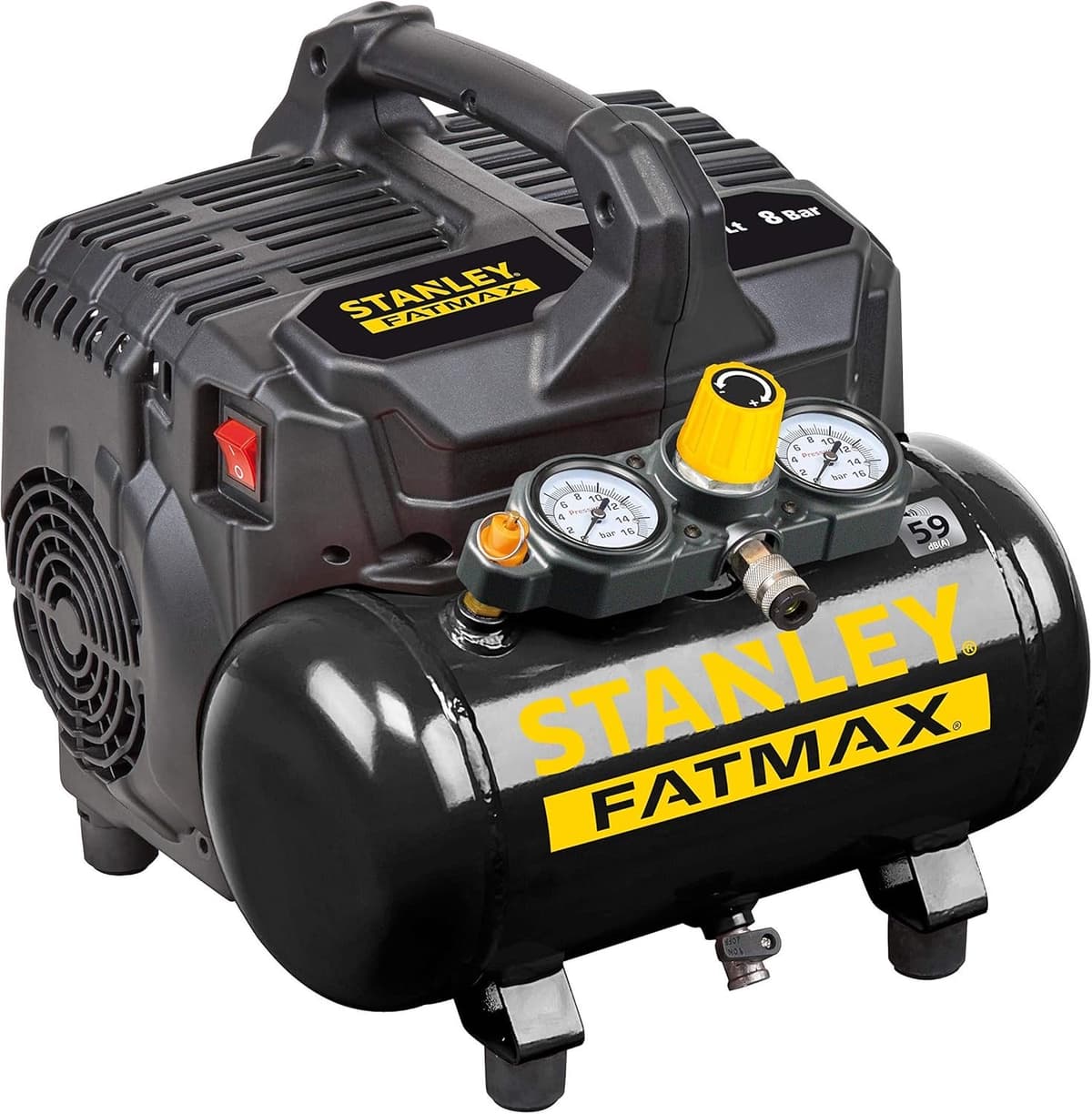
You have two product pages open: a small quiet receiver and a heavier 50 litre machine, and the titles do not tell you which pump belongs in your garage. An oil-free or oil compressor choice is about how long you run the motor and whether the unit stays upright. It is not a noise contest, and it is not a promise that one type of air is automatically clean enough for paint.
Bostitch's UK choosing guide puts lubricated pumps with continuous heavy use, and oil-less pumps with lower volume, less day-to-day oil checking and steeper working angles. Sealey makes the same split: oil where the machine runs for long periods, oil-free for occasional use or where clean air matters, including spraying. A catalogue decibel number does not overrule those guides.
In short
Buy oil-free when the jobs are short, you may tilt the compressor, and you do not want a sump to check. Buy oil-lubricated when you run tools for long periods and you will actually watch the oil. In the Stanley listings used here, the quiet 59 dB DST models are not the oil receiver: the oil-styled D210-8-50 prints 95 dB.
What the two pumps change
An oil-free pump, often called oil-less in UK guides, has no oil bath around the piston. Bostitch's choosing guide puts that construction with lower volume, less oil to check, and steep angles that would starve a lubricated pump. Sealey adds the air-quality case: occasional use, or work where clean air matters, including spraying.
A lubricated pump is the long-run machine. Bostitch links it with more durable continuous heavy use. Sealey's test is time: choose oil when the compressor runs for long periods, and check that oil only as the model's manual says. The limit is the sump. Oil can travel into a spray line, which is the contamination warning in the SGS buyers' guide.
SGS also says oil-less machines skip oil changes and tend to be lighter, with a coating it calls Teflon that wears. The same table calls oiled compressors quieter. That noise line does not fit this Stanley set, where the oil-styled receiver is the loud listing. Use that table for wear and spray-line contamination.
The British Compressed Air Society's note on ISO 8573 is the other limit. Oil-free cuts oil from the compressor. It leaves vapour that was already in the intake air, so the tank still makes water.
Occasional use or a long run
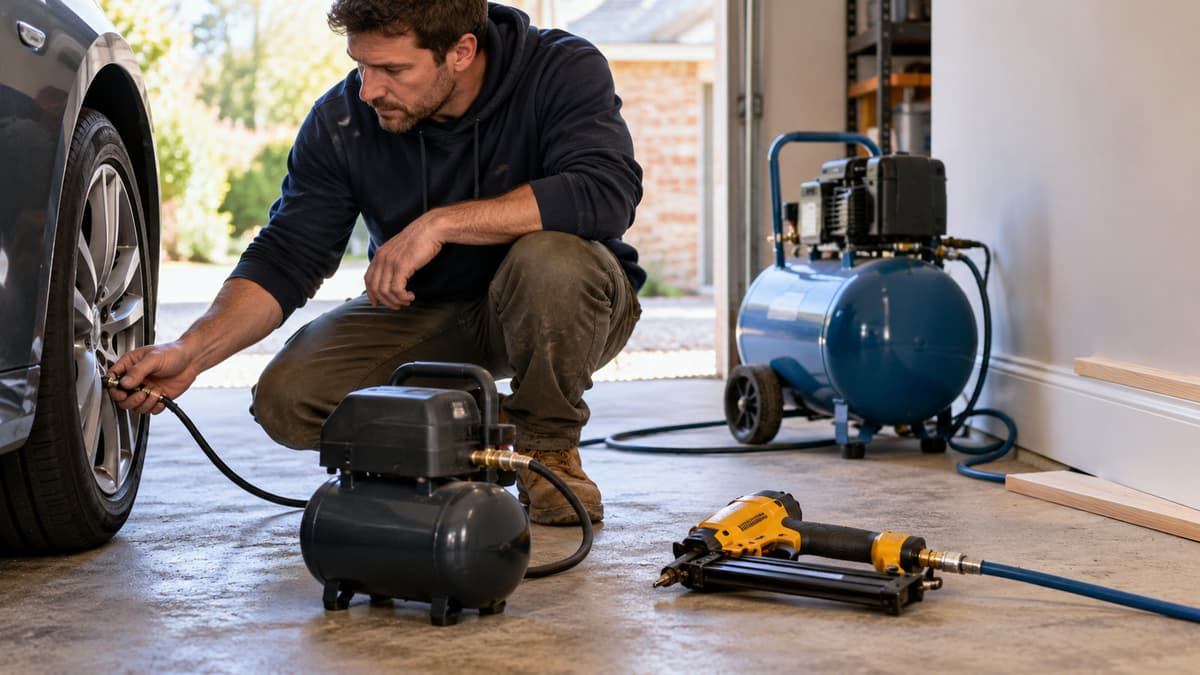
Match the pump to how long the motor runs. Tyres, a bench blow-down or a few minutes with a brad nailer are the occasional jobs Sealey points at oil-free compressors. A small oil-free tank restarts often. A framing nailer or a long spraying session has left that short-job brief.
Hours of air tools are the lubricated case. You accept oil checks, weight and the noise that model prints. A bigger tank cuts restarts. It leaves an oil-less pump on the short-job side of those guides.
Tilt is the second filter. An oil-lubricated compressor needs the orientation that keeps oil on the pump. Oil-free matches a short job you lift out of a boot and run on a drive. If the machine will stand in one garage corner for long runs, that angle advantage falls away and the lubricated pump is the one to price.
Spraying crosses both filters. Sealey names it as a clean-air reason for oil-free, and SGS warns that oil from a lubricated machine can enter the spray line. Intake vapour still condenses, so you still drain and separate water. A weekend tyre compressor remains a weak match for a hungry spray gun. For the long-run receiver, the 50 litre vertical compressor comparison covers floor space, and the Weldinger air compressor comparison is the other-brand route. Neither comparison turns a short-job oil-free pump into a day-long workshop machine.
Noise is not the decider
SGS says oiled compressors are the quieter ones. In this Stanley set the oil-styled D210-8-50 prints 95 dB and is listed at 33.5 kg. The quiet listings are the 59 dB DST models, and B&Q calls the 6 litre DST 101/8/6 oil-free. Those printed figures retire a universal claim that oil means quiet.
59 dB and 95 dB are catalogue claims. We did not meter either compressor, and the pages do not all state the distance. Rank them as printed: the oil-styled Stanley here is the loud one, and the low figure sits on the DST models. That pair does not rank every oiled compressor in Britain. An oil-free portable is the lighter pattern SGS describes, with coating wear in place of a sump.
A blank oil line is its own trap. Several tables in this set never say oil-free or lubricated. A decibel number does not fill that gap, and neither does tank size. When one line says oil-free and another on the same listing says oil-lubricated, keep both. When the table is silent, check the manual or another seller's sheet before you order.
The one oil Stanley
Only the D210-8-50, amazon.co.uk ASIN B003TOEFXC, is styled oil-lubricated in this Stanley set. The capture lists £428.11 and a 50 litre tank. Open it when the work is long runs and you accept the noise and the oil. It is a weak match for a flat and for occasional tyres.
The listing disagrees with itself. The style is oil-lubricated and the kit bullet says oil-free. Keep both lines. Until a manual or a seller sheet states the sump plainly, the conflict stays unresolved. Running a sump machine as if it were oil-free, or pouring oil into an oil-free pump because a bullet worried you, can damage a unit you have not identified.
Reviews on that ASIN describe oil lost in transit. Check the level against the manual before the first run, and leave the grade to that manual. A wet carton means the unit may have travelled inverted. It is a stop-and-check, not a top-up. If the level is down and you do not have the specified oil, leave the compressor unplugged.
B&Q's DST 101/8/6 is the clear oil-free sheet we used: 6 litres, and one of the 59 dB DST models. Other Stanley tables that never mention oil stay unassigned. The Stanley compressor comparison puts those listings side by side, including the conflict on B003TOEFXC.
Maintenance you still do
Oil-free means there is no sump to read. SGS's limit is wear of the coating, which a bottle of oil does not service. The British Compressed Air Society is clear that oil-free construction leaves intake vapour in place, so water still drops out.
Drain the receiver after use. Skipping the cock because the listing said oil-free is how a small tank rusts from the inside. A dry label on the pump is not a dry tank.
On a lubricated piston compressor, the Compressor Shop FAQ offers every 500 to 1,000 hours or six months. That is that shop's rule of thumb, not a Stanley manual interval. About fifteen minutes a week is roughly thirteen hours a year, so 500 hours is decades of tyre-only use and the six-month half of the same shop rule would arrive first. The model handbook still wins.
Oil in the B003TOEFXC carton is the job people improvise. Inspect the level and stop there. This article states no viscosity, so chainsaw oil and leftover engine oil stay on the shelf. If the manual is not to hand and the level is uncertain, the compressor stays off.
Angle is maintenance as well as buying. A lubricated receiver on a slope, or laid down between jobs, loses the film Bostitch describes. Stand it upright, let the oil settle as the manual says, and read the sight glass before you restart.
Our Products Compared editorial team used the Bostitch, Sealey, SGS and BCAS guides named above, the Compressor Shop interval only as that shop's rule of thumb, B&Q on the DST 101/8/6, and the amazon.co.uk listing for the D210-8-50. We ran no lab noise test, duty-cycle test or spray trial, and US duty-cycle percentages are not proof for these UK models. A qualifying purchase through amazon.co.uk links can earn us a commission at no extra cost to you.
Common questions
Which compressor should I buy for a flat and occasional tyres?
Which type if I run air tools for hours?
Can I tip an oil-lubricated compressor?
Does oil-free air stay dry?
Will oil in the air spoil paint?
How do I know which Stanley is oil-free?
What if oil leaked in the box?
Is the quiet Stanley oil-free?

Products Compared publishes British-English buying guides based on amazon.co.uk listings and public UK sources. We do not run a lab and we do not invent test scores.
Related articles

Oil-free compressor condensate: drain the wet tank
Oil-free air is not dry air. See why condensate still forms in the tank and why you still drain it.

How often to drain air compressor: after each use
A practical drain interval for a small home tank, and what service means when the pump is oil-free.
Air compressor size for nail gun: tyres or framing
Tyres and a brad nailer are short jobs. Spraying and a framing nailer ask more of the tank and the pump.