Air compressor size for nail gun: tyres or framing
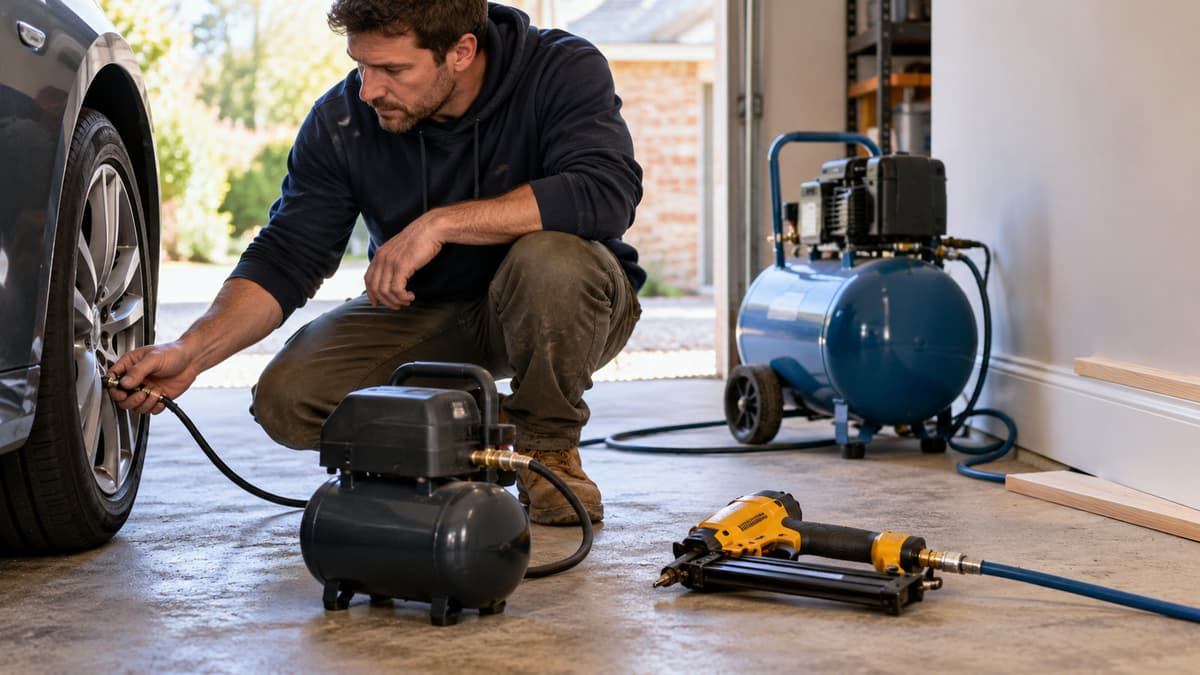
Air compressor size for a nail gun depends on the job you will do. A 6 litre tank covers a tyre and a brad burst. Framing and spraying need more free air.
On this page

The car has lost a few psi overnight, the skirting still needs pinning, and you are choosing between a 6 litre portable and a 24 or 50 litre receiver. Air compressor size for a nail gun decides which one you carry to the drive. A tyre chuck and a brad nailer spend air in short bursts. A framing nailer and a spray gun spend it for as long as the trigger is held. The CFM bands below are UK seller rules of thumb about free air at working pressure, and this guide includes no flow-bench result for a Stanley pump.
In short
Choose the air compressor size for a nail gun from the hungriest job you will actually do. A 6 litre tank covers a car-tyre top-up and a brad nailer in bursts, and the motor will restart if you keep going. Framing, from about 2.4 CFM in the seller tables, and any spraying you want as a constant supply, belong on a larger receiver whose pump can deliver that free air. Tank litres store air. They do not create it.
Tyres and a brad nailer are short jobs
UK Tool Store's size table puts a tyre top-up at about 0–2 CFM and a tank of 6–24 litres. Garden-review puts car tyres at about 1–3 CFM at 4–8 bar, with the same tank band. The ranges overlap without matching, and 6 litres is already inside both. You top a tyre up to the pressure on the sidewall, then take the chuck off.
A brad nailer sits in the same short-job group if the tank recovers between runs of pins. SGS puts a nailer at about 1 SCFM. UK Tool Store and Air Supply often start at about 1.2 CFM. Garden-review is wider, about 0.3–1.5 CFM. Those floors cannot all be your gun, so the plate on the nailer, at the pressure beside the CFM, is the number you buy against. Bostitch points the MRC6, a 6 litre compressor, at light nailing. A suitcase air compressor is that job beside the car. A dozen pins with pauses can live on 6 litres. Run the same gun hard along a whole landing and you have left the short burst that size was bought for.
Framing and spraying ask for more air
Framing is where the seller tables step up together, then part company on the tank. UK Tool Store asks for about 2.4 CFM and 24 litres or more. Garden-review puts a framing nailer at about 2.4–4 CFM. Air Supply starts framing at about 2.4 CFM. Quote about 2.4 CFM as the shared floor. About 4 CFM is the hungrier end, and your plate may sit anywhere in between.
Bostitch does not use that 24 litre floor for first fix. It points the RC10 at first-fix framing: 6 litres for light nailing, 10 litres for first fix, then 24 and 50 litres for a constant supply, spraying included. "24 litres or nothing" walks you past a 10 litre machine Bostitch sells for framing. Neither the 24 litre floor nor the RC10 was timed on your nailer.
Spraying exposes a small tank quickest. UK Tool Store puts it at 100 litres or more. SGS allows a 6 litre tank only for spray in short bursts. Bostitch puts a constant supply, spraying included, on 24 and 50 litres. If the pump's free air is below the gun, a bigger tank only lengthens the gaps between motor starts. Continuous spraying on 6 litres is the failure they share. A vertical air compressor is the usual larger store when the work is framing or spraying and the pump's free air covers the plate. For a tyre chuck alone, that receiver is weight you do not need to carry.
The tank rule of thumb
SGS prints a buyer's shortcut: minimum tank litres are about the tool's SCFM multiplied by 6. A British Standard would carry a number and a year. This shortcut carries neither. About 1 SCFM lands near 6 litres. About 2.4 SCFM lands near 14 litres, already past a 6 litre tank. At 4 SCFM, 4 times 6 is 24 litres, the UK Tool Store floor for framing. Your plate still decides the tank.
Air Supply multiplies the tool's SCFM by 1.2 so free air sits a little above the plate: about 1.4 CFM for a 1.2 CFM brad nailer, about 2.9 CFM for a 2.4 CFM framing nailer. That 1.2 is headroom on flow. SGS's times six is a guess at tank volume. A large vessel with a small pump can pass the tank sum, store one burst, and then fail to refill it while you work. If two tools run together, add their plate figures before the 1.2. Two guns at 1.2 CFM are 2.4 CFM before any uplift. If you use one tool at a time, size for the hungrier plate. Both sums assume free air at the tool's pressure, not an intake litres-per-minute figure.
What 5 litres and 6 litres will keep doing
Reviewers put a credible 5 litre or 6 litre Stanley on topping up tyres, blowing dust, and a short nailer burst. The same machines restart if you keep going. The Stanley compressor comparison is where those small receivers sit next to listings whose tank line you should read twice. Bostitch is clear that a bigger receiver changes how long the motor runs, and leaves delivery unchanged. On a tyre, the stored puff is the whole job. A framing nailer or a spray gun spends it, and the motor starts. SGS allows only short spray bursts on 6 litres.
Listing B01A5QP5MQ prints a 50 litre tank and weighs 9.1 kg. A workshop receiver you would trust for framing is a heavy vessel, and 9.1 kg fails that weight check, so leave this listing off the framing shortlist. The title does not multiply the free air.
Read the tool plate
The plate, or the manual page that repeats it, should show flow and pressure together. CFM or SCFM at 90 psi, or the metric pair the maker chose, is the demand. A bare "uses air" line can describe a different gun. Write the figure down, including the pressure, before you look at compressors. A flow quoted at a low pressure can look easier than the same gun at the pressure you set on the regulator.
Read the compressor in the same units, and only if the figure is free air delivery near that pressure. Intake litres per minute, and a displacement figure at the pump inlet, describe air that has not yet been squeezed into the tank. If the listing never says free air, treat the number as unfinished. A brad plate often lands near 1–1.5 CFM, framing near 2.4 CFM and up, and tyres inside roughly 0–3 CFM, where a tank can be 6 litres. Garden-review's 0.3 CFM floor is the outlier. Follow the plate when it sits above the band.
Choose for the longest job
Write the longest job of the next year in one sentence before you compare prices. Two tyres and a skirting run are a 6 litre job. A first-fix nailer most Saturdays will restart that tank. Spraying moves you to 24–50 litres, or 100 litres and above, and free air still has to clear the gun. Bostitch's 6, 10 and 24–50 litre split is guidance for its own range.
If the motor never reaches cut-out, or the safety valve lifts while a gun is open, stop. A larger tank is the wrong next purchase when the pump cannot deliver the plate. A reset is the wrong next step when a safety device has opened. A competent person takes the compressor from there.
Products Compared prepared this from public UK seller pages (UK Tool Store, Garden-review, Air Supply, SGS and Bostitch) and from the amazon.co.uk listing conflict on ASIN B01A5QP5MQ, checked in October 2026. There is no flow-bench result here. Confirm the tool plate and the live page before you rely on a litre claim. A qualifying purchase can earn us a commission at no extra cost to you.
Common questions
Can I inflate a car tyre with a 6 litre compressor?
Will the same machine run a brad nailer?
What changes for a framing nailer?
Why does the motor keep starting?
Is SCFM times 6 a British Standard?
Do I add CFM if I use two tools?
Is a 50 litre tank always better?
What if the listing's litres per minute are intake?

Products Compared publishes British-English buying guides based on amazon.co.uk listings and public UK sources. We do not run a lab and we do not invent test scores.
Related articles
Free air delivery compressor: read the litres first
A litres-per-minute line on the pump is not the free air a nailer plate is asking for.

Vertical or portable air compressor: space or carry
A larger vertical receiver cuts restarts. A portable still wins when you have to carry it.

Water separator for air tools: when the hose still spits
A drain on the tank is a different job from a separator at the nailer or the spray gun.