Free air delivery compressor: read the litres first
Free air delivery is the air a compressor discharges at a stated pressure. A lone litres figure is often intake, and dividing by 28.3 keeps it that way.
On this page
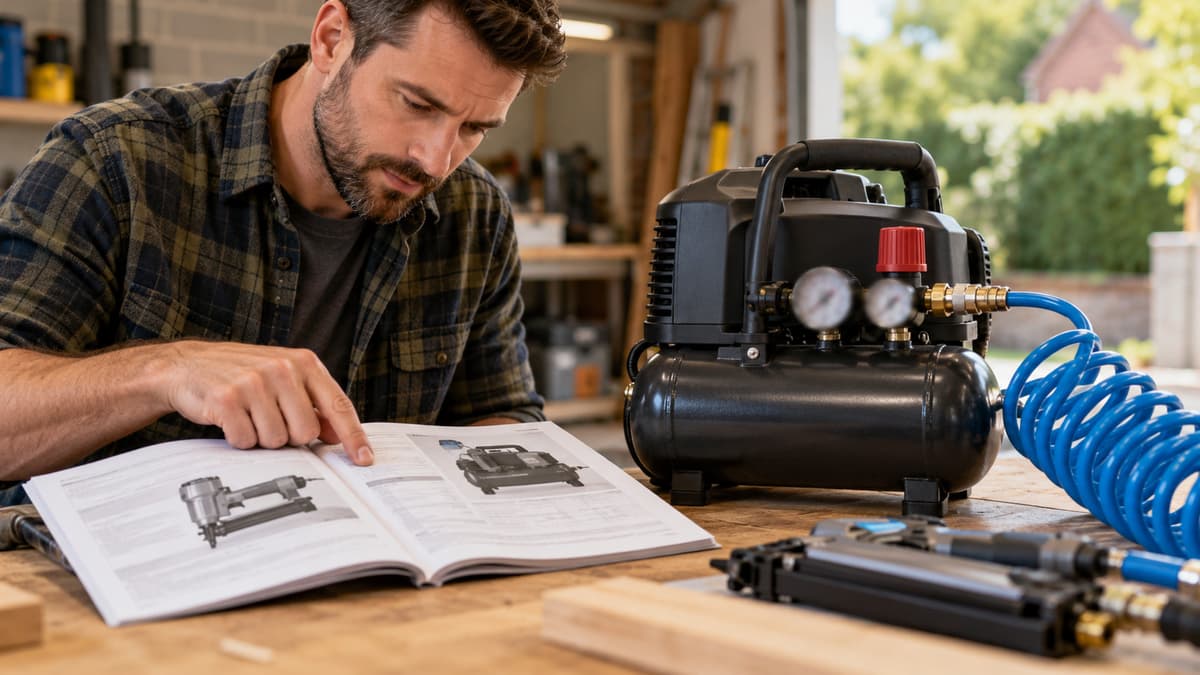
You have a nailer manual open at a line that asks for cubic feet per minute at 90 psi, and a compressor page that answers in litres. The phrase you need is free air delivery compressor: the air the pump discharges, stated as free air at a named pressure. The Stanley rows in this comparison print one litres-per-minute figure and leave that phrase off.
In short
Free air delivery is the air a compressor discharges, expressed as free air at a stated pressure. Displacement or suction is the larger theoretical or inlet figure, and Axminster, Air Supplies and SGS treat free air as often about a third less, as a rule of thumb. The Stanley litres in this set are not captioned either way, so dividing by 28.3 still leaves you holding the original number in cubic feet.
Two different litres
Displacement is the theoretical volume the pump sweeps. Air Supplies UK describes it as that pump-volume sum, before valves, heat and receiver pressure take their share. Intake or suction is the air drawn in, and it is usually the large number on the sheet. Free air delivery, often shortened to FAD, is the air that leaves, stated as the volume it would occupy as free air. Axminster tells you to shop on that delivered figure, because a tool can use only the air that got out.
SGS illustrates that shared rule of thumb as 10 CFM of displacement and about 6.6 CFM of free air. A third off ten is about 6.7, so 6.6 is their rounding. The sketch belongs on a page that has already named displacement. On a listing that printed neither word, it is only a guess.
Wickes prints the split these Stanley rows lack, on an Einhell 2 hp, 50 litre, 10 bar oil-free compressor: 240 litres per minute suction and 76 litres per minute at 7 bar. A third less than 240 would be about 160. The printed output is 76, under a third of the suction figure. The rule of thumb points the right way and misses the distance.
Why 28.3 does not create free air
Air Power UK states 1 CFM as 28.328 litres per minute, and CEJN's UK table uses 28.32. For a garage sum, 28.3 is close to both. The failure is the quantity you feed in. A converter that treats 105 litres per minute as free air has changed the unit and kept the seller's silence.
Divide that 105 by 28.3 and you get about 3.7 cubic feet per minute of the airflow already printed. Inlet air in cubic feet is still inlet air. The other Stanley rates only change unit. 85 litres per minute is about 3.0 cubic feet per minute, 150 is about 5.3, and each 180 litre line is about 6.4. None of those quotients is labelled free air.
Taking a third off after the division stacks a second guess on the first. Two thirds of 3.7 is about 2.5, and two thirds of 6.4 is about 4.2. That arithmetic is not measured free air for B081FKBF6W or B00GN89EQE. A figure you can defend is one the page or the manual prints as output at a pressure.
Why the number falls with pressure
Axminster notes that free air delivery falls as pressure rises. The pump is pushing against a fuller receiver, so each minute yields less volume once you state it as free air. A line that says CFM at 90 psi asks for delivery at about 6.2 bar. Six bar is about 87 psi, 7 bar is about 101 psi, 8 bar is about 116 psi, and 10 bar is 145 psi. A figure with no pressure beside it may be inlet air, which has not climbed the slope at all.
On the Einhell sheet, 76 litres per minute belongs to 7 bar. Divide by 28.3 and you get about 2.7 cubic feet per minute at that pressure. Seven bar is about 11 psi above 90 psi, so that 2.7 is a different claim from CFM at 90 psi. Treating the 240 litre suction line, about 8.5 cubic feet per minute, as free air at 90 psi drops both the pressure and the word suction.
SGS mentions multiplying SCFM by 1.2. Read that beside Axminster's advice to add about 20 percent to the tool's CFM. Both are headroom, and 1.2 does not turn standard cubic feet into cubic feet at 90 psi. A worked example of 4 CFM on your own tool sheet becomes about 4.8 CFM of free air with that margin on, so a compressor that truly delivers 4.0 at the tool's pressure is already short.
What the Stanley rows actually print
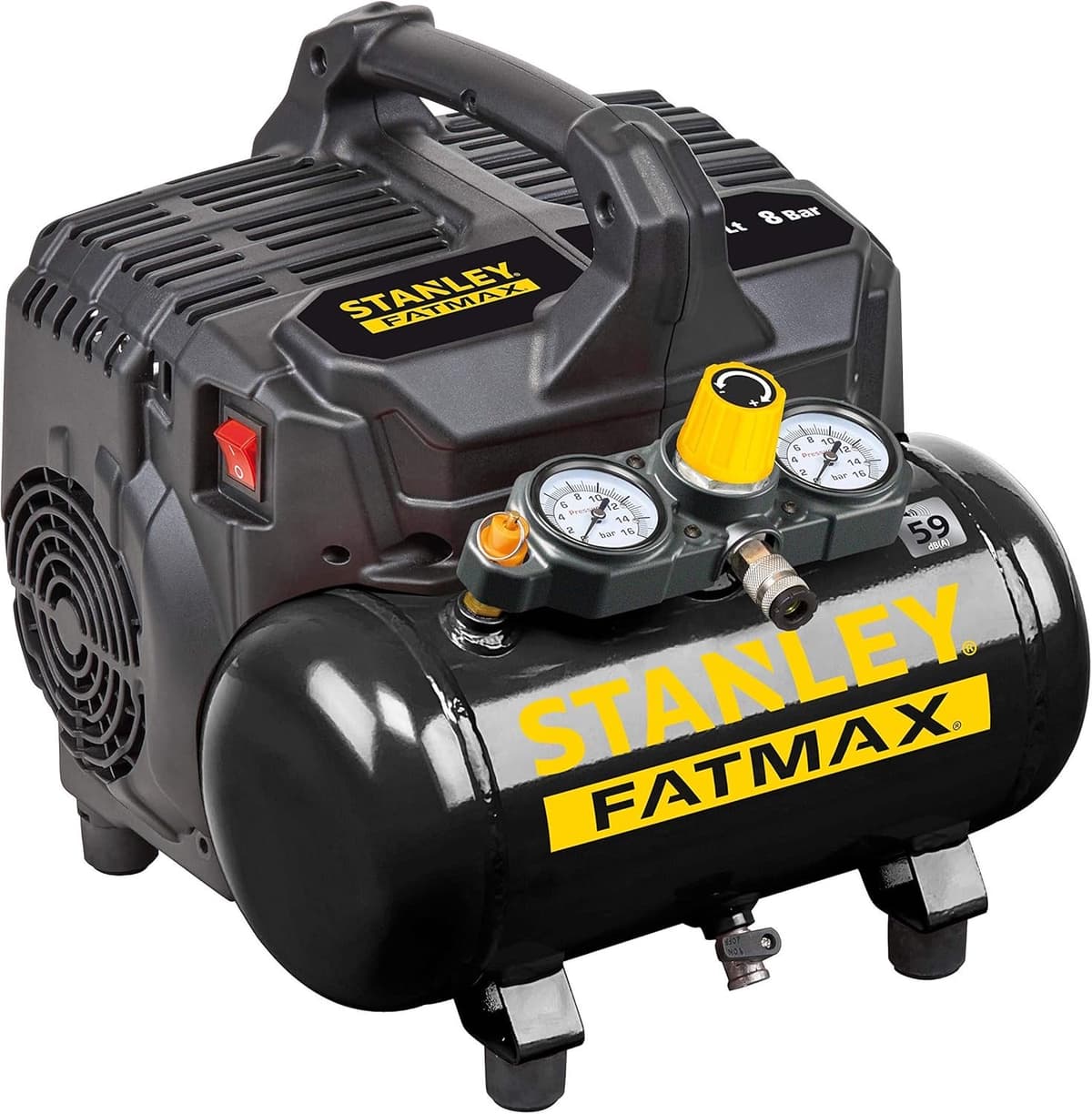
The digest records 180, 180, 85, 105 and 150 litres per minute. Wider Stanley pages run from 85 to 222. The oil model's table has no airflow figure. None of those lines says free air delivery. You can open the Stanley compressor comparison and still leave free air as n/a.
The DST 101/8/6, ASIN B081FKBF6W, prints 105 litres per minute. The 6 litre tank line on the same listing does not turn the rate into free air, and it does not raise delivery. B00GN89EQE sits under the same limit: a third off its printed airflow is not a measured free air delivery.
Use the litre figure, and treat free air as unpublished. If the manual later prints suction and output at a bar, the manual outranks the bullet. If it repeats one unlabelled litre, you are back on the listing.
A Vevor air compressor page and a Weldinger air compressor page can look cheaper, or larger in litres, and still be a different kind of litre. This article does not import their airflow figures. Every litre per minute stays unproved as free air until its own page names it.
How to read a tool requirement
Start from the tool sheet and write down the air use with its pressure. The 4 CFM at 90 psi in this article is a worked example, not a claim about a named gun. Spraying and a framing nailer keep asking after the tank's head start is gone. Tyres and a short run of brads can hide a weak pump, because the receiver covers the burst.
Where the compressor prints free air or output near the tool's pressure, convert with 28.3 and put the 20 percent on the tool. Where the litre is unlabelled, leave free air blank.
A larger receiver stores more air for a short job. It does not raise delivery, which is the point from Bostitch recorded in this research. Choosing a 6 litre portable or a 24 to 50 litre receiver is about time between restarts, covered in the size guide for a nailer or car tyres.
Tank capacity is litres, a volume sitting in the receiver. Airflow is litres per minute, a rate. Keep "per minute" on the rate when you copy a Stanley page, because a 50 litre tank is a different claim from a 50 litre-per-minute pump.
When one litres figure is not enough
Copy the airflow number with its unit, then look for free air, FAD, output, discharge, suction, intake or displacement, and for a pressure in bar or psi. Where the noun and the pressure are both there, convert if you must and compare with the tool plus about 20 percent. A higher pressure means less free air. Where the noun is missing, leave free air as n/a, skip the division, and keep tank litres out of the airflow column.
For paid work, or a finish you will look at, ask for output at a stated pressure, or pick a listing with a split like the Wickes sheet. A guessed 6.6 from a round 10, or 2.5 from 3.7, fails once the tool stays on.
Products Compared used the Stanley airflow lines in the hub digest, the Wickes Einhell example, and guides from Axminster, Air Supplies, SGS Engineering, Air Power UK and CEJN. We did not measure cubic feet per minute, and the third-less sketch is not a result for B081FKBF6W or B00GN89EQE. Check the live amazon.co.uk page and the manual, because bullets change. A qualifying purchase through our links can earn a commission at no extra cost to you.
Common questions
What is free air delivery on a compressor?
Is litres per minute the same as CFM?
Can I divide 180 by 28.3 and match a nailer?
Why does airflow drop at 6 or 7 bar?
What is the one-third-less rule of thumb?
Which Stanley airflow figure is intake?
Does a bigger tank raise CFM?
What should the compressor listing have printed?

Products Compared publishes British-English buying guides based on amazon.co.uk listings and public UK sources. We do not run a lab and we do not invent test scores.
Related articles
Air compressor size for nail gun: tyres or framing
Tyres and a brad nailer are short jobs. Spraying and a framing nailer need the pump, not a bigger tank.
Oil-free or oil compressor: which one should you buy
When a low-maintenance oil-free pump is the point, and when a lubricated receiver is the one for longer running.

Water separator for air tools: when the hose still spits
A drain on the tank and a separator at the tool do different jobs once water is already in the hose.