Water separator for air tools: when the hose still spits

A water separator for air tools catches liquid that reaches the hose. Drain the tank first. Buy a dryer only if water is still arriving after the trap.
On this page

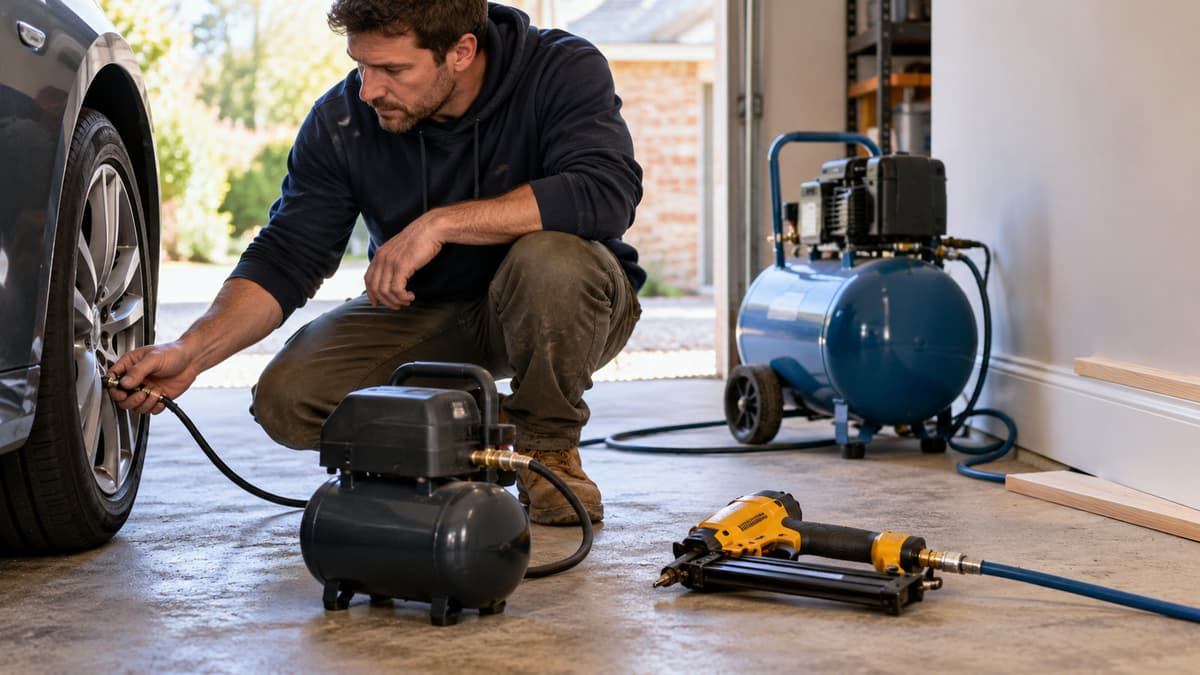
You have just run a row of brads along the skirting, opened the valve under the tank, and watched a brown dribble hit the garage floor. The next length of hose still pushes a bead of water into the nailer. The drain emptied the receiver. The tool is seeing liquid that had already left the tank, or liquid that condensed once the air cooled in the hose. A water separator for air tools is the fitting that catches that liquid where you install it. On a six-litre DIY compressor the drain is still about a minute at the end of the job, as a rule of thumb, because the receiver is the sump.
In short
A water separator for air tools takes bulk liquid out at the point where you fit it. A dryer is the machine that takes water vapour. BCAS describes the separator's usual result as ISO 8573-1 class 6 for water, a liquid cut, short of the dryness a spray finish needs. Drain the receiver every session. Add a trap when liquid reaches a nailer or a spray gun. Buy a dryer only when water is still arriving after both.
Liquid in the hose is a different problem from a wet tank
Algar Air puts the receiver in the role of a sump. Compression heats the air, the air cools inside the tank, and water drops to the bottom. The outlet sits above that pool, so a drained tank sends air onward. Skip the valve and the pool rises until the air leaving the tank carries the water with it. Air Equipment's order starts here: drain the receiver after use on a home machine, before you spend money on anything downstream.
A clear valve and a wet tool can both be true on the same afternoon. Air that leaves the tank warmer than the garage keeps cooling in the hose, especially on a concrete floor in an unheated shed. Moisture in the airline then shows up as beads or a wet magazine, after the tank valve has already run clear. The drain removed what had pooled. It cannot catch a drop that forms later along a cold line. The separator only sees liquid that reaches it. A six-litre DIY receiver still passes whatever collects if the valve stays shut. The suitcase air compressor comparison covers that carrying job. Oil-free air is not dry air. Water at the tool after a thorough drain means liquid is travelling, or forming, beyond the receiver.
What a water separator for air tools removes
Atlas Copco's description is the one to keep: a water separator takes bulk liquid, and a dryer takes vapour. The trap knocks droplets out and holds them in a bowl. Air that continues has lost that liquid and has kept the water still held as vapour. Cool the air again after the bowl and new liquid can form. A trap at the compressor can look empty while a long cold hose still wets the gun, so the bowl belongs where the air cools.
BCAS, in its filtration and drying guide, treats a water separator as a cut in liquid water at that point, often to ISO 8573-1 class 6 for water. The device protects a coalescing filter by taking the liquid first. A separator is not always required when filters sit straight after a receiver and the air does not cool any further. Class 6 means liquid has been removed there. The air can still be too wet for a finish, and the class is not a dew point you measured.
Tanair adds the limit that thread size hides. You size a trap on airflow and on pressure, not only on the BSP thread on the port. A quarter-inch port may meet a small coupling. It says nothing about whether the bowl can pass your tool's flow, or whether the body is rated for the pressure your compressor reaches at cut-out. Match those two ratings, then check the thread. The water separator comparison is where each amazon.co.uk listing prints port, pressure and drain. Empty the bowl on the same day you drain the tank, or it becomes a second receiver you forgot.
When a nailer or a spray gun is the reason
A brad nailer shows water as a spit, a rusty coupling, or a pin that sits proud because the driver met a wet magazine. Ask whether you need a water separator for a nailer only after the tank is drained and the hose still misbehaves. A short whip in a warm garage, with a filter already on the receiver and no further cooling, can stay on the drain alone. That is the BCAS case. A coil of hose on a cold floor is extra cooling, and that is when an inline water trap earns the fitting. For tyres alone, spend the effort on the tank valve.
Compressor water in a spray gun shows up as fisheyes or a blotch you then sand. A class 6 trap can take the slugs of liquid. Vapour goes through, and a cold hose can drop it out again before the needle. If the gun still receives water after a drained tank and an emptied trap, the next machine is a dryer. Sit the trap near the tool when the hose is the cold stretch, and closer to the receiver when the air cools as soon as it leaves the tank. If the listing does not say whether the thread is G, R or NPT, stop before you force a coupling.
What the trap will not fix
A water separator catches liquid water. Oil carried as a fine mist is a coalescing filter's job, and BCAS puts the separator ahead of that filter so the filter is not flooded. Oily spots in a finish can remain with the trap fitted. Air Equipment notes that condensate can be oily, which a lubricated pump can shed into the sump. Catching that mix in a bowl leaves the disposal question where it already sits. An oil-free machine still fills the tank with water, because the water comes from the air you compressed. The Stanley compressor comparison sets out oil-free receivers as compressors. The water in them is the same drain you owe any other small tank.
A dry hose and a nailer that still sinks pins short is a tool fault, a tip fault, or a pressure fault. Drain the tank, empty the trap, and run the tool into a dry rag. Liquid on the rag means the airline is still wet. A dry rag means you stop buying air treatment and look at the tool. Two bowls in series still pass vapour. The dryer is the next buy once the drain and the trap are both in use and water is still at the tool.
Drain the tank, then the trap, then a dryer
Air Equipment's sequence is to open the tank valve after use, including on a six-litre DIY unit, until the air comes out without a dribble, then close it. A valve that weeps, or a plug you cannot turn, is a repair on the compressor. A separator will not empty a tank that cannot drain. Fit a trap only when the tool still receives liquid. Hang it vertical, follow the marked flow, and choose it by airflow and pressure. Beside the machine, a manual drain shows you the volume. If the pump runs while you are elsewhere, an automatic drain empties without you.
Buy a dryer when water remains after both. It takes vapour, the fraction a bowl leaves behind. Refrigerant and desiccant dryers are a different purchase from the inline trap. A "dry air" title on a bowl is still the liquid cut. Tank only: keep draining. Tool after a real drain: a separator. Tool after both: a dryer, or a shorter, warmer hose if cooling is the whole cause.
Products Compared prepared this from Atlas Copco, Tanair, the BCAS filtration and drying guide, Air Equipment, and Algar Air, plus the amazon.co.uk listings in the water separator comparison. We did not install a trap on a test rig, and we did not measure a dew point. Prices move, so read the live page before you buy. Confirm the manual before you open a tank valve. A qualifying purchase can earn us a commission at no extra cost to you.
Common questions
I drained the tank and the nailer still spits water. What next?
Is a water separator a dryer?
Do I need a water separator if I only inflate tyres?
Where does a water separator go in the hose?
Should the drain on the trap be manual or automatic?
Will a water separator remove oil from the air?
What does ISO class 6 mean in plain English?
Which comparison lists water separators?

Products Compared publishes British-English buying guides based on amazon.co.uk listings and public UK sources. We do not run a lab and we do not invent test scores.
Related articles

Why an oil-free compressor still makes water
Oil-free air is still wet air. Condensate forms in the tank, and you still drain it after use.

How often to drain a home compressor
A small home tank wants a drain after use. Here is what that interval means in a garage.
What size compressor for a nailer or car tyres
Tyres and a brad nailer are short jobs. Spraying and a framing nailer ask more of the tank.