Oil-free compressor condensate: drain the wet tank

Water still pools in an oil-free compressor tank. The pump has no oil sump, room air stays humid, and a 6 litre receiver still needs a drain after use.
On this page
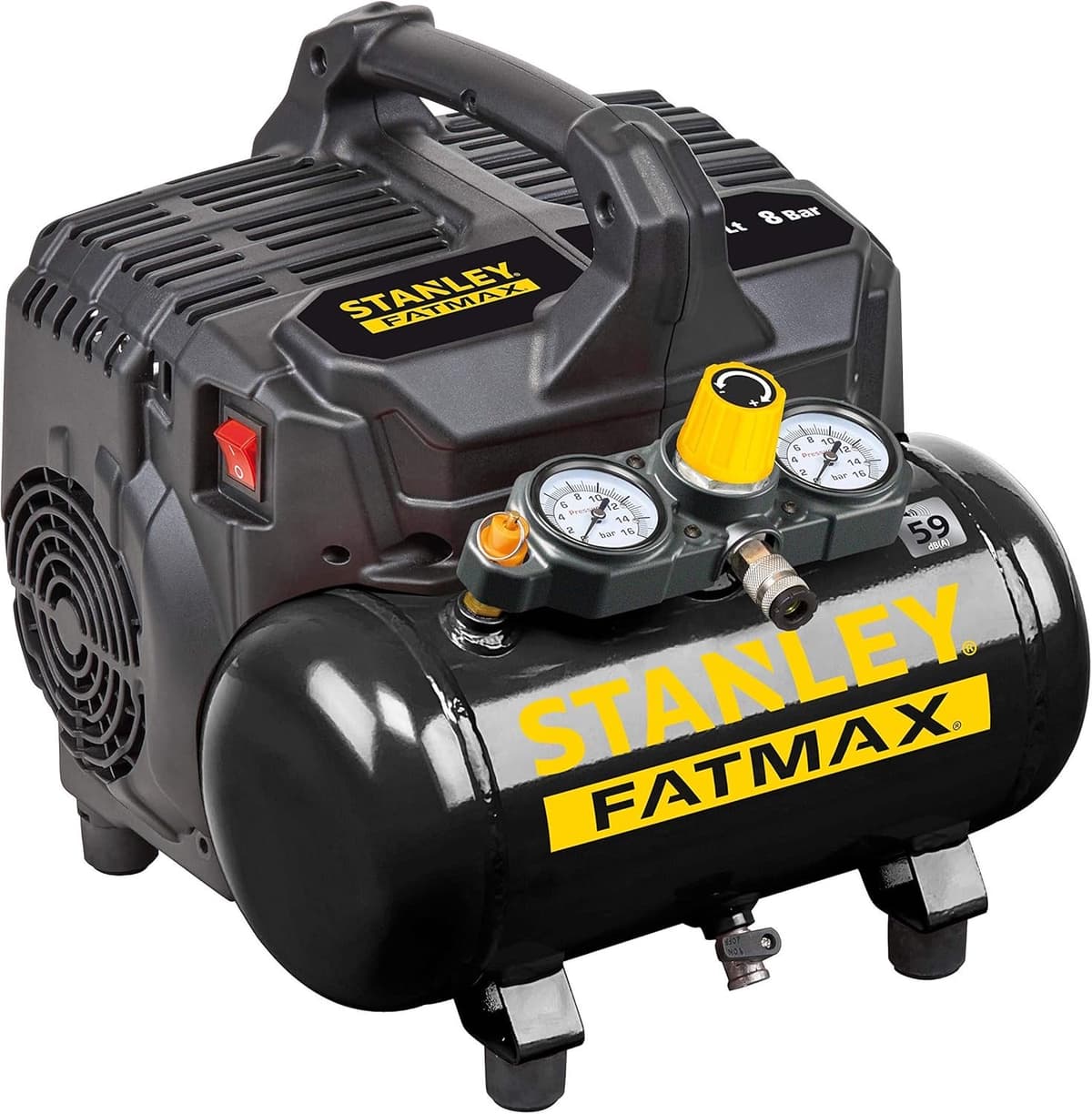
You finish the car tyres, crack the valve under a quiet six-litre compressor, and a spoonful of water hits the garage floor. Oil-free compressor condensate is that water. The pump squeezed humid room air, the metal tank cooled it, and liquid collected at the bottom.
The British Compressed Air Society puts typical ambient oil vapour at 0.05 to 0.5 mg per cubic metre, and says that load concentrates at 7 bar gauge. That figure is an industrial illustration of intake air, not a measurement of a Stanley tank. Its dictionary calls condensate the water that drops out when air cools or pressure rises, often with oil and solids mixed in. HSE guidance HSG39 treats even a very small receiver as the aftercooler and tells you to fit a drain. The document is older priced guidance, and the drain point still holds.
This page uses those UK sources, the Stanley DN200/10/5 manual, and the B&Q listing for the silent DST 101/8/6. We ran no laboratory dryness test. A qualifying purchase from the amazon.co.uk links can earn us a commission at no extra cost to you.
In short
Oil-free compressor condensate is water from the air you compressed, collected in the tank as it cools. An oil-free pump has no sump to top up, and the air is still moist, so you drain the receiver. A water separator on the hose is a second device, placed for the tool, and the tank valve is still yours to open.
Oil-free is the pump, not the air
Oil-free describes how the pump is lubricated. On a small DIY machine there is no sight glass and no oil to change between jobs. The air that enters is the air already in the garage, the shed, or the spare room. That air holds water vapour, and compressing it packs the vapour into a smaller space.
The British Compressed Air Society draws the oil line in the same place. An oil-free compressor reduces oil from the compressor itself. Oil vapour that was already in the intake stays in the flow. A seller line that equates "no oil" with "no contamination" overclaims. The teaspoon from a home tank was not assayed in that note, and the air is not clinically clean because the pump has no sump.
On a Stanley compressor listing, oil-free means you are not buying a lubricated pump with an oil service. The receiver can still collect water. A tyre inflator tolerates a wetter hose than a spray gun, and our sources name no spray purity class for these small tanks, so this page will not invent one. Empty the tank for the puddle you already made.
Why the tank sweats
The water was vapour in the intake, and it became liquid when the tank changed the conditions. Air Equipment's thermodynamics note puts the puddle in the receiver. Air leaves the pump hot, the tank cools it back towards room temperature, and liquid water collects. Hotter air holds more vapour. Once that air sits in a metal shell and loses heat, the vapour condenses.
Pressure works the same way. A six-litre shell after a short run can still show a wet valve, because condensate is what those pages call the liquid that drops out as air cools or pressure rises.
The shell is doing that cooling work, so use the drain the receiver already has. HSG39 is the drain principle here, not a current parts list.
Leave the water in place and the next session can push it down the hose. A nailer can spit, and a spray gun can carry liquid into the finish. A tyre inflator will usually finish, and the tank still sits wet until you empty it. B&Q sells the DST 101/8/6 as an oil-free silent six-litre machine, and the tank is metal. Quiet running does not remove the drain.
What a 6 litre owner should do
The home action is the drain. The Stanley DN200/10/5 manual tells you to drain each day, and it warns that residual oil can be in that condensate on that oil-free model. The pump type does not turn the puddle into pure water. If your booklet names a different interval, follow the booklet for your model. The daily line is the DN200/10/5 instruction in our sources. No UK statute here sets one interval for every compressor.
Drain on the day you run it, once the tank is cool enough to handle, into a tray or a thick rag. Waiting until the valve weeps on its own leaves that water in the steel. Do the drain in this order, and take the valve movement from your manual if it differs.
- Switch the compressor off and let the receiver cool before you open the valve.
- Put a tray or a rag under the drain, because the manual allows for residual oil in the first spit.
- Open the drain until the flow stops, then close it fully, so the next start can build pressure.
A valve left a quarter-turn open lets the tank hiss, the motor runs long, and the pump takes the blame. Skipping the drain because there is no dipstick is the other miss. The DN200/10/5 is on our Stanley compressor comparison because that manual names the daily drain and the residual oil. We did not measure an Airboss drain in a lab. The listing is on amazon.co.uk. If you are choosing a carry handle against a larger receiver, see suitcase air compressors. The drain stays either way.
The separator does not empty the tank
A water separator sits in the hose, usually near the tool, and knocks liquid out of air that has already left the receiver. The tank drain empties the receiver itself. Fit a separator when you spray, or when a nailer keeps spitting, and still open the tank valve on the day you run the compressor. A full bowl overflows towards the gun. A valve you never open stores the next puddle in the shell. The water separator comparison is the buying page for the inline part.
What the industrial litre counts are not
Industrial explainers often quote about 85 litres of condensate from a 100 kW compressor. That figure belongs to that class of machine. It is not a forecast for a six-litre oil-free tank, and our sources give no measured daily volume for the DST 101/8/6 or the DN200/10/5. Dividing 85 litres by the gap in motor size invents a number. Expect a household teaspoon, not an industrial waste route and not a weighed Sunday sample.
The 0.05 to 0.5 mg per cubic metre figure, concentrated at 7 bar gauge, describes intake air on a system. It does not report the milligrams in a six-litre drain. A silent six-litre machine needs the manual's drain, a tray, and the residual-oil warning.
When disposal rules enter
The DN200/10/5 manual's residual-oil warning is the household limit. Liquid from the valve can look clear and still carry oil, on an oil-free model, because that manual says so. Keep a spoonful off the flowerbed. A rag that one cloth can hold matches the teaspoon scale these sources use for a six-litre drain. This page does not send you to book a hazardous-waste carrier for that teaspoon.
British Compressed Air Society material is written for compressed-air systems, where condensate is usually oily and the volumes are larger. Trade-effluent consent and off-site waste belong with that discharge. A Sunday garage compressor for tyres and a nailer is a different quantity. A receiver that runs all day and gives a steady oily flow belongs on the site's waste route. Empty a separator bowl into the same rag, and still follow the oil warning in the compressor manual.
Products Compared is the editorial name on this page, updated in October 2026. Sources are the British Compressed Air Society on ISO 8573 and its dictionary, Air Equipment on receiver cooling, HSE HSG39, the DN200/10/5 manual, and the B&Q page for the DST 101/8/6. When your manual and this page disagree on the valve, follow the manual.
Common questions
If it is oil-free, why is the tank wet?
Where does the water come from?
Is the water clean enough to tip anywhere?
Will water spoil a nailer or a spray gun?
Does a quiet Stanley still need draining?
Is a water separator the same as a drain?
What do the industrial litres-per-shift figures mean at home?
When is oily condensate a workplace disposal problem?

Products Compared publishes British-English buying guides based on amazon.co.uk listings and public UK sources. We do not run a lab and we do not invent test scores.
Related articles

How often to drain a home compressor
Daily or after use for a small tank, and what service means when the pump is oil-free.

When air tools need a water separator
A tank drain and a separator at the tool do different jobs when you spray or nail.

Oil-free or oil-lubricated compressor
When a low-maintenance oil-free pump is the point, and when a lubricated pump suits longer running.