Air compressor will not stop: before the valve lifts
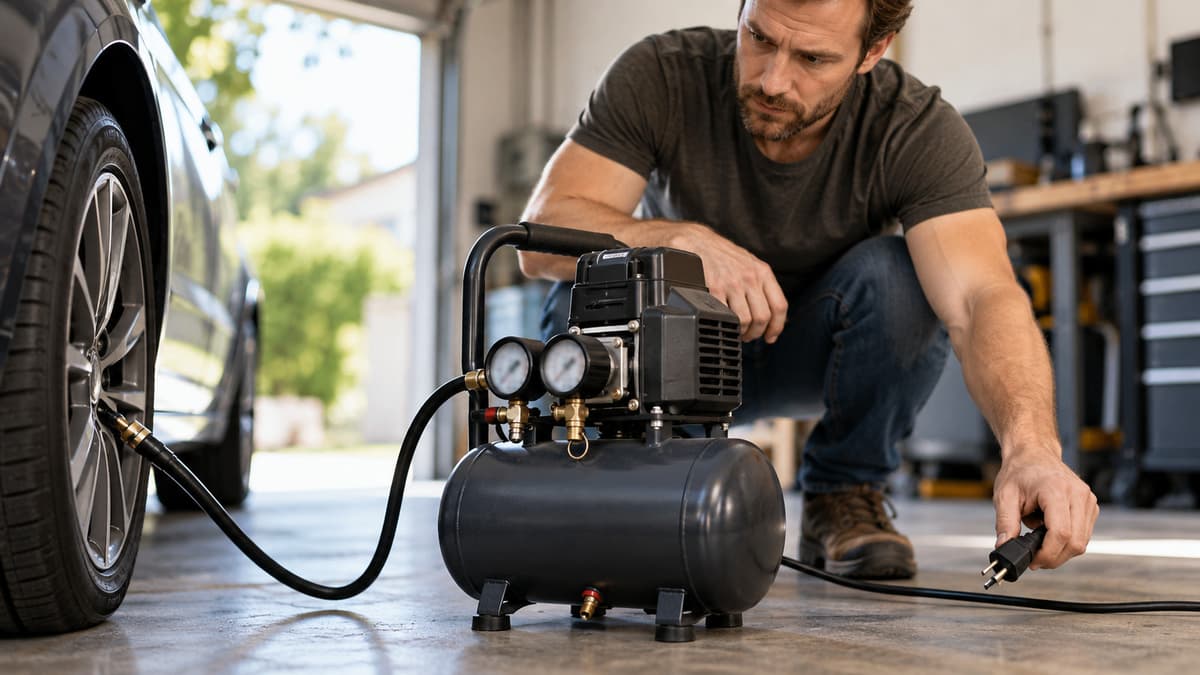
If your air compressor will not stop, or the safety valve lifts, switch off and unplug. A small tank restarting is normal. Pressure past cut-out is not.
On this page
You have finished the tyres, the gauge is already at the top of its scale, and the motor is still humming. Or a sharp hiss has started at the valve on the tank while the pump has not cut out. An air compressor will not stop is the case you sort before you touch a screw. A 5 litre or 6 litre tank that starts again after you use air is ordinary. A motor that keeps running once the tank is up, or a safety valve that lifts, is where you switch off and unplug.
In short
A small home tank restarts because you used air, and the motor should still cut out when pressure is back. If the motor will not cut out once the tank is up, or the safety valve lifts, switch off, unplug, and leave the valve and the pressure switch alone. A drain you left open can explain a tank that never fills. It does not explain a valve that has already opened.
A small tank restart is a normal cycle
On a 5 litre or 6 litre home compressor the motor will start again during a short job. You let a little air out for a tyre, a brad nailer, or a blow gun, the pressure falls, and the switch closes. The motor reaches the set pressure, switches off, and waits. Frequent starts with real pauses between them are what a tiny receiver does.
The failure has a different shape. The gauge is already at the pressure the machine is built to stop at, and the pump keeps going until the safety valve opens or you pull the plug. That run has missed its pressure switch cut-out. A restart after you use air is not the same fault.
Makers set the on and off points for each model, so this page does not give one cut-in figure. A forum number can sit above the valve setting on your plate. Air used, pressure down, motor on, pressure up, motor off: that is the cycle. Motor on, pressure stuck at the top, valve starting to hiss: that is the stop.
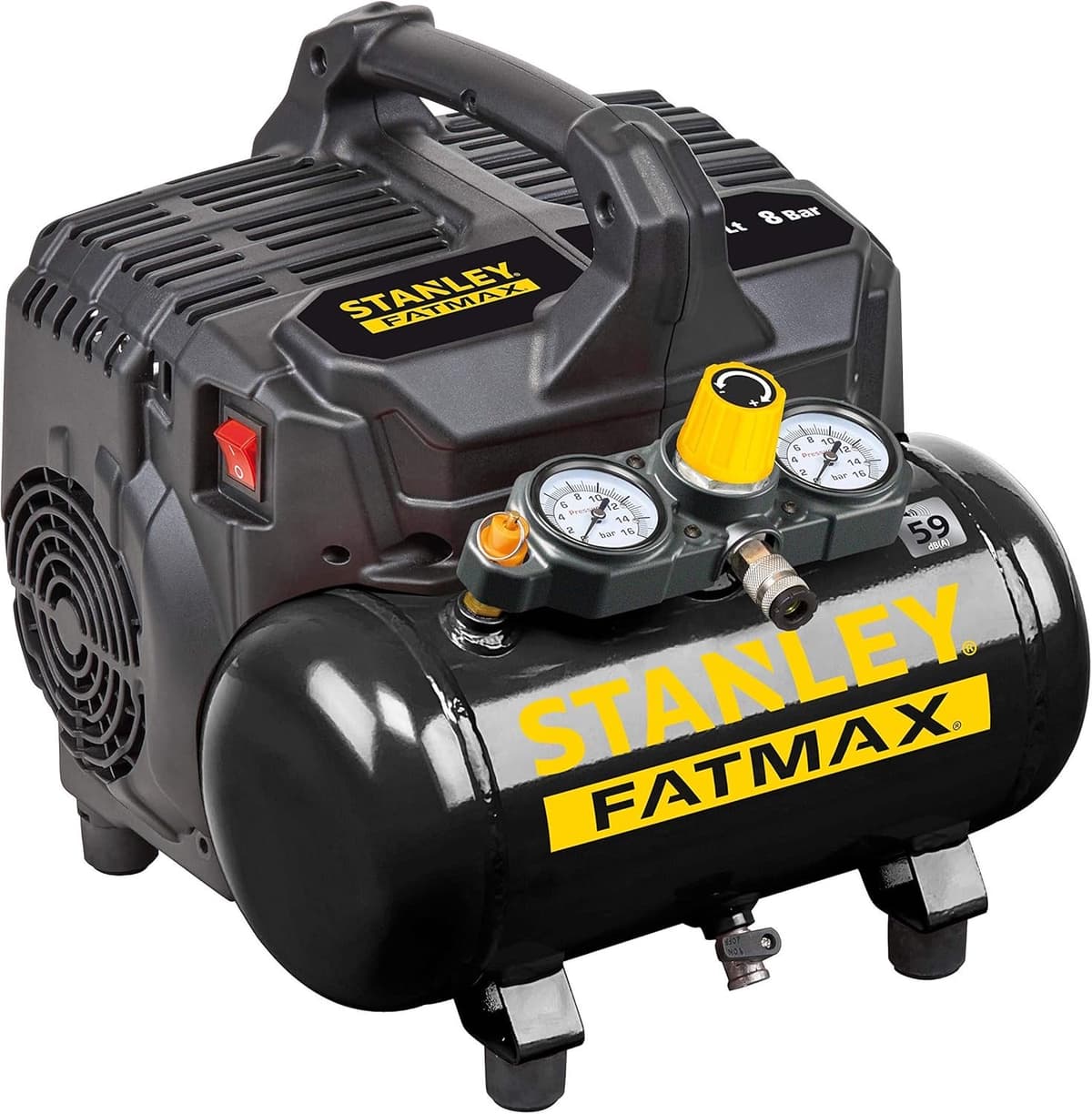
The Stanley compressor comparison is for when you choose a small receiver later. Ten minutes at the top of the gauge is already too long.
When an air compressor will not stop
Separate two failures before you touch anything. In the first, the pump runs and the tank never really fills. In the second, pressure climbs through the normal stop and the safety valve lifts. Mixing them up is how people block a relief valve to force the gauge up.
DeWalt's support note describes the second failure. If the compressor continues to run and build pressure past its advertised cut-off until the safety valve engages, the pressure switch is replaced at a service centre. They tell you not to adjust the safety valve. The valve is the last opening on the vessel.
SIP's UK troubleshooting draws a line around the valve. If it operates below the rated pressure, SIP points at the valve. If it operates above the rated pressure, SIP points at the pressure switch. Tell a repairer which side of the plate the gauge was on, then switch off. Do not keep the motor running to hear the hiss again.
On the DN200/10/5, the manual sets the safety valve at 10 bar, which is 145 psi, and says that valve must not be adjusted or removed. Ten bar is that model's figure. Another plate does not inherit it. Read the plate on your tank with the plug out, after the run has stopped.
On a workplace system, BCAS BPG 108 confirms the safety-valve setting with the competent person on the written scheme, not a bench tweak. The moment the valve lifts, remove the power.
The checks that are still safe
Three looks are enough, and they take about a minute. Switch the compressor off at its own switch, then take the plug out of the wall. If the lead is trapped, pull the plug you can reach. Do not climb over a pressurised receiver to do it.
With the power gone, look at the drain. A drain valve left open lets air out as fast as a small pump can make it, so the gauge barely moves and cut-out never comes. Close the cock only when the machine is unplugged and the tank is not holding pressure. If air is still rushing out, let it finish before you shut it.
Then disconnect any hose left coupled to a tool. A blow gun, a nailer, or a coupling that does not seal will empty a 6 litre tank quickly. Listen at the hose with the pump silent.
If the safety valve has already lifted, do not start again. Do not cap the outlet, tape the drain, or hold the relief shut. One later start is fair only after the drain is shut, the hose is off, and the valve is exactly as the maker fitted it. If that try fails to build pressure, or the valve lifts again, you are finished.
PTFE tape belongs on a depressurised thread where the maker allows a sealant. It does not belong on a safety valve that has opened, or on a pressure switch that will not open. Plugging the valve hides the only automatic relief the tank has.
What you leave alone
Leave the pressure-switch screw where the maker set it. DeWalt's position is that cut-out is not a user setting, and that the switch is replaced at a service centre when the compressor runs past the advertised cut-off until the valve opens. Air Supply UK treats a switch that will not shut off at cut-out as a repair, even where an adjustment article exists. A quarter-turn that raises cut-out can move the stop closer to the relief setting, or past it.
The ring on the safety valve is the other tempting part. Adding washers or fitting a blank means it has stopped being a relief valve. The DN200/10/5 manual forbids adjusting or removing its valve, set at 10 bar (145 psi) on that model. DeWalt tells you not to adjust a safety valve either. Read your manual with the plug out where a forum method disagrees.
A short hiss after the motor stops can be the unloader. That sound arrives after the stop. A safety valve hiss arrives while the motor is still pushing the gauge up. You do not need to strip a check valve to hear the difference. Blanking an unloader can leave the motor starting against a charged line.
Oil from a sump means you unplug and hand the machine over. An oil-free compressor may have nothing to top up, and a lubricated pump has a level the maker specifies. This guide does not tell you how to rebuild a pump.
Who takes over
Call a professional when the safety valve has lifted, when the motor will not stop once the tank is up, or when oil is coming from the sump. Stanley tells owners to call a professional. DeWalt names a service centre when the switch has failed. For a home unit, use the seller, the maker's service route, or a repairer who replaces the switch or the valve.
On a workplace system, HSE guidance allows a competent person to require the system stopped, and BCAS BPG 108 puts the safety-valve setting with that person. A householder inflating tyres may have no written scheme, and this page does not create one. A 6 litre unit still stops on valve lift or a failure to cut out.
The vertical air compressor comparison covers stationary receivers, and the 50 litre vertical compressors are the larger workshop size. A longer first fill can be normal. If the switch never opens, unplug at the first lift of the valve. A US workplace drain rule is the wrong law for a UK home tank.
Products Compared used DeWalt's support notes, SIP UK's troubleshooting split, the DN200/10/5 manual, Stanley's call-a-professional line, BCAS BPG 108, and the HSE pressure-systems pages. We did not run a compressor until a valve lifted. Manuals change, so read the plate on your model. A qualifying purchase through our links can earn a commission at no extra cost to you.
Common questions
It keeps running. Is that normal on a small tank?
The safety valve has opened. Can I reset it and carry on?
What if the drain was left open?
What if it never builds pressure?
Can I turn the pressure-switch screw?
Is a short hiss after stop a fault?
Who do I call?
Does this apply to a 6 litre home unit?

Products Compared publishes British-English buying guides based on amazon.co.uk listings and public UK sources. We do not run a lab and we do not invent test scores.
Related articles

How often to drain a home compressor
A drain left open keeps the motor running with an empty tank. This is the home interval once the machine is off.
When a workshop compressor needs a written scheme
A workplace receiver can sit under a written scheme. The competent person on it can require the system stopped.

Why an oil-free compressor still makes water
Oil-free air still makes water in the tank. Condensate is a drain job, separate from a safety valve that has lifted.