Hygrometer, damp and mould
The hygrometer says 68%, the window is wet, and you want to know whether that number means mould. It means the air at the sensor was holding a lot of water vapour. It does not mean the wall has been tested, and there is no single UK legal indoor humidity band. The Centre for Sustainable Energy and East Herts Council publish different lines, and both are guidance. The Products Compared editorial team checked the twelve amazon.co.uk listings dated 15 October 2026. There was no laboratory test. If you buy through our Amazon links, we may earn a commission at no extra cost to you. The meters are on the [hygrometer comparison](/hub/climate-measuring/hygrometer).
The hygrometer says 68%, the window is wet, and you want to know whether that number means mould. It means the air at the sensor was holding a lot of water vapour.
The hygrometer says 68%, the window is wet, and you want to know whether that number means mould. It means the air at the sensor was holding a lot of water vapour. It does not mean the wall has been tested, and there is no single UK legal indoor humidity band. The Centre for Sustainable Energy and East Herts Council publish different lines, and both are guidance. The Products Compared editorial team checked the twelve amazon.co.uk listings dated 15 October 2026. There was no laboratory test. If you buy through our Amazon links, we may earn a commission at no extra cost to you. The meters are on the hygrometer comparison.
Our top picks
| Badge | Product | What it displays | RH tolerance | What it cannot do | Note | Price | Offer |
|---|---|---|---|---|---|---|---|
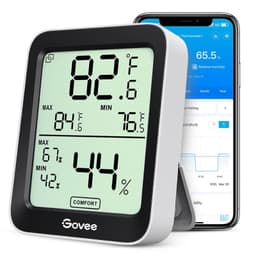
| Best overall |  Govee Govee H5075 | Live RH plus a nearby graph | ±3% RH, span not stated | Prove the plaster is saturated | 8.5 | about £9.98 | View offer |
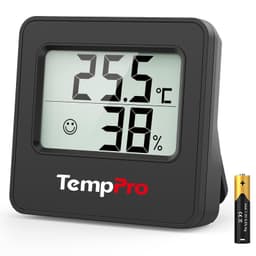
 TempPro TempPro TP157 | The moment on a small screen | ±2% to 3% RH; span not stated | Dry a wall or prove the plaster | 8.6 | about £5.29 | View offer | |
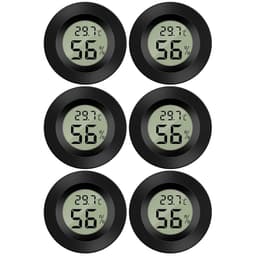
| Alternative |  Thlevel Thlevel TBM-40 (6-pack) | 20% to 90% RH and temperature | ±5% RH at 25 °C | Dry a wall or meet Approved Document F | 8.0 | about £14.99 | View offer |
On this page
The bands UK bodies actually publish
The meter reads the air, not the plaster
A reading is not the repair
What a log can and cannot do in a rented home
Common questions
What indoor humidity should a UK home aim for?
Does 60% RH mean mould, or is it 70%?
Can a hygrometer prove the wall is wet?
Does owning a hygrometer meet ventilation rules?
What is the difference between a hygrometer and a dehumidifier?
When should I tell the landlord, and can a log blame a tenant?
Related pages
Sources
Public UK sources used for this comparison. Listing prices, stars, and review counts are the amazon.co.uk lines from 15 October 2026.
- Centre for Sustainable Energy — condensation, damp and mould (retrieved 15 October 2026)
- East Herts Council — damp and mould (retrieved 15 October 2026)
- GOV.UK — health risks of damp and mould (retrieved 15 October 2026)
- Met Office — humidity (retrieved 15 October 2026)
- Property Care Association — control of dampness in buildings, January 2023 (retrieved 15 October 2026)
- Approved Document F, volume 1, dwellings (retrieved 15 October 2026)
- Consumer Rights Act 2015, section 9 (retrieved 15 October 2026)
- Yorkshire Housing — temperature and humidity sensor FAQs (retrieved 15 October 2026)