Independent comparisons. We may earn from shop links. More info

Hygrometer buying guide

Updated: October 2026

You are on amazon.co.uk with a dozen small screens that all show a percentage. A hygrometer buying guide for this set is a refusal list. Keep a listing when it prints both a humidity span and a tolerance you can live with, and leave a listing that hides the tolerance or prints two limits that cannot both be the range. The Products Compared editorial team checked the twelve listings dated 15 October 2026. There was no laboratory test. If you buy through our Amazon links, we may earn a commission at no extra cost to you. The rows are on the [hygrometer comparison](/hub/climate-measuring/hygrometer).

You are on amazon.co.uk with a dozen small screens that all show a percentage. A hygrometer buying guide for this set is a refusal list.

Our top picks

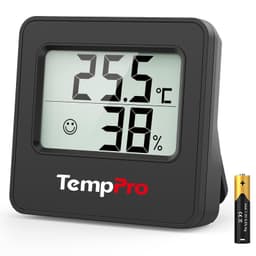
TempPro TempPro TP49 (3-pack)

Best overall

TempPro TempPro TP49 (3-pack)
7.9/10about £12.61
TempPro TempPro TP157

Rank 2

TempPro TempPro TP157
8.6/10about £5.29
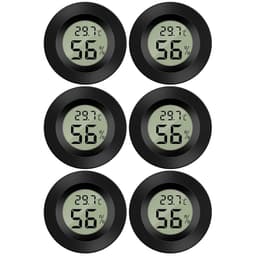
Thlevel Thlevel TBM-40 (6-pack)

Alternative

Thlevel Thlevel TBM-40 (6-pack)
8.0/10about £14.99
On this page

What a hygrometer listing has to tell you

Start with the job, then the span, then the tolerance, then temperature, then the cell. A span with no tolerance tells you the scale. A tolerance with no span tells you a window and not where it applies. The Boulton and the CNMTCCO four-pack state ±5% and omit the span. The TP157 states ±2% to 3% RH and no span. The H5075 states ±3% RH and no span. At room temperature, the National Physical Laboratory notes that a 1 °C temperature error can change relative humidity by more than 6% of the value. None of these twelve uses a BS 1363 plug. Where you put the meter, once you own one, is the how to use a hygrometer page.

What ±5 % RH actually allows

Do not turn the Laboratory’s ideal band into a claim that the TP157 or the H5075 has been shown to meet it. A blank is not a hidden ±2%. The Centre for Sustainable Energy’s “from about £8” is a price remark, not a promise of ±1 % RH. Shelf prices here run from £4.79 to £160.99. Pay the pack price on the listing. Who each meter is for is the best hygrometer page.
TempPro TempPro TP49 (3-pack)

Testsieger

TempPro TempPro TP49 (3-pack)
7.9/10about £12.61

Refuse a listing that fights itself

The KUYTUE keyring is £49.99, with no reviews, no span, and no tolerance. Power is printed as solar and a button cell, as 1 AAA, and as rechargeable. That is a refusal. The iHMeiju attribute says rechargeable and the bullets say a 1.5 V button cell. The DANOPLUS title says psychrometer and the bullets do not name wet-bulb or dew point. The Tzone prints dew point and wet-bulb, and no numeric tolerance. UK blogs that attach ±3% RH to a TP49 are using a figure these listings do not print.

Cells, packs, and what you are not buying

Power here is AAA, a CR2032, an LR44, a 1.5 V button cell, or three AA on the logger. The single TP49 includes 1 AAA while the attribute says 2 AAA are required. The Thlevel bullets name an LR44 that is not on the included-components line. The H5075 includes a battery and does not name the chemistry. An LR44 or another button cell is a swallowing hazard if a child can reach a loose one. A dehumidifier removes water, and these meters only display a percentage, which is the damp and mould page.

Common questions

What should I check on a hygrometer listing before I buy?
Check the job, the humidity span, the tolerance, the temperature limits, and the cell. A complete cheap line in this set is the Thlevel’s 20% to 90% RH and ±5% RH at 25 °C. A span without a tolerance, or the reverse, is incomplete. If two temperature limits are printed and they differ, keep both. Do not pick the wider one because it looks more capable.
Is ±5 % RH accurate enough for a UK home?
It is a 10-point window. A screen at 55% can still sit inside a stated ±5% from 50% to 60%, which is the point Meaco’s Chris Michael makes about cheap thermohygrometers in an Ideal Home interview. The National Physical Laboratory’s ideal band is about ±2 %rh to ±3 %rh, and its difficult band is about ±5 %rh to ±10 %rh, at 95% confidence. A printed ±5% tells you the window is wide. It does not prove the meter meets the tighter band.
Why do two meters in the same room disagree?
Two meters that each claim ±5% RH can sit 10 points apart and both match their listings. A temperature error of about 1 °C can move relative humidity by more than 6% of the value. Pack mates in the TP49 reviews differ by about 0.5 °C to 1 °C. Expect a gap. That is not a calibration this comparison performed.
What if the bullets and the attributes disagree on temperature?
Treat the row as unresolved. The TP50 bullets say −50 °C to 70 °C and the upper attribute says 40 °C, with both 0.5 °C and ±0.1 °C also printed. You cannot know which line the seller will stand behind. Refuse the row if the top of the scale matters. Do not average the two limits into a third number nobody printed.
Does a hygrometer need a mains plug?
No listing here uses a BS 1363 plug. Power is a cell: AAA, CR2032, LR44, another button cell, or three AA on the Tzone. A dehumidifier, which removes water and does use mains power, is a different purchase. These screens only measure.
Which batteries are a swallowing hazard, and should I refuse a blank tolerance?
The Thlevel names an LR44 and the iHMeiju bullets name a 1.5 V button cell. A loose one is a swallowing hazard if a child can reach it. Refuse a blank humidity tolerance when you need a number you can explain: the TP49 leaves it empty, and a blank is not a hidden ±3%. The KUYTUE, at £49.99 with no reviews, leaves the span blank as well.

Related pages

Sources

Public UK sources used for this comparison. Listing prices, stars, and review counts are the amazon.co.uk lines from 15 October 2026.

  1. Centre for Sustainable Energy — condensation, damp and mould (retrieved 15 October 2026)
  2. East Herts Council — damp and mould (retrieved 15 October 2026)
  3. GOV.UK — health risks of damp and mould (retrieved 15 October 2026)
  4. Met Office — humidity (retrieved 15 October 2026)
  5. Property Care Association — control of dampness in buildings, January 2023 (retrieved 15 October 2026)
  6. Approved Document F, volume 1, dwellings (retrieved 15 October 2026)
  7. Consumer Rights Act 2015, section 9 (retrieved 15 October 2026)
  8. Yorkshire Housing — temperature and humidity sensor FAQs (retrieved 15 October 2026)