Independent comparisons. We may earn from shop links. More info

Basement water leak alarm

Updated: 20.10.2026

A beep in a cellar is optional noise if you are two floors up with the hatch shut. A basement water leak alarm has to survive that distance, and an empty house. Peter F. used amazon.co.uk review comments and public UK sources, including Aviva’s July 2026 claims note and the Association of British Insurers, and did not measure decibels in a loft. A qualifying purchase can earn us a commission at no extra cost to you. Assume you will not hear a local siren unless you have stood upstairs and proved it. Kitchen order stays on the [placement guide](/hub/burglar-protection/water-leak-alarm/sub/water-leak-alarm-how-to-place). The listings are on the [water leak alarm comparison](/hub/burglar-protection/water-leak-alarm).

A beep in a cellar is optional noise if you are two floors up with the hatch shut. A basement water leak alarm has to survive that distance, and an empty house. Peter F.

Our top picks

On this page

A siren on the wrong floor is optional noise

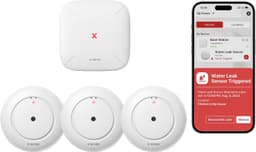
Listing loudness is not a hearing test through a floor. SEBSON prints 85 dB, and one reviewer lost that tone through floorboards and carpet. Geevon, SwitchBot and VETOUCH print 100 dB. A Geevon buyer would not trust the siren in a basement, a garage or an attic. SwitchBot reviewers who put the unit in a loft treat the app as the real warning. X-Sense claims 110 dB on the sensor and on the SBS50 base, which helps only if that base sits in a room you occupy, not beside the tank. SwitchBot’s phone alert, or an X-Sense base upstairs, matches this room better than a lone 85 dB puck. Skip Zigbee or Smartvest if you do not own the hub.

Where the water actually collects

A sump corner is not a kitchen sink, and a loft tank is not the sump. Put the probe where that room’s water will pool: the low corner, the gully beside the sump, or the floor under the washing machine if the utility is downstairs. Do not drop a puck into the sump pit if the pump’s job is to clear that pit. A loft tank needs the probe at the overflow, and the radio where a closed hatch will not swallow it. A sump and a loft tank need two probes. Listen once with a damp cloth before you trust a decibel claim. The Wi-Fi versus standalone page is the decision if that test fails.

January pipes and July appliances

Leaks are not only a freeze story. Aviva said in July 2026 that a quarter of its escape-of-water claims over three years fell in July, August and September, and that July was the second-busiest month after January in 2025. The average on that book was £8,595. That is Aviva’s book, not your insurer’s average. A burst loft pipe and an August hose both leave a siren with nobody beside it. The ABI says insurers pay £1.8 million a day for this damage, and the first step is still the stopcock, then the insurer. Thames Water lists cellars among places an inside stop valve may sit.

An alarm is not the policy

Fitting a detector does not mean the insurer will pay, waive an excess, or give a discount. Howden describes an extra excess and treats a detector as prevention, not as cover. Tesco Insurance puts gradual leaks and poor maintenance outside a sudden escape. If you have a sudden leak, the ABI order is the stopcock first, then the insurer. Do not climb a soaked loft to silence a beep before the water is off. Thames Water says clockwise closes the inside stop valve. Call a professional when the stopcock is seized, when water is at the consumer unit, or when the insurer wants a trace and access. Which alert path you can buy is on the buying guide.

Common questions

Will I hear an under-stairs or loft alarm from the bedroom?
Only if you have tried it. SEBSON’s 85 dB claim has already failed one reviewer through boards and carpet, and a Geevon buyer would not trust the tone in a basement or an attic. SwitchBot users in a loft relied on the app. Stand in the bedroom, trip the sensor with a damp cloth, and keep a phone path if you cannot hear it with the doors shut.
Is a sump corner the same job as a kitchen sink?
The rule is the same, probe the pool you care about, and the pool is different. A kitchen puck watches a tray. A sump alarm should sit where water escapes the pit, not in the water the pump is meant to clear. A loft tank is a third pool. Two risks need two probes.
Do I need a phone alert for a boiler cupboard?
You need one if the cupboard is far from where you sit, or if you are out while the boiler is still on. A local 100 dB claim can be enough for an airing cupboard next to a bedroom if you have heard it. It is a poor match for a cellar utility while you sleep upstairs. X-Sense’s base in the living space, or SwitchBot’s app on 2.4 GHz, moves the warning.
Are leaks only a winter problem?
No. Aviva’s July 2026 note says a quarter of its escape-of-water claims over three years were in July to September, with July second only to January in 2025. Appliances, tanks and empty holiday homes sit in that summer share. The £8,595 figure is Aviva’s average claim, not every insurer’s. A siren-only puck fails an empty August house for the same reason it fails a cold loft.
Does a louder decibel number fix a closed hatch?
No. A higher figure on the box does not open a loft hatch or a cellar door. X-Sense’s 110 dB claim helps when the base is in earshot. A 120 dB print on an 18-review overflow probe does not. If the hatch is shut, use a second path, an app, a base upstairs, or a panel you already own, and prove it with a test.
Should the sensor sit in the sump or beside it?
Beside it, or on the floor where an overflow would spread, unless you specifically want an alert that the pit itself is high. A sensor in the pit can trip whenever the pump is doing its job. Keep the radio body where you can reach it without climbing into standing water.
Will the insurer pay because I fitted an alarm?
Not on that basis. Howden treats detection as prevention and still describes an extra excess. Tesco Insurance’s guide excludes gradual damage and poor maintenance. The ABI’s burst-pipes advice is to turn off the stopcock and then call the insurer. An alarm can shorten the time you take to do that. It is not the policy.

Related pages

Sources

Public UK sources used for this comparison, last checked on 19.10.2026.

  1. ABI, Burst pipes and water leaks (retrieved 19.10.2026)
  2. Howden, Escape of water and your home insurance (retrieved 19.10.2026)
  3. Howden, A guide to water leak detection systems (retrieved 19.10.2026)
  4. Aviva, summer escape-of-water release (July 2026) (retrieved 19.10.2026)
  5. Tesco Insurance, Escape of water advice (retrieved 19.10.2026)
  6. Thames Water, how to find and use your inside stop valve (retrieved 19.10.2026)
  7. Thames Water, leaks at home (retrieved 19.10.2026)
  8. RiskSTOP, Water leak detection alarms (retrieved 19.10.2026)