Independent comparisons. We may earn from shop links. More info

How to use a diamond core drill rig

Updated: 2026-10-21

You have the rig, the manual, and one hole to bore. The stand walks, the barrel touches before water or extraction is running, or the bit is forced on steel. This is how to use a diamond core drill rig on one hole. It does not rank machines. Diameter and thread are on the [diamond core drill buying guide](/hub/workshop/core-drilling-rig/sub/core-drilling-rig-buying-guide). The table is the [core drilling rig comparison](/hub/workshop/core-drilling-rig). The Products Compared editorial team followed HSE sheet CN8 and a UK hire sheet, not a lab test of our own. A purchase through our links can earn a commission at no extra cost to you.

You have the rig, the manual, and one hole to bore. The stand walks, the barrel touches before water or extraction is running, or the bit is forced on steel. This is how to use a diamond core drill rig on one hole.

Our top picks

On this page

Before the motor starts

Find out what is in the wall. A pipe, a cable and a flue can sit on the line you want. If you cannot say the wall is clear of services, do not start. The bit choice is on wet vs dry core drilling. Read the voltage on the plate, not from the wattage. Every listing kept in this comparison omits 110 V and 230 V. A yellow site outlet and a 13 A socket are not interchangeable. The detail is on 110V or 230V core drill. Dry coring of brick needs on-tool M or H class extraction where that is reasonably practicable. Dry work beyond about 15–20 minutes in a day, and long wet coring in a closed room, are the CN8 cases for respiratory protection with an assigned protection factor of at least 20. The workplace limit for respirable crystalline silica is 0.1 mg/m³ over eight hours.

Fix the stand and set the water or the extractor

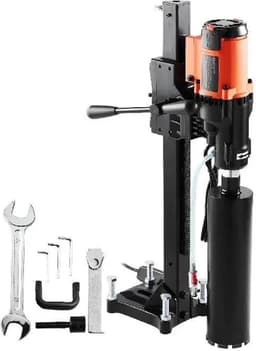
Anchor the base the way the manual describes, then try to rock the column. If the base moves, the fixing is not finished. Vacuum is not a method for walls and ceilings. KJ Hire allows it on a smooth floor, at right angles. Set the barrel square to the mark, and open the water or start the extractor before the crown touches. For wet concrete, CN8 wants water suppression and a slurry path you have already planned. Hire sheets use a milky flow as the cue that water is reaching the rim. These listings print no litres-per-minute figure. For dry brick, the extractor stays on the tool. A domestic vacuum is a poor substitute for an M or H class unit. A large crown wants a low speed. Where the listing only says stepless, the manual is the number you use, not the title.

Feed, rebar and the plug

Bring the rim onto the surface slowly and let the diamonds cut. Forcing the handwheel polishes the bond and is how a stand that was only just tight begins to walk. Keep water or the extractor running for the whole cut. If the slurry goes dusty, stop and correct that. Steel changes the feel. Hire practice is to ease off when the slurry colour changes on reinforcement, not to add feed until the motor complains. If the drill has no clutch, switch off, and do not spin the mast to free a stuck crown. When the crown breaks through, stop the motor before you release the stand. Support the plug so it cannot drop out of the wall. Do not strike a live crown.

When to stop and get help

Stop if you still cannot say what is inside the wall, if the base will not hold still, or if the voltage on the plate does not match the supply. Stop if the cut is overhead, at height, or in an element that carries load. Those are the jobs for a driller who does this work under the Control of Substances Hazardous to Health rules. A householder's single vent through ordinary brick, after a services check and with the right bit, is the narrow case this sequence is for.

Common questions

How should the stand be fixed?
Follow the manual's anchors, then try to rock the column. If it moves, it is not ready. Vacuum is for a smooth floor at right angles, with the limits in the hire instructions, and it is not the method for a wall or a ceiling. Extra anchoring is the normal requirement there. Do not start a cut in order to test the base.
How much water is enough?
Enough that the rim stays wet and the slurry stays fluid for the whole cut. These product listings do not state a flow in litres per minute, so a figure copied from a different manual would be a guess. Hire practice uses a milky slurry as the cue that water is arriving. If the paste goes dry, stop and restore the feed.
What changes when the bit hits steel?
Ease the feed. Hire sheets treat a change in slurry colour as the sign that the barrel has met reinforcement. Forcing the handwheel loads the segments and the mast. A clutch should release a jam if the drill has one. If yours does not say it has a clutch, switch off rather than leaning harder. Deep bar in structural concrete is a point to get help.
What do I do with the slurry?
Catch it while you drill, and bag it. Do not dry-sweep the dust once it has dried, and do not assume a hose to the nearest drain is acceptable. Wet slurry still leaves a silica question in a small room, which is why long wet work in an enclosed space still sits inside CN8's respiratory guidance. Stop the motor before you pull the plug from the barrel.
When should I not do this myself?
When the wall may hide cables or pipes, when the concrete is structural, when the hole is overhead or at height, or when the site expects a formal dust assessment. One ordinary brick vent, with services checked and the right bit, is the case for a careful owner. A silent voltage and a missing clutch are reasons to hire even for that single hole.

Related pages

Sources

Sources for the safety and trade points above. Listings were checked on 19 October 2026.

  1. HSE CN8, Diamond coring and hole cutting (retrieved 19 October 2026)
  2. HSE EH40/2005, workplace exposure limits (retrieved 19 October 2026)
  3. HSE, electrical safety on construction sites (retrieved 19 October 2026)
  4. IET Wiring Matters, reduced low voltage systems (retrieved 19 October 2026)
  5. Eibenstock UK, choosing a diamond core drill (retrieved 19 October 2026)
  6. Sealey DCD230V diamond core drill (retrieved 19 October 2026)
  7. Eibenstock BST 90 drill stand (retrieved 19 October 2026)
  8. HSE, PUWER overview (retrieved 19 October 2026)