Diamond core drill buying guide
You already know the hole, and the amazon.co.uk titles in this set answer with a wattage. A 110 mm soil pipe through ordinary brick is a different machine from a 160 mm core in reinforced concrete. This diamond core drill buying guide is the order of checks: material, diameter, stand, clutch, then voltage, spindle thread and what is actually in the box. Prices sit on the [core drilling rig comparison](/hub/workshop/core-drilling-rig). The Products Compared editorial team used amazon.co.uk listings saved on 19 October 2026 and did not run a laboratory test. If you buy through a link, we may earn a commission at no extra cost to you.
You already know the hole, and the amazon.co.uk titles in this set answer with a wattage. A 110 mm soil pipe through ordinary brick is a different machine from a 160 mm core in reinforced concrete.
You already know the hole, and the amazon.co.uk titles in this set answer with a wattage. A 110 mm soil pipe through ordinary brick is a different machine from a 160 mm core in reinforced concrete. This diamond core drill buying guide is the order of checks: material, diameter, stand, clutch, then voltage, spindle thread and what is actually in the box. Prices sit on the core drilling rig comparison. The Products Compared editorial team used amazon.co.uk listings saved on 19 October 2026 and did not run a laboratory test. If you buy through a link, we may earn a commission at no extra cost to you.
Our top picks
| Badge | Product | Maximum diameter | Stand | Bit in the box | Note | Price | Offer |
|---|---|---|---|---|---|---|---|
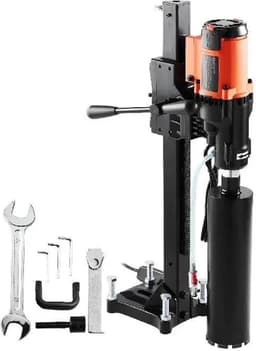
| Best overall |  Langjiee Langjiee core drill with stand | 200 mm claimed | Column stand | 4.25 in bit | 6.3 | about £115.26 | View offer |
 Generic Generic 3200 W core drill with stand | 205 mm | Rig stand included | Unsized set | 6.6 | about £355.99 | View offer | |
| Best value |  Generic Generic 160 mm core drill (KM-kqwO1b) | 160 mm | Column not stated | n/a | 5.5 | about £195.99 | View offer |


On this page
Start with the hole, not the wattage
Stand, clutch and speed
Voltage, thread and the box
What stays on the other pages
Common questions
Does the included bit match the maximum diameter?
When is a handheld drill the wrong shape?
Why do masonry and concrete maximums differ on a trade drill?
What thread do UK bits use?
Which of these checks are on the voltage page instead?
Related pages
Sources
Sources for the safety and trade points above. Listings were checked on 19 October 2026.
- HSE CN8, Diamond coring and hole cutting (retrieved 19 October 2026)
- HSE EH40/2005, workplace exposure limits (retrieved 19 October 2026)
- HSE, electrical safety on construction sites (retrieved 19 October 2026)
- IET Wiring Matters, reduced low voltage systems (retrieved 19 October 2026)
- Eibenstock UK, choosing a diamond core drill (retrieved 19 October 2026)
- Sealey DCD230V diamond core drill (retrieved 19 October 2026)
- Eibenstock BST 90 drill stand (retrieved 19 October 2026)
- HSE, PUWER overview (retrieved 19 October 2026)