Independent comparisons. We may earn from shop links. More info

Kentia palm or areca palm

Updated: October 2026

You searched for a kentia and the results also offered an areca, a parlour palm, and something labelled sago. Those are not the same plant, and one of them is a serious pet hazard. This page is the split: kentia palm or areca palm, plus the two lookalikes that rode along in the same amazon.co.uk search. The [kentia palm comparison](/hub/trees-and-palms/kentia-palm) only kept listings that name a kentia. Species and pet risk live here. The Products Compared editorial team updated this on 16 October 2026 from RHS plant records, ASPCA, and Animal PoisonLine. We did not rank the three kentia ASINs on this URL. A qualifying purchase can earn a commission at no extra cost to you.

You searched for a kentia and the results also offered an areca, a parlour palm, and something labelled sago. Those are not the same plant, and one of them is a serious pet hazard.

Our top picks

On this page

Four names that are not interchangeable

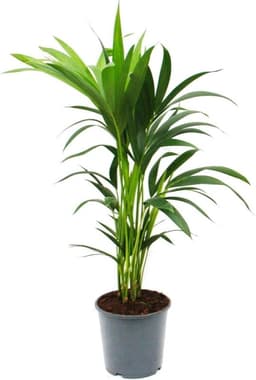
Howea forsteriana is the kentia: one trunk over time, arching fronds, from Lord Howe Island, sold in Britain as a houseplant. The RHS rates it H1A. Dypsis lutescens is the areca, also called golden cane, and older labels still say Chrysalidocarpus. It clumps, and the RHS says it wants bright light, with a winter minimum around 13°C advisable. Chamaedorea elegans is the parlour palm: compact, shade-tolerant, and an RHS Award of Garden Merit plant. That award is not a kentia prize, and a parlour palm is not a small kentia. Cycas revoluta is a sago, a cycad, even when the title says palm. If the label is not Howea forsteriana, it is not the kentia this comparison is about. An air purifying bullet does not identify the plant. Arecas, parlour palms, and a sago were left out of this comparison. They are not rows on the main table. The kentia palm buying guide is the checklist once you know you want Howea.

Light and shape

A darker British room favours kentia or parlour palm over areca. The RHS groups Chamaedorea and Howea as plants that tolerate quite low light, and it treats Dypsis as the one that needs brightness. Howea is also the better dry-room houseplant of the pair on that page. Quite low still means daylight. A north-facing room with a window can hold a kentia. A windowless hall cannot. An areca in that north room is the plant that thins while the kentia grows slowly. An areca sends up several cane-like stems and reads as a screen. A kentia is a single trunk, though a nursery pot may hold several young plants, which Palm Centre sells that way. Crocus has called a kentia multi-stemmed. The RHS record says single-stemmed. If you wanted one trunk, ask whether the pot is one plant or a group. A parlour palm stays smaller. It will not become the floor palm people mean by a mature kentia, which Palm Centre puts at about 1.5–3 m indoors, sometimes 3.5 m, over years. Winter figures are not interchangeable. About 13°C is the RHS line for Dypsis. About 16°C is the RHS indoor-page night figure for Howea, with H1A meaning warmer than 15°C. Do not swap them. The how to care for a kentia palm page is for Howea only.

Pets, and why sago is the hazard

ASPCA lists Howea forsteriana as non-toxic to cats and dogs. Animal PoisonLine's pet-safe list includes kentia palm under that name, and it still warns that any plant can upset a stomach. That is the limit of the safe claim. It is not a group pass for every title with palm in it. Cycas revoluta is the opposite. ASPCA lists sago palm as toxic, with liver damage among the signs. The RHS says it is toxic to dogs and cats and a skin irritant. The Horticultural Trades Association marks Cycas toxic to pets if eaten, harmful to people if eaten, and a skin irritant. Animal PoisonLine has written that cycads, mainly sago, can cause severe liver damage if eaten. If a dog or cat may have chewed a sago, or a plant you cannot name, phone a vet. We are not quoting a case result, only that warning. Do not use a kentia care routine or a low-light spot to justify a sago. If the room is too dark for a living plant, the artificial kentia palm page is the décor choice. A fake has no pet-toxicity entry because it is not a plant. A child can still pull a tall one over. The silk listing does not claim a tip-proof base.

What this category kept

This comparison kept three kentia titles and removed the rest. The living row is Howea forsteriana, about 80 cm, £29.99, with no review line. The other two are artificial kentias, 70 cm plastic and 120 cm silk. If your basket still shows Dypsis, Chamaedorea, or Cycas, you have left this set. Choose a kentia when you want the single-stem habit, dimmer light than an areca will take, and a room that stays above the RHS winter line. Choose an areca only in genuinely bright light, when you want the clump. Choose a parlour palm for a small pot, knowing it is a different species. Do not choose a sago as a safe palm. Open the main comparison once the label says Howea forsteriana, or the title says artificial kentia in plain words.

Common questions

Which one copes with a darker British room?
Kentia and parlour palm, on the RHS indoor-palm page, tolerate quite low light. Areca (Dypsis lutescens) wants bright light. A dark room with no daylight is a poor home for all three. Between a north-facing window and a bright conservatory, the kentia is the more forgiving of the kentia-and-areca pair, and it is the better dry-room houseplant of those two on that RHS page.
Why does an areca look fuller?
It clumps. Several cane-like stems come from the pot, so a young areca reads as a bush. A kentia is a single trunk, though a seller may put several young plants in one pot and the clump is then several kentias, not an areca. Read the name. Fullness in the photo is not the species.
Is a parlour palm a small kentia?
No. A parlour palm is Chamaedorea elegans. It stays smaller, it tolerates low light, and it holds an RHS Award of Garden Merit. That award is not a kentia award. If the label says Chamaedorea, you are buying a parlour palm.
Is a sago a palm, and can my dog chew it?
It is a cycad, Cycas revoluta, often sold with palm in the title. It is toxic to dogs and cats. ASPCA lists liver damage among the signs, and Animal PoisonLine warns that cycads can cause severe liver damage if eaten. If a pet may have chewed one, call a vet. Do not treat it as a kentia.
The listing says air purifying. Does that identify the species?
No. That phrase turns up on more than one of these plants and it is not a lab result we are willing to repeat as a percentage. The name on the label identifies the plant: Howea, Dypsis, Chamaedorea, or Cycas.
Can I use the kentia care routine on an areca?
Only in the broad sense that both hate a wet saucer. Areca wants brighter light, and the RHS winter figure for Dypsis is about 13°C, not the 16°C night line for Howea. Do not assume the same corner will do.
Were those other plants in this comparison?
They appeared in the wider search and were left out of this comparison: live arecas, parlour palms, a sago, and some artificial arecas. The published table is three kentia titles only. If you still need a species check, use the botanical name before you open the main comparison.

Related pages

Sources

Public UK sources from the research digest, last checked on 16 October 2026. Shelf prices and the single review line are the amazon.co.uk figures in the display file, captured on 15 October 2026. Hardiness and care lines are quoted from the RHS and BBC Gardeners' World, which disagree on the winter minimum.

  1. RHS: Howea forsteriana (retrieved 16 October 2026)
  2. RHS: Indoor palms (retrieved 16 October 2026)
  3. RHS: Hardiness ratings (retrieved 16 October 2026)
  4. BBC Gardeners' World: kentia palm (retrieved 16 October 2026)
  5. ASPCA: Kentia palm (retrieved 16 October 2026)
  6. RHS: Cycas revoluta (retrieved 16 October 2026)
  7. Animal PoisonLine: plants and poisons (retrieved 16 October 2026)
  8. GOV.UK: plant passports in Great Britain (retrieved 16 October 2026)