German or Oriental cockroach: where each species hides

A German cockroach is about 10–15 mm, with two stripes, and likes warmth behind a fridge. An Oriental cockroach is 20–24 mm, dark, and uses cool damp drains.
On this page

You slide the fridge out to mop, and a small insect with two dark stripes runs under the kickboard. Later the same week a larger, dark insect is by the basement drain. A German or Oriental cockroach is not a reason to order two different traps. It is a reason to measure the adult, note the stripes, and look in the warm gap or the damp structure that species actually uses. Get that wrong and you will keep searching the oven while the insect is in the floor gully, or the other way round.
Adult sizes and development times come from the British Pest Control Association cockroach advice. Coventry City Council and Manchester City Council supply the rounded sizes, the sour-smell note, and the temperature band they publish. Trap prices and stars are amazon.co.uk listings in the cockroach trap comparison. Peter F. did not run a laboratory test, and this page makes no market-size claim. A qualifying purchase through our links can earn a commission at no extra cost to you.
In short
A German cockroach is about 10–15 mm, with two dark stripes, and keeps to warm, humid spots such as behind a fridge or an oven. An Oriental cockroach is about 20–24 mm, dark, and uses cool, damp basements and drains. Council pages round those lengths rather than naming a third insect. The monitor you buy does not change with the species. The place you look does.
German or Oriental cockroach: size and colour
Start with an adult you can see against a ruler. The British Pest Control Association puts the German cockroach, Blattella germanica, at about 10–15 mm and the Oriental cockroach, Blatta orientalis, at about 20–24 mm. That is the cockroach size these UK advice pages print. The larger adult is roughly twice the length of the smaller one. A guess from across the kitchen will not hold that gap.
Coventry City Council puts the German cockroach at 12–15 mm and describes two black stripes. That range sits inside the BPCA band, so it is a tighter wording of the same insect. Manchester City Council rounds the German cockroach to about 12 mm and the Oriental cockroach to about 22 mm. Both roundings sit inside the BPCA spans. Quote BPCA when you need the full range, and treat the council figures as shorter versions of it.
Colour on these pages is sparse. The German cockroach is picked out by the two stripes, and the Oriental cockroach is described as dark. There is no colour chart and no nymph length, so a young insect, smaller than the adult band, can look like either species. If the stripes are unclear, do not force a name. A search for a steam fly cockroach is aimed at the smaller striped insect, the German cockroach, not the 20–24 mm dark one.
Where a German or Oriental cockroach sits
The British Pest Control Association puts the German cockroach in warm, humid harbourages, including behind a fridge or an oven. That is what a cockroach behind the fridge usually means. The motor and the oven surround stay warm, often with condensate, when the room feels ordinary. Coventry City Council also names sinks and drains. If you only pull the appliance out, you have checked half of what that page lists.
The same BPCA sheet puts the Oriental cockroach in cool, damp places, especially basements and drains. Manchester City Council says both species like about 20–33°C, and that the Oriental cockroach also uses cooler drains. A shared temperature band does not erase the cooler-drain note. A kitchen is not automatically a German harbourage, and a hot basement plant room is a weak reason to assume the larger insect.
Drains are the overlap, because both insects are tied to drains in at least one of these sources. The split is heat and damp, not the name of the room. A cold void under a sink can suit the larger dark insect while you stand in a kitchen, and a warm duct in a basement can suit the striped insect. Look at the conditions, then at size and stripes.
Signs when you do not see a live insect
You will often miss the insect because you are looking at open floor, not at the gap it uses. The BPCA sheet, Coventry’s page, and Manchester’s page do not publish a clock for when either species walks. A lunchtime look is not evidence the flat is clear, and one daytime sighting is not a headcount those pages never give.
Coventry records a sour smell with the German cockroach, together with sinks and drains. Use that as a prompt to inspect. The page does not describe a test for the smell, and it does not say the odour belongs only to that species. Other damp faults smell sour as well. If you have not seen an insect, check the fridge and oven gap, the sink waste, and the basement floor drain.
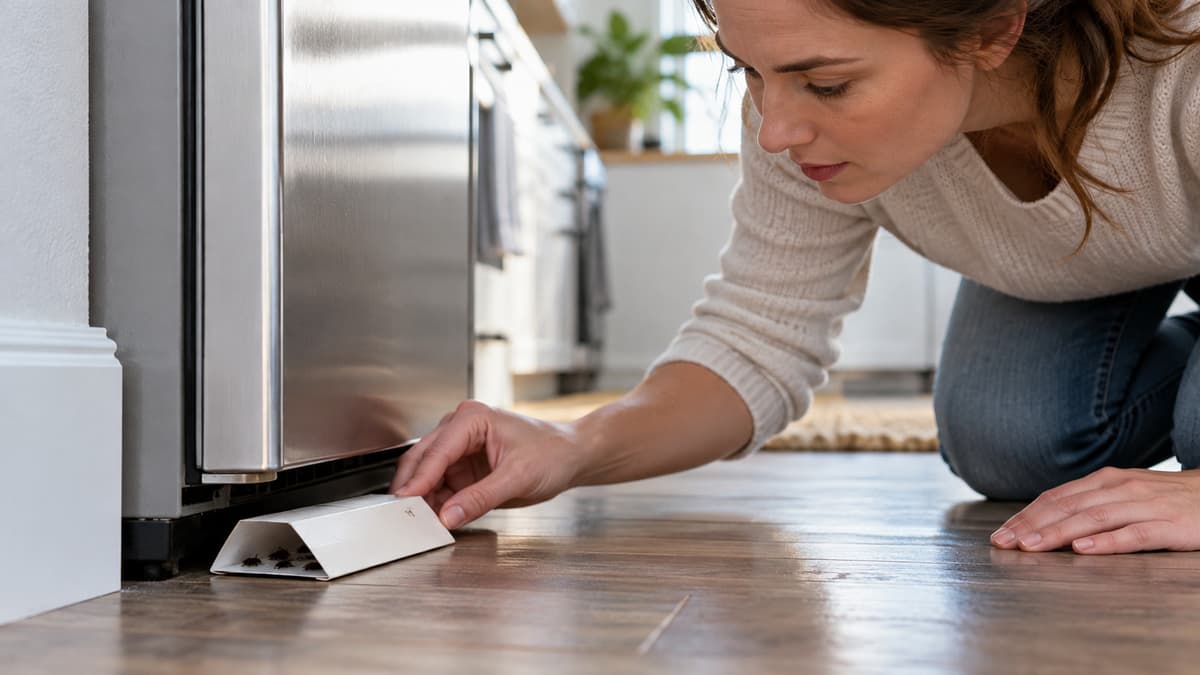
A card tells you whether something crossed a chosen spot, so place it where the structure already suggests movement. The how to use a cockroach trap page covers that sequence, and a cockroach trap for the kitchen is the route for a kitchen at home. Date the position when you set it. An empty card means that spot, in that window, caught nothing. Dust, or a card in the middle of the floor, can do that while the insect stays in the gap you did not open.
One trap for a German or Oriental cockroach
The species does not change the box. Monitors in this comparison are not species-specific killers. Nothing in the batch is sold as a German card and a separate Oriental card. You identify the insect with size, stripes, and harbourage, then use one monitor to see whether that route is active.
The top pick on the cockroach trap comparison is the Super Ninja 12-pack, ASIN B0BQ3DGXQP. On amazon.co.uk in that comparison it is about £13.90, a paper glue card with food bait in the glue, rank 1 in Cockroach Control, and 4.1 from 3,123 reviews. That review block is shared with the 4-pack and the 24-pack, so it is not a count for this pack alone. The bullets say the cards kill, while the comparison also records the BPCA position that sticky cards are for monitoring. A kill claim on a listing is not a cleared harbourage, and it is not a reason to buy a second design because the insect was larger and dark.
One reviewer on that listing caught nothing in two weeks. Another said a cockroach can leave a leg on the glue. A blank fortnight is not a certificate, and a card that sometimes loses the insect is not a census. Use a catch to check size and stripes again, then go back to the warm gap or the cool drain.
When the building is bigger than one appliance
Speed is the other difference, and it comes from the BPCA leaflet. German cockroach development is about 6–12 weeks, and Oriental cockroach development is about 6–12 months. Those are ranges, not a timetable for your flat this month, because food, moisture, and warmth sit outside the sentence. The contrast is still large. A striped insect in a warm kitchen can rebuild on a scale of weeks, while a dark insect in a cool basement is described on a scale of months. Waiting to see if it was a one-off costs more in the first case.
Access matters once you cannot reach the harbourage. Pulling out one fridge in a house you control is a household search. A soil stack shared with the flat above, a basement that belongs to the freeholder, or a commercial kitchen is not. The species still tells a contractor where to start: warm appliances for the German cockroach, cool damp structure and drains for the Oriental cockroach. It does not let you treat a neighbour’s void, and it does not turn a retail card into a building-wide treatment.
If the room is a café, a takeaway, or a shop that handles food, this is no longer only a household identification. The guide to cockroaches in a food business is the page for that duty. The same millimetres in a food room are a different job. The card can show activity. It does not close the hygiene question.
Common questions
How big is a German cockroach?
What do the two stripes mean?
Why is a cockroach behind the fridge?
Can an Oriental cockroach live outside?
Do I need a different trap for each cockroach?
Are German and Oriental cockroaches nocturnal?
What are the signs if you do not see one by day?
Does the species change whether you call someone?

Peter F. is the editor for DIY & tools at productscompared.co.uk. Comparisons in this category are checked against amazon.co.uk listings, review evidence and public UK sources.
Related articles

When a food business must call pest control for cockroaches
A café or takeaway with cockroaches needs a contractor. A household glue card does not close that duty.

Sticky insect traps show activity. They do not finish the job
A sticky card shows that an insect crossed that spot. It leaves the harbourage itself untreated.
How often to check a trap
The first check is not the same interval as a later one. An insect card and a live cage differ.