Independent comparisons. We may earn from shop links. More info

Is it illegal to trap birds UK

Updated: 21 October 2026

A cage or a net in the basket is not permission to take a wild bird. In Great Britain you must not intentionally kill, injure or take one, and you must not use a list of methods that includes certain traps and nets. A general licence is a narrow exception, and it changes by nation. This page answers is it illegal to trap birds UK by that route: the Act, then England in 2026, then Wales, Scotland and Northern Ireland. It does not tell you how to assemble a cage. The shelf is the [bird trap comparison](/hub/traps/bird-trap). Peter F. used legislation.gov.uk, GOV.UK, Natural England, NRW, NatureScot and DAERA, as published on 19 October 2026. If you buy through our links, we may earn a commission at no extra cost to you.

A cage or a net in the basket is not permission to take a wild bird. In Great Britain you must not intentionally kill, injure or take one, and you must not use a list of methods that includes certain traps and nets.

Our top picks

Gonetre Gonetre bird catching net

Best overall

Gonetre Gonetre bird catching net
7.2/10about £18.19
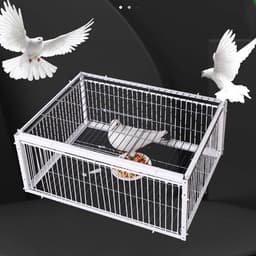
ybaymy ybaymy four-door pigeon cage

Alternative

ybaymy ybaymy four-door pigeon cage
3.6/10about £37.99
On this page

What the Act already forbids

Section 1 of the Wildlife and Countryside Act 1981 protects wild birds. Intentional killing, injuring or taking is an offence, and so is taking or damaging a nest in use, or taking or destroying an egg. That does not pause because a bird is on your shed. A feral pigeon is a wild bird. So is a robin. The shop is irrelevant. Section 5 restricts specified traps, and a net, bird-lime, or a tethered, blinded or injured decoy, used to kill or take wild birds. A marketplace net is still a net. Humane on a title does not delete section 5. Section 8(1) requires room for a captive bird to stretch its wings, unless a licence sets that aside for that trap. Welfare law still applies once an animal is under your control. Section 16 is the licensing power. GOV.UK says avoid a licence if you can, then see whether a general licence already covers you, and only then apply for an individual licence. You do not apply to get a general licence. Acting without a required licence can mean an unlimited fine and up to six months in prison. A delivered parcel is not a defence.

England in 2026

From 1 January 2026, GL40, GL41 and GL42 are issued by Natural England. GL41 lists feral pigeon for slips and falls, disease spread to humans, and nesting that threatens health or safety. The cage-trap decoys named there are jackdaw and monk parakeet, not feral pigeon. GL42 marks feral pigeon for livestock foodstuffs and crops, not for a direct attack on livestock. Wood pigeon is marked for foodstuffs and crops. That decoy list does not name either pigeon. A nuisance is not one of those lines. Pigeon purposes in more detail are on the pigeon trap cage page. GL33, from 1 January 2026 to 31 December 2026, is the conditions for trapping, not the permission to take a bird. It names five designs and no other type: walk-in multi-catch, Larsen, Larsen mate, Larsen pod, and pigeon trap. A pigeon trap there is a mesh cage birds walk into through a one-way entrance to reach food. You must inspect at least every 25 hours, close enough to see the animal, any decoy, food, water and the mechanism. Do not set the trap if you cannot keep that interval. You still need a licence that names the species and the purpose. Nothing in this comparison is a government-approved design. The table marks follow amazon.co.uk stars and price. They are not a legal ranking. Designated sites need extra care.
Gonetre Gonetre bird catching net

Testsieger

Gonetre Gonetre bird catching net
7.2/10about £18.19

Wales, Scotland and Northern Ireland

In Wales, NRW’s own 2026 licences apply. GL001 covers serious damage, including feral pigeon and wood pigeon. GL002 limits a feral-pigeon cage to a walk-in or a pigeon trap, with an inspection that must not exceed 25 hours, and the cage must be made incapable of holding birds when it is not in use. GL004 for carrion crow runs from 1 February 2026 to 31 August 2026. GL016, for food premises, asks for checks twice a day and release at least four miles away. In Scotland, NatureScot GL01/2026 sets checks at least every 24 hours. Decoy conditions include food, water, shelter and a perch. Registration on the page used here covers Larsen, Larsen mate, Larsen pod and multi-catch crow traps, each with a tag. Do not assume a pigeon cage is on that register, or exempt, without the Scottish conditions. In Northern Ireland the statute is the Wildlife (Northern Ireland) Order 1985. DAERA’s TPG1 includes feral pigeon and jackdaw. TPG2 adds wood pigeon and corvids. TPG3 covers hooded crow and magpie from 1 March to 31 August. Sunday conditions are on the TPG PDF. England’s GL numbers are the wrong document there.

If you are outside the table

If the species or the purpose is missing, the general licence does not stretch. GOV.UK points you to an individual licence, A08 or A09. You do not trap while you wait. If you cannot identify the bird, unset the trap. The same applies on a designated site when you do not know whether the general licence runs there. What the visit looks like is on how to set a pigeon trap. A wooden box 16 cm wide, sold as a finch trap, is not a lawful way to catch a wild finch because the listing exists. Section 1 still applies. You either meet a current general licence for your nation, or you hold an individual licence before you act, or you do not trap. Scaring, proofing the building, or changing how feed is stored can be the step that means you never needed the cage.

Common questions

Is it illegal to trap a wild bird in a garden?
It is an offence under section 1 of the Wildlife and Countryside Act 1981 to intentionally take a wild bird, unless a licence exception applies and you meet it. A garden does not cancel that. Nests in use and eggs are protected as well. A general licence covers only the species and purposes it lists, for an authorised person, with the method conditions. A cage bought for a robin, a finch or small birds is not such an exception by itself.
Do I apply for a general licence?
No. A general licence is published so that people who already fit it can rely on it. You read the current licence for your nation and you comply, including the trap design and the inspection rule. If you do not fit, you do not tick a box to join it. The next step GOV.UK describes is an individual licence, A08 or A09, and you wait for that decision before you take a bird.
Which trap designs does England name for 2026?
GL33 names five, and no other type: a walk-in multi-catch, a Larsen, a Larsen mate, a Larsen pod, and a pigeon trap. The pigeon trap is a mesh cage birds walk into through a one-way entrance to reach food. A Larsen is a decoy design used in corvid control, not a food cage for pigeons. A 12 cm cube, a 16 cm finch cage and a catching net are not on that list of five.
Does GL33 by itself let me take birds?
No. GL33 sets standard conditions for trapping and decoys from 1 January 2026 to 31 December 2026, including the 25-hour physical inspection. The permission to take a named species for a named purpose is a different licence, such as GL41 or GL42, or an individual licence. Meeting the inspection rule on a species that is not on your licence does not repair the gap. Natural England issues GL40, GL41 and GL42 from 1 January 2026.
Do I have to register a cage trap in Scotland?
NatureScot requires registration, and a tag with the registration number, for Larsen, Larsen mate, Larsen pod and multi-catch crow traps. That is the list on the registration page used here. Checks under GL01/2026 are at least every 24 hours. Whether your particular pigeon cage falls under a Scottish registration duty has to be read on the current NatureScot conditions, not assumed from GL33. The tag rule is not an England rule pasted north.
How does Wales differ on season and on food premises?
NRW’s GL004 for carrion crow runs from 1 February 2026 to 31 August 2026, so the date matters. GL016, for food premises, requires checks twice a day and release at least four miles away. GL002 limits feral-pigeon cage types to a walk-in or a pigeon trap and keeps a 25-hour inspection ceiling. Those are not the same document as Natural England’s GL41. If the premises are in Wales, the Welsh licence is the one you read.
What happens if the species is not on the table?
The general licence does not cover you. You either stop, or you apply for an individual licence and do not trap in the meantime. That is the A08 or A09 route on GOV.UK. The same stop applies if you cannot tell what you have caught, if the purpose on the table is not your purpose, or if the site is designated and you have not checked. Acting without the licence you need is the offence the GOV.UK collection ties to an unlimited fine and up to six months in prison.

Related pages

Sources

Public UK sources from the research digest, plus amazon.co.uk listings for the seven traps. Shelf date 19 October 2026. Natural England issues the England general licences quoted here from 1 January 2026.

  1. Wildlife and Countryside Act 1981 (retrieved 19 October 2026)
  2. GOV.UK, bird licences (retrieved 19 October 2026)
  3. GL33 (2026), trapping wild birds (retrieved 19 October 2026)
  4. GL41, public health or safety (retrieved 19 October 2026)
  5. GL42, serious damage (retrieved 19 October 2026)
  6. NRW general licences 2026 (retrieved 19 October 2026)
  7. NatureScot, trap registration (retrieved 19 October 2026)
  8. DAERA, wildlife licensing (retrieved 19 October 2026)