Independent comparisons. We may earn from shop links. More info

How to use a 230 mm angle grinder

Updated: 22 October 2026

You have a large Bosch grinder on the bench, or one on the way, and the first cut is where a shortcut does the damage. A 230 mm disc at 6,500 rpm is a two-handed tool of about 5.3–5.5 kg. The guard, the nut and the wheel matter more than the wattage on the carton. This is how to use a 230 mm angle grinder: unplug, fit a disc that matches the spindle, keep the guard on, run it free with people clear, then cut with both hands. The [Bosch angle grinder 230 comparison](/hub/tools/bosch-angle-grinder-230) lines the five listings up. This page does not rank them. Peter F. followed Electrical Safety First, HSE HSG17 and Bosch’s English family manual.

You have a large Bosch grinder on the bench, or one on the way, and the first cut is where a shortcut does the damage. A 230 mm disc at 6,500 rpm is a two-handed tool of about 5.3–5.5 kg.

Our top picks

Bosch Bosch GWS 22-230 J

Best overall

Bosch Bosch GWS 22-230 J
8.7/10about £115.81
Bosch Bosch GWS 20-230 J

Rank 2

Bosch Bosch GWS 20-230 J
9.2/10about £145.00
Bosch Bosch GWS 22-230 P

Alternative

Bosch Bosch GWS 22-230 P
7.0/10about £156.07
On this page

Before the disc goes on

Unplug before your hands go near the spindle. Electrical Safety First puts that ahead of any adjustment, whether the lead ends in a UK 3-pin plug or a yellow site connector. Which supply you should have bought is on the 110 V or 230 V page. None of the five cartons includes a disc. Reject a disc that is cracked, warped, or missing a speed mark. The family manual’s table for this class is 230 mm, a bore of 22.2 mm, and 6,500 rpm no-load. Diamond discs are sold as 22.23 mm, the same hole. The disc’s own maximum must be at least 6,500 rpm. A 115 mm or 125 mm wheel is the wrong diameter. A grinding wheel is the wrong type when the job is a cut. Do not fit a chainsaw-style attachment. Electrical Safety First has warned against those discs.

Guard, flanges and the spanner

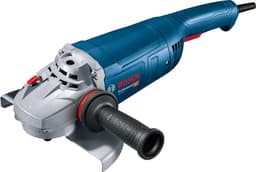
The guard ships in every carton here, with a backing flange, a locking nut and a two-hole spanner. Fit it so it sits between you and the wheel, and leave it there. HSG17 expects the guard secured before the wheel runs. Taking it off to see a chalk line puts you in the plane of the disc. If the guard screw on a GWS 20-230 J feels tight, a review in that file says it can seize unless it is greased. Do not delete the guard. Use the two-hole spanner from the box. Seat the backing flange and the locking nut in the order the English family manual shows for this spindle, and tighten with that spanner. Do not hammer the nut, and do not slip a pipe over the spanner. The side handle goes on before you start. You need two hands either way. If you are still choosing the switch, the buying guide is the checklist.
Bosch Bosch GWS 22-230 J

Testsieger

Bosch Bosch GWS 22-230 J
8.7/10about £115.81

The no-load run and the first cut

Bosch asks you to run a new disc for at least one minute at no load. HSG17 says that free run happens with everyone standing clear, which means you step out of the plane of the wheel. If the disc vibrates, stop, unplug, and take it off. Do not try to cut it out on the slab. Restart only when the wheel has run smoothly for that full minute. For the cut, both hands stay on the tool and the lead stays off the disc. Let the disc feed at its own pace. Forcing it heats the housing. On a P model the switch stops the motor when you release it. On a J model the manual describes restart protection, and some switches in that manual can lock on. Read the switch on the tool in your hands.

When you stop

Stop and unplug if the disc vibrates in the cut, if you smell burning from the wheel rather than ordinary stone dust, or if the guard has moved. A J model that is instantly at full speed, with none of the starting-current limitation the manual describes, should go for service. A dead unit out of the box is a return, not a fitting puzzle. Call a professional when the rating plate and the supply disagree, when the cut is commercial concrete with a silica duty, or when you employ people and the operator has not been trained under PUWER 1998 and HSG17. A householder does not have to hold one named abrasive-wheels certificate. Employers do have the training duty. Put the tool down only once the disc has stopped.

Common questions

Do I unplug before I change the disc?
Yes. Unplug before you touch the wheel, the nut or the guard. Electrical Safety First states that for angle grinders, on a BS 1363 plug or a 110 V site plug. A switch you believe is off is not a substitute. On a P model the motor is meant to stop when you release the trigger, and you still pull the plug before the spanner comes out.
Which way do the flanges go?
The backing flange and locking nut go on in the order shown in Bosch’s English family manual for this spindle. Use the two-hole spanner from the box. Do not hammer the nut or extend the spanner. If the disc vibrates on the one-minute run, unplug and reseat them. This page does not add a homemade diagram.
Can I take the guard off to see the line?
No. The guard stays secured before the wheel runs, which is the HSG17 point. Mark the cut so you can follow it with the guard in place. Removing it to see a chalk line puts your hands and face in the plane of a 230 mm disc. HSE links a large share of abrasive-wheel accidents to unsafe methods and operator error.
How long should the test run be?
Bosch’s family manual asks for at least one minute at no load with a new disc. HSG17 expects everyone to stand clear, out of the plane of the wheel. If it vibrates during that minute, stop and unplug. Do not start the cut to see if it settles. A smooth minute is the gate.
What PPE is the minimum?
Electrical Safety First calls for eye protection, and you need both hands on the tool. For concrete and masonry, HSE CN1 adds on-tool extraction in M or H class and respiratory protection at APF 20 or better. Goggles do not cover that dust. A metal cut still needs eye protection and the guard. Gloves do not replace the unplug step.
When should I stop and get the tool serviced?
Stop if a J model is instantly at full speed, if the disc vibrates, or if the plate voltage and the supply do not match. Those are not spanner adjustments. Brush wear over years is a service item once cutting suffers. A tool that will not start out of the box is a return. Commercial concrete with a silica duty belongs with someone who already runs extraction and RPE as the method.

Related pages

Sources

Public UK sources used for this page in October 2026. Prices, stars and review counts are from the five amazon.co.uk listings scored on 20 October 2026. HSE vibration limits, CN1 and PUWER apply at work. They are not a certificate for a domestic tool, and a declared vibration figure is not a daily dose.

  1. Bosch UK, GWS 20-230 P (retrieved 20 October 2026)
  2. Bosch UK, GWS 22-230 P (retrieved 20 October 2026)
  3. Bosch UK, GWS 2200 P 110 V (retrieved 20 October 2026)
  4. Bosch, English family manual (retrieved 20 October 2026)
  5. HSE, HSG17 (retrieved 20 October 2026)
  6. HSE, Site electrics (retrieved 20 October 2026)
  7. HSE, Vibration regulations (retrieved 20 October 2026)
  8. HSE, CN1 silica dust (retrieved 20 October 2026)