Independent comparisons. We may earn from shop links. More info

How to use a 115mm angle grinder

Updated: 22 October 2026

The carton is open on the bench, two metal guards are in the tray, and the first disc still has its card sleeve on. How to use a 115mm angle grinder starts before the plug goes into the wall: you match a 115 mm disc to the speed on the tool, you fit the guard that belongs to that disc, and you keep both hands on the body. The twelve corded tools in this set are listed on the [115 mm angle grinder comparison](/hub/tools/angle-grinder-115mm). Peter F. used Electrical Safety First, HSE HSG17, and the mount sequence described in small-grinder manuals such as Trotec and Sealey. This is not a training course and not a lab test. A qualifying purchase can earn a commission at no extra cost to you. Updated 22 October 2026.

The carton is open on the bench, two metal guards are in the tray, and the first disc still has its card sleeve on.

Our top picks

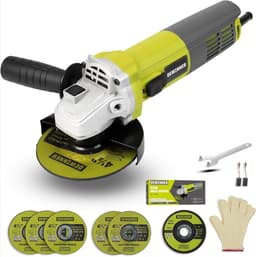
DEWINNER DEWINNER 850 W

Best value

DEWINNER DEWINNER 850 W
7.4/10about £29.74
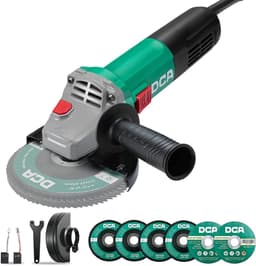
DCA DCA 860 W

Alternative

DCA DCA 860 W
7.2/10about £29.99
On this page

Before you plug in

Read the plate on the tool you actually received. In this set the speeds run from 10,000 rpm on the KATSU 720 W to 12,000 rpm on several DEKOPRO and DEWINNER lines. The Bosch table does not state rpm, so the plate is the only figure that counts. The disc must be 115 mm, with a 22.2 mm bore, and the maximum rpm printed on the disc must be at least the tool's no-load speed. A disc marked below the tool is the wrong disc, even if it seats on the spindle. UK mains are 230 V. You want a BS 1363 plug and a cable with no nick in the sheath. The Draper bullets claim that plug. One DEKOPRO 800 W review describes a plug with no earth wire. If that is what arrived, stop and return it. Electrical Safety First says to unplug before a wheel change, to clamp the work, and to run a new disc unloaded for about 30 seconds. A Sealey 115 mm instruction adds an RCD, both hands, no water on the disc, and no asbestos. HSE's HSG17 is written for workplaces. The point you can use at home is the same: the guard stays on, and it is there so an oversize wheel does not fit. If your discs are 125 mm, this tool is the wrong size. That choice is on 115 mm or 125 mm. Clear the bench of thinner, rags and aerosol cans before the first spark.

Fitting the disc and the guard

Unplug the tool and leave it unplugged until the disc is tight and you have spun it by hand. Press the spindle lock only while the lead is out. The usual small-grinder sequence, as Trotec describes it for a 115 mm body, puts the disc label towards the gearbox, then the outer flange, then the nut. Tighten enough to hold. Crushing the flange until the disc dishes is how a wheel cracks later. Spin the disc by hand. It should turn without a wobble and without touching the guard. HSG17's workplace figure for a new wheel on a portable machine is a guard clearance of no more than about 6 mm. If the disc kisses the guard, refit it. Do not bend the guard out of the way. A cutting guard is the more closed cover, used with a thin cutting disc held square to the work. A grinding guard leaves the face of a depressed-centre wheel or a flap disc exposed, and you grind at a shallow angle. DCA, Dong Cheng and several DEKOPRO cartons include both. UK reviews of the DCA call those guards fiddly. Einhell, both KATSU models and the Draper do not hand you a ready cutting disc, so you fit a disc you bought, rated for that tool. After the nut is tight, hold the tool clear of the work and let a new disc run unloaded. Follow the manual in your carton if it names a time. Switch off at once if the disc wobbles, smells of burning, or the guard moves.

The first cut

Clamp the work. A bolt or offcut held in one hand, with the grinder in the other, is how discs grab. Electrical Safety First wants both hands on the tool, the side handle fitted, and the cable kept off the spark line. Stand so the guard is between you and the disc. Start the tool in free air, let it reach speed, then bring it to the cut. Sealey's instruction is the same idea: do not switch on while the disc is already touching the work. Use light pressure. Forcing a 650–900 W DIY body through thick steel only heats the disc and the gearbox. A thin steel cut belongs on a cutting disc and the cutting guard. Face grinding and rust belong on a grinding wheel or a flap disc and the grinding guard. Sparks from a short cut on a bolt are an ignition source. Point them at concrete or a cleared patch of floor. When the cut finishes, keep the tool in the air until the disc stops. Then set it down so the disc is not touching anything. The metal-specific disc marks, and how deep about 30 mm really is, are on using a 115 mm angle grinder on metal.

When to stop

Stop when the disc wobbles after a correct mount, when the case is cracked, or when the switch will not turn the tool off. Unplug first. Do not tape a slide down, and do not keep cutting while you hunt for the off position. In this set the stiff slide is a known complaint on the C P CHANTPOWER, the Einhell push-forward switch, and the DEKOPRO 800 W, where one UK review says the button stuck on at first use. A stiff switch you can still turn off is a reason to decide whether you keep the tool. A switch that stays on is the end of the session. Stop as well when you cannot see what is inside the cut. A chase in a plastered wall can meet a cable or a pipe. Structural steel and load-bearing masonry are the same kind of stop. At home, a seized exhaust bolt or a length of box section on the bench is the work these 115 mm bodies are bought for. If the spindle lock on a KATSU 750 W will not engage, which more than one UK review reports, do not hold the spindle with pliers while the nut is still tight. Return the tool.

Common questions

Do I unplug before changing a disc?
Yes. Electrical Safety First tells you to isolate the tool before a wheel change, and the spindle lock is only for a stationary spindle. In this comparison that means the BS 1363 plug is out of the socket before you press the lock, loosen the nut, or swap a guard. Put the plug back in only after you have spun the new disc by hand and checked that it clears the guard. If a switch has stuck on, unplug before you touch the disc.
Which guard is for cutting?
The cutting guard is the more enclosed cover, used with a thin cutting disc at roughly 90 degrees to the work. The grinding guard is the more open cover, used with a depressed-centre wheel or a flap disc on the face. DCA and several DEKOPRO kits include both, and reviewers call them fiddly to swap. Fit the pair that matches the disc on the spindle. Leave the guard on. HSG17 describes the guard as the part that contains fragments and blocks an oversize wheel.
Which way does the disc face?
On the small-grinder manuals used for this guide, including Trotec's 115 mm instructions, the disc label faces the tool, towards the gearbox, with the outer flange and nut outside it. The bore is 22.2 mm on a standard 115 mm disc. Tighten the nut so the disc is held flat. If the disc wobbles when you spin it by hand, unplug again and refit it. A wobble after a correct mount is a reason to scrap that disc, and a reason to stop.
How tight is the flange nut?
Tight enough that the disc cannot slip, and no tighter than a firm nip with the pin spanner once the spindle lock is engaged. Over-tightening can dish a thin cutting disc. The lead stays unplugged while you do this. After the nut is on, spin the disc by hand and confirm it does not touch the guard. Then run it unloaded, clear of the work, for the time your manual states. Electrical Safety First cites about 30 seconds for a new disc.
What PPE do I need in a UK garage?
Wear eye protection that can take a fragment, hearing protection, and gloves that still let you work the switch. Electrical Safety First also expects the work clamped and both hands on the tool. A grinder sheds dust and sparks. Brick and concrete add respirable silica, which is an HSE workplace limit of 0.1 mg/m³ over eight hours, so a short tile cut at home still wants dust kept down and a mask you actually seal. These tool cartons do not include that kit.
Why is the slide switch so stiff?
Several tools in this price band use a lock-on slide that UK reviewers struggle to move. On the C P CHANTPOWER, one reviewer had to press the back of the switch before it would slide. Einhell reviews call the push-forward action awkward. A DEKOPRO 800 W review says the button stuck on. You should be able to turn the disc off with gloves on. If the switch stays on, unplug the tool and return it.
When should I stop and call someone else?
Stop and get a competent person when the cut may meet a hidden cable or pipe, when the steel or masonry is structural, or when you are mounting wheels as part of paid work covered by HSG17 and PUWER. Also stop, and unplug, when the switch will not turn off, the case is cracked, or the disc wobbles after you have refitted it correctly. A weekend bolt on a bench, with the guard on and the work clamped, is the job these 115 mm DIY bodies are for.

Related pages

Sources

Public UK sources from the research digest, used for this page in October 2026. Prices, stars and review counts are from the twelve amazon.co.uk listings in this comparison. HSE silica limits, HAVS figures and PUWER apply at work. They are not a certificate for a domestic grinder, and they are not a personal exposure limit for a weekend cut.

  1. HSE, HSG17 Safety in the use of abrasive wheels (retrieved October 2026)
  2. HSE, PUWER L22 (retrieved October 2026)
  3. Screwfix, Angle grinder buying guide (retrieved October 2026)
  4. Toolstation, Angle grinder buying guide (retrieved October 2026)
  5. Electrical Safety First, Angle grinders (retrieved October 2026)
  6. HSE, Grinder vibration and noise bulletin (retrieved October 2026)
  7. HSE, INDG463 Control of exposure to silica dust (retrieved October 2026)
  8. Norton Abrasives UK, Why an angle grinder is essential (retrieved October 2026)