Independent comparisons. We may earn from shop links. More info

How to strip twin and earth cable

Updated: October 2026

To strip twin and earth, treat the grey sheath and the insulated conductors as two jobs. Flat 6242Y has brown and blue cores plus a bare earth. Open the sheath without marking the cores, sleeve the earth green and yellow, then strip the length the accessory needs. This guide is for understanding that sequence, not for encouraging live work. Isolate and prove dead first, and use the [stripping tool comparison](/hub/tool-accessories/stripping-tool) to check which products actually state a flat-cable range. A qualifying purchase can earn a commission at no extra cost to you.

To strip twin and earth, treat the grey sheath and the insulated conductors as two jobs. Flat 6242Y has brown and blue cores plus a bare earth.

Our top picks

On this page

What you are cutting through

The grey PVC is the sheath, not the insulation that belongs in the live and neutral terminals. Under it sit brown and blue cores and a bare circuit protective conductor, which needs green-and-yellow sleeving where it is exposed. The sheath comes off first. The cores are prepared afterwards. Isolate and prove the circuit dead before you start. A detector in a multi-tool is not enough unless it is documented for that proving method. Leave enough spare cable to cut back, and stop if the tail in the box is already too short for a second attempt. The familiar 1.0, 1.5 and 2.5 mm² figures are conductor area. A sheath tool may instead state flat-cable width. Do not treat those numbers as the same thing, and do not assume every wire stripper accepts complete twin and earth.

Pliers versus a flat-cable tool

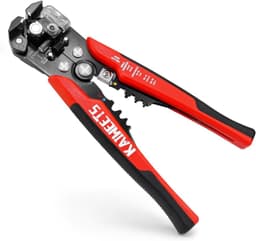
Automatic pliers can strip cores that fit the jaws. The complete flat cable may not. One UK review of the Stanley FatMax says 1.5 mm twin cable would not enter the jaws, and another found the cutter less clean on outer sheath than on inner insulation. A strong core stripper is not automatically a sheath tool. The Knipex 16 64 125 SB is the clearest flat-cable tool in this set. It states flat cable up to 12 mm wide, round cable from 4 to 13 mm, and positions for 0.8, 1.5 and 2.5 mm² cores, in a 48 g body meant for boxes. UK users call the Knipex faster in flush boxes on 1.5 mm², with use also reported on 2.5 mm². Some say the blade only scores the sheath, the clip can fall off and no spare blades are included. Separate the sheath only as the instructions allow. Hilitand claims several calibres but does not number them. Cerlingwee claims push-or-pull sheath removal and 1,000 V language but gives no cable width, and the listing has one rating without review text.

Sheath length, core length and CPC sleeving

Sheath length depends on the enclosure. Sandwich Electrical gives about 50–60 mm of sheath removal for a 25 mm box. That is a worked example, not a universal dimension. Keep the sheath entering the box, and do not expose more conductor than the layout needs. Check the brown and blue insulation all the way around as soon as the sheath opens. A cut or exposed copper means you cut back and start again. Check the bare CPC too. Fit green-and-yellow sleeving over it before you arrange the connection. UK guidance describes that identification as a BS 7671 requirement. Strip the brown and blue cores only after the sheath work is sound. About 8–10 mm is a published rule of thumb for many socket and switch terminals, but the moulded gauge or manufacturer instruction on the accessory takes priority. Insulation must not sit under the metal clamp, and bare copper should not protrude beyond the terminal. The how to strip wire guide covers jaw selection and the inspection for nicked copper.

When the cable end is not good enough

A sheath that only separates on one face needs a check of cable width and blade orientation, not a harder pull. If the inner insulation has been touched, cut back to undamaged material. Tape over a blade mark is not a repair. Stop when there is not enough cable left to remake the end, when insulation is brittle or heat-damaged, or when you cannot prove the circuit dead. Also stop if the work extends into a consumer unit or unfamiliar fixed wiring. Do not feed a socket tail into a scrap machine such as the HYEPNED or Qivine. Those are for disconnected round offcuts. The wire stripper buying guide maps each cable job to a tool family.

Common questions

How do I remove the grey sheath without cutting the inner insulation?
Use a method or tool intended for flat cable, keep the blade within its stated capacity and inspect the brown and blue insulation as soon as the sheath opens. If either layer is scored, cut back to sound material rather than covering or terminating the damaged section.
How much grey sheath should I remove?
One UK worked guide gives about 50–60 mm for a 25 mm box, but the required length depends on the enclosure and layout. Keep enough sheath entering the box and avoid exposing more conductor than necessary.
Does the bare earth need sleeving?
Yes. The exposed circuit protective conductor should receive green-and-yellow sleeving for identification. Keep the conductor intact. If it is nicked, stretched or damaged during sheath removal, cut back and remake the end.
What should I do if the blade only scores the sheath?
Follow the tool’s instructions for flexing or separating the scored sheath and keep the inner insulation away from the blade. Do not lever the cable aggressively against the cutting edge. If the tool repeatedly fails, confirm cable fit or use a more suitable method.
When should I call an electrician?
Stop if you cannot prove the circuit dead, the cable is too short to cut back, insulation is damaged beyond the end, or the task involves unfamiliar fixed wiring. A clean strip is not a substitute for competence in the complete electrical job.

Related pages

Sources

Public UK sources for live-work rules, proving dead, and insulated hand tools. Listings checked 16 October 2026. Prices on amazon.co.uk move.

  1. Electricity at Work Regulations 1989, regulation 14 (retrieved 16 October 2026)
  2. HSE HSG85, electricity at work: safe working practices (retrieved 16 October 2026)
  3. HSE GS38, electrical test equipment for use by electricians (retrieved 16 October 2026)
  4. BSI, BS EN IEC 60900:2018 live working hand tools (retrieved 16 October 2026)
  5. Knipex 16 64 125 SB stripping tool (retrieved 16 October 2026)
  6. HSE HSG141, electrical safety on construction sites (retrieved 16 October 2026)
  7. amazon.co.uk listings for these 12 ASINs (retrieved 16 October 2026)