Independent comparisons. We may earn from shop links. More info

Best automatic wire strippers for UK core work

Updated: October 2026

The best automatic wire strippers are the ones that match the conductor you actually need to prepare. In this amazon.co.uk comparison, Stanley FatMax has the strongest review record, while KAIWEETS offers similar stripping controls and crimping at a lower price. Neither should be bought as a guaranteed way to remove the grey sheath from flat twin and earth. This page compares automatic pliers for individual cores. The [stripping tool comparison](/hub/tool-accessories/stripping-tool) covers sheath tools and scrap machines as well. If your conductor fits its jaws, Stanley is the top pick here, with KAIWEETS the lower-priced alternative. A qualifying purchase can earn a commission at no extra cost to you.

The best automatic wire strippers are the ones that match the conductor you actually need to prepare.

Our top picks

On this page

What this page means by best

Best needs a job. Here it means removing a controlled length of insulation from one solid or stranded conductor without cutting the copper. Look for a stated range, a length stop and enough UK reviews to show recurring limits. Amazon rank alone does not prove a clean result on every cable. Stanley and KAIWEETS stand apart because each has thousands of ratings rather than one or two. Stanley shows 4.6 from 12,650 amazon.co.uk reviews. KAIWEETS shows 4.5 from 6,813. Those figures describe buyer sentiment, not a laboratory test, and they are a firmer base than a 5.0 from one or two ratings. Automatic jaws grip, score and pull insulation as you close the handles. A flat-cable tool scores the outer sheath. A crank machine feeds long scrap cable past a blade. If you have not made that distinction yet, start with the wire stripper buying guide.

Stanley FatMax when the core fits

The Stanley FatMax FMHT0-96230 is the top pick for repeated core stripping because it combines that review record with self-adjusting jaws, a wire stop, a cutter and crimping positions. Its amazon.co.uk bullets state a 0–6 mm² range and the title uses 10–22 AWG. Stanley’s UK product page is more specific: 0.2–6 mm² for a single cable, up to 10 mm² for multiple cables, and a strip-length stop adjustable from 6 to 18 mm. Keep those lines separate rather than blending them into a wider promise. UK buyers mention saving time on a house rewire and on an electrical college course. At about £21.61 it is not the cheapest pliers in the set. Its limit appears when wire really means a complete flat cable. One UK reviewer says 1.5 mm twin cable would not enter the jaws. Another found the cutter acceptable on thin inner insulation but less clean on an ordinary outer sheath. Buy Stanley when the conductor fits the published range, and skip it when your first job is opening the grey sheath.

KAIWEETS when price and crimping matter

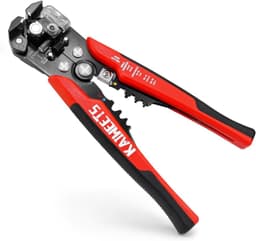
The KAIWEETS KWS-103 costs about £12.74, almost £9 less than Stanley. It strips, cuts and crimps insulated terminals, with a pressure knob and a length stop. The bullet range is 0.2–5.27 mm² and the crimp range is 0.32–5.27 mm². The title says 10–22 AWG, while one bullet says 10–24 AWG, so confirm compatibility at the edge rather than trusting the broader figure. One UK reviewer reports stripping the grey sleeve and then resetting the knob for the inner cores. Moving between layers may need a different pressure setting, and one successful cable does not turn the pliers into a purpose-built sheath cutter. For routine core ends and occasional insulated-terminal crimping, it is the best value choice in this comparison. Choose KAIWEETS when price matters and the stated range covers your conductors. Choose Stanley when the deeper review record and the clearer UK specification justify the extra spend.

Who should not buy either

Anyone whose first job is the grey sheath should use a dedicated sheath tool. The Knipex 16 64 125 SB states flat cable up to 12 mm, with the usual limits of an incomplete score and no spare blades. The twin and earth guide explains the sheath-then-core sequence. Tinminx looks tempting at about £7.99, with a 14–24 AWG claim, a length stop and pressure adjustment. Its perfect rating comes from only two reviews, and the listed 20 g weight is questionable for a 16.5 cm carbon-steel tool. Funnytek also has two reviews, gives no stripping range, and adds a detector that is not documented as suitable equipment for proving dead.

Common questions

Is KAIWEETS good enough for occasional DIY work?
Its 4.5 rating from 6,813 reviews, pressure adjustment, stop, cutter and insulated-terminal crimper make it a credible lower-priced choice. Confirm the conductor range first because its title and bullet disagree between 10–22 and 10–24 AWG.
Will automatic pliers strip twin and earth?
They may strip individual brown or blue cores if those fit the jaws, but the complete flat cable is a separate question. One Stanley reviewer could not insert 1.5 mm twin cable. Use a method or tool intended for the outer sheath.
Why do some electricians prefer side cutters?
An experienced user may work quickly with a familiar cutter and judge pressure by feel. Automatic pliers trade some compactness for repeatability and a length stop. Neither approach excuses damaged copper, and inexperienced users should not copy a fast cutting technique without understanding the risk.
Do crimp jaws make one model better?
Only when you need them and the stated die range matches your terminals. KAIWEETS states 0.32–5.27 mm² for insulated terminals. A vague multi-function claim without sizes is less useful than a compatible stripping range.
Can a five-star product with two reviews be a top pick?
Not on that evidence alone. A tiny sample may contain no recurring complaints and can change sharply with one new rating. Review depth, specification quality, task fit and price all belong in the decision.

Related pages

Sources

Public UK sources for live-work rules, proving dead, and insulated hand tools. Listings checked 16 October 2026. Prices on amazon.co.uk move.

  1. Electricity at Work Regulations 1989, regulation 14 (retrieved 16 October 2026)
  2. HSE HSG85, electricity at work: safe working practices (retrieved 16 October 2026)
  3. HSE GS38, electrical test equipment for use by electricians (retrieved 16 October 2026)
  4. BSI, BS EN IEC 60900:2018 live working hand tools (retrieved 16 October 2026)
  5. Knipex 16 64 125 SB stripping tool (retrieved 16 October 2026)
  6. HSE HSG141, electrical safety on construction sites (retrieved 16 October 2026)
  7. amazon.co.uk listings for these 12 ASINs (retrieved 16 October 2026)