Independent comparisons. We may earn from shop links. More info

How to strip wire without damaging the conductor

Updated: October 2026

How to strip wire is about leaving sound copper for the terminal. Disconnect the supply, isolate it and prove the conductor dead with suitable equipment before you pick up a tool. Then match the stripper, remove only the required length and inspect the end. This guide covers a single core or short flex end. Flat twin-and-earth sheath needs a separate method. The [stripping tool comparison](/hub/tool-accessories/stripping-tool) shows the different tool types, but no product compensates for a live conductor or a damaged end. A qualifying purchase can earn a commission at no extra cost to you.

How to strip wire is about leaving sound copper for the terminal. Disconnect the supply, isolate it and prove the conductor dead with suitable equipment before you pick up a tool.

Our top picks

On this page

Strip only cable you have proved dead

Do not rely on a wall switch, a consumer-unit label or a detector built into the pliers. Electricity at Work Regulations 1989 regulation 14 sets a high bar for work on or near live conductors. Isolate the circuit and prove it dead with suitable equipment before you touch the copper. If you cannot do that confidently, stop and use a competent electrician. The Funnytek listing claims an integrated voltage detector, but it does not describe a two-pole indicator conforming to BS EN 61243-3 or the GS38 approach. Do not treat it as proof that a wire is safe to handle. Tinminx says to use its stripper on disconnected wires only. Leave enough undamaged cable to cut back if the first attempt fails, and identify the terminal’s strip length before you cut. If the wire is inside flat grey installation cable, use the twin and earth method for the sheath and the circuit protective conductor.

Set the jaw or hole, then pull straight

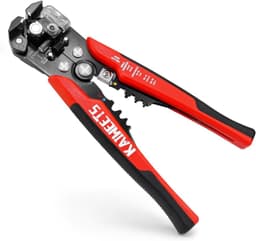
With a fixed-hole stripper, choose the opening for that conductor. Close the handles and pull the waste straight off. A smaller hole can score solid copper or sever strands. If the insulation does not release, reopen the tool and reassess the size rather than twisting against the copper. Self-adjusting pliers such as the Stanley FatMax grip and pull in one squeeze. Set the length stop to the terminal, not to the tool’s full travel. Stanley’s stop adjusts from 6 to 18 mm, which is the adjustment range, not a required strip length. KAIWEETS adds a pressure knob. Use only enough pressure to cut the insulation, and reset it when the insulation changes. Hold the section behind the cut steady and pull along the conductor axis. A conductor entering at an angle can take a deeper mark on one side. Do not use a drill-powered scrap machine as a shortcut for a short terminal end.

Look for a nick before you terminate

Rotate the stripped end under good light. A solid conductor should have no ring, notch or flat where the blade sat. Stranded wire should keep every strand. BEAMA installer guidance calls for undamaged conductors and no broken strands, including outside a consumer unit. If you see a nick, cut off the damaged section and strip again. Do not hide the mark inside the terminal, and leave enough cable for that second attempt. If repeated attempts keep cutting copper, the hole, jaw pressure or tool type is wrong. The wire stripper buying guide separates a core stripper from a sheath or scrap tool.

How long to strip

The required length comes from the accessory, not from this page. Many sockets and switches have a moulded strip gauge, and that mark wins. BuildWiz gives about 8–10 mm for many socket and switch terminals. DIY Doctor uses about 12–15 mm in its example. Both are published rules of thumb, not a legal dimension. Insulation must not sit where the terminal should clamp copper, and bare copper should not stick out of the terminal. Cut the conductor square, set the stop if the tool has one, and compare the end with the accessory gauge before you tighten anything. Do not transfer an 8–10 mm core-strip figure to the grey sheath of twin and earth. A scrap machine’s 1–25 mm claim usually describes outside diameter, not how much insulation to remove from a terminal end.

Stop when the job extends beyond stripping

Stop if the circuit cannot be identified, the cable is too short to cut back, the insulation is heat-damaged, or the copper is blackened beyond the end. A damaged accessory or repeated tripping needs diagnosis, not a cleaner strip. Do not move from this guide into a consumer unit or unfamiliar fixed wiring. A sound stripped end for a competent person can be the right stopping point.

Common questions

How much insulation should I remove?
Use the strip gauge or instruction supplied with the terminal. About 8–10 mm is published for many socket and switch terminals, while another UK guide uses 12–15 mm in its example. Those are rules of thumb, not one length for every connection.
Can I use a built-in voltage detector to prove dead?
Not on the evidence in this comparison. The Funnytek detector is not documented as a suitable two-pole proving device. Follow a proper safe-isolation procedure with appropriate equipment, and call an electrician if you cannot do that confidently.
What if the insulation will not pull off?
Release the tool rather than twisting harder. Check the conductor size, jaw pressure, blade condition and tool type. A fixed hole that is too large may not cut enough. One that is too small may damage the metal.
Should I twist stranded wire?
Keep all strands together and inspect for broken ones, but follow the terminal maker’s preparation instructions. Do not remove loose-looking strands to make the end fit, because that reduces conductor cross-section. Use a terminal sized for the complete conductor.
Is the method different for twin and earth?
Yes. You first remove the flat grey sheath without damaging the brown and blue insulation, then sleeve the bare circuit protective conductor and strip the individual cores to the terminal requirement. Use the dedicated twin-and-earth guide for that sequence.

Related pages

Sources

Public UK sources for live-work rules, proving dead, and insulated hand tools. Listings checked 16 October 2026. Prices on amazon.co.uk move.

  1. Electricity at Work Regulations 1989, regulation 14 (retrieved 16 October 2026)
  2. HSE HSG85, electricity at work: safe working practices (retrieved 16 October 2026)
  3. HSE GS38, electrical test equipment for use by electricians (retrieved 16 October 2026)
  4. BSI, BS EN IEC 60900:2018 live working hand tools (retrieved 16 October 2026)
  5. Knipex 16 64 125 SB stripping tool (retrieved 16 October 2026)
  6. HSE HSG141, electrical safety on construction sites (retrieved 16 October 2026)
  7. amazon.co.uk listings for these 12 ASINs (retrieved 16 October 2026)