Independent comparisons. We may earn from shop links. More info

Wire stripping machines for scrap copper cable

Updated: October 2026

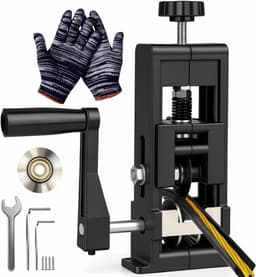
A wire stripping machine for scrap copper makes sense with metres of disconnected offcut, not one end in a back box. These machines pull round cable under an adjustable blade by crank or drill. The ranges are outside diameter, and the base needs mounting before powered use. This guide compares the HYEPNED, Qivine and generic MWS0002 machines at roughly £22–£25, then separates them from Miangerrn’s drill-bit set. See the [stripping tool comparison](/hub/tool-accessories/stripping-tool) for all product types. A qualifying purchase can earn a commission at no extra cost to you.

A wire stripping machine for scrap copper makes sense with metres of disconnected offcut, not one end in a back box. These machines pull round cable under an adjustable blade by crank or drill.

Our top picks

On this page

When a machine beats a pliers stripper

Pliers take a short length off a terminal end. A scrap machine slits the covering along a longer disconnected cable so the copper can be separated. A few mixed offcuts may not repay the setup. Repeated lengths of one known diameter are the case for a fixed machine. Measure outside diameter before you shop. HYEPNED claims 4–25 mm and Qivine claims 1–25 mm. That is not 4–25 mm² of conductor. One HYEPNED buyer reports failure on 5 mm cable even though that size sits inside the advertised range. All cable must be disconnected and free from a supply. A scrap machine is not a way to strip an installed tail, and a drill drive adds rotating parts beside an exposed blade. If your task is preparing a single core for a terminal, use the how to strip wire guide and an appropriate pliers stripper instead.

HYEPNED, Qivine and the generic machine

HYEPNED has the deepest record of the three, and it is still modest: 4.0 from 19 amazon.co.uk reviews. It weighs 1.42 kg, claims 4–25 mm, and needs a drill chuck of at least 10 mm if you do not use the crank. One buyer reports failure on 5 mm cable. The base has bolt holes and is described as thin. Qivine costs about £21.99 and weighs 860 g. The listing claims 1–25 mm, spare blades and a glove. One buyer received it without instructions. The 3.5 from nine reviews is the weakest average here. The generic MWS0002 lists 1.6 kg, an aluminium body and four mounting holes. Both UK reviews are positive, and there are only two. The title says 1.5–25 mm while the bullets say 1–21 mm and also print 10–24 AWG. Use 21 mm as the cautious ceiling unless the seller gives one coherent figure. At about £24.99 it is no cheaper than HYEPNED.

Drill, chuck and fingers

Bolt the base down before you turn the crank or fit a drill. Holes only help when the fixings actually stop the frame moving. A loose machine can pull your hand towards the feed if the cable catches. Set the blade on a short disconnected sample first, and keep the cable in line with the roller. HYEPNED specifies a drill chuck of at least 10 mm. Run it slowly enough that you can stop a jam. Stop the drill before you change blade depth or clear insulation. Keep fingers, loose sleeves and jewellery away from the shaft and the blade. Qivine claims that a glove is included. A bundled glove is not a safety certification, and loose material can snag. If instructions are missing, do not improvise drill operation.

A drill-bit set is a different tool

The Miangerrn product does not feed cable lengths through a bench frame. It supplies five colour-coded heads intended to strip short wire ends in a drill, plus a conical head for twisting several stripped conductors. The title says 10–16 AWG, but a bullet names 10, 12 and 14 AWG before referring vaguely to other common sizes. It requires low-speed drill use. Its 5.0 comes from one rating, with no review text. It is not a smaller HYEPNED, and it does not belong in a decision about metres of scrap cable. The wire stripper buying guide explains the differences between core pliers, sheath tools and scrap machines.

What the listings do not establish

None of these listings says what a scrap yard will pay, or whether stripping raises the return after your time. Ask the recycler before you buy a machine for the money. Do not invent a price per kilogram. Insulation hardness, cable construction and blade setup still decide the result. Buy for a repeat batch of measured, disconnected cable you are entitled to process, not for the widest number in the title.

Common questions

Is a machine worth buying for a few offcuts?
Usually only if the offcuts are long enough and similar enough to justify mounting and adjustment. For a small mixed handful, manual preparation may take less time. A machine becomes more useful when repeated lengths share a known outside diameter.
Should I bolt the stripper down?
Yes. Use the provided mounting holes and a stable bench before powered operation. A secure base helps stop the frame moving when cable catches. Mounting does not remove the need to keep hands clear and stop power before adjustments.
Why do the generic specifications disagree?
The listing appears to combine a 1.5–25 mm title with 1–21 mm bullets and an unrelated AWG line. The available evidence does not reconcile them. Treat the lower ceiling cautiously and ask the seller about your measured cable.
Can I strip cable that is still connected?
No. Disconnect, isolate and prove the cable dead before any stripping. A drill-powered machine is for loose scrap on a stable bench, not installed wiring. If the cable’s status is uncertain, do not feed it into the machine.
Is the Miangerrn drill set a scrap machine?
No. It uses drill-mounted heads for short wire ends and includes a separate twisting head. It does not feed cable lengths through a bench-mounted blade, and its evidence is limited to one rating without review text.

Related pages

Sources

Public UK sources for live-work rules, proving dead, and insulated hand tools. Listings checked 16 October 2026. Prices on amazon.co.uk move.

  1. Electricity at Work Regulations 1989, regulation 14 (retrieved 16 October 2026)
  2. HSE HSG85, electricity at work: safe working practices (retrieved 16 October 2026)
  3. HSE GS38, electrical test equipment for use by electricians (retrieved 16 October 2026)
  4. BSI, BS EN IEC 60900:2018 live working hand tools (retrieved 16 October 2026)
  5. Knipex 16 64 125 SB stripping tool (retrieved 16 October 2026)
  6. HSE HSG141, electrical safety on construction sites (retrieved 16 October 2026)
  7. amazon.co.uk listings for these 12 ASINs (retrieved 16 October 2026)