Independent comparisons. We may earn from shop links. More info

How to fit a Heimeier thermostat

Updated: October 2026

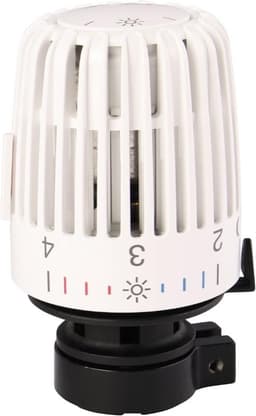
You already have a Heimeier head that matches the valve, and you are about to drain the whole house for a job that usually stays dry. How to fit a Heimeier thermostat, when the part in your hand is only the head, is a hand swap, a pin test, and a dial setting. If the pin will not spring, or water appears, you stop. The [Heimeier thermostat](/hub/thermostats/heimeier-thermostat) comparison is the catalogue, not the method. Listings were captured on amazon.co.uk on 15 October 2026. We did not run a lab test. A qualifying purchase through our links can earn a commission at no extra cost to you.

You already have a Heimeier head that matches the valve, and you are about to drain the whole house for a job that usually stays dry.

Our top picks

On this page

Change the head without draining

A matching head comes off and goes on without draining the radiator. The water stays behind the valve. What you undo is the ring that clamps the head onto the insert, not a compression joint on the pipe. UK guides say to set the old head to a high number first, so it is not pressing the pin hard, then unscrew the ring by hand. Turn the heating off until you know the pin is free. A new body, a new olive, or a weeping gland needs a drain. A dial does not. Set the old head high, switch the heating off, unscrew the clamping ring by hand, and look at the pin before the new head goes on. If the pin springs, fit the new head by hand until the ring is firm, not crushed. If the ring needs force, stop.

Check the pin

The pin is the small metal stud in the centre of the insert. With the head off, it should spring back when you press it gently and let go. A pin that returns means you fit the new head. A pin that stays down means the new head sits on a valve that cannot open, and the radiator stays cold however you set the dial. Press with a thumb, once. Do not lever it with pliers, and do not oil it. If it will not move, the fault is in the insert or the body, and a new Heimeier head will not repair it. Call an engineer, especially on a sealed system you are not used to refilling. One amazon.co.uk review of the RAVL-pattern head describes a unit that did not open or close the radiator. That can be a bad head, or a pin that was already dead. The test tells you which. Who may work on the controls is covered in who can fit a thermostat in the UK.

Set number 3, then leave it

On a standard Heimeier K with marks 1–5, IMI’s sheet treats number 3 as about 20 °C in a climatic chamber, with about 4 °C between numbers. Right is cooler, left is warmer. Setting 1 on a 6–28 °C head is the frost mark, about 6 °C. It is not a living-room setting. IMI’s rule of thumb is about 6% more heat per degree. That percentage is their rule, not a measured saving for these shop heads. Number 3 is not a thermometer at the sofa. Energy Saving Trust says to start at a middle setting and then use the lowest setting you are comfortable with. If the room overshoots, turn it down one mark and leave it. A K-Eco head does not use marks 1–5. The bullets for 6071-43.500 print minus as 16 °C, Eco as 20 °C, and plus as 24 °C. If the head will sit behind curtains or in a tight niche, that case belongs on the Heimeier remote sensor thermostat page. Do not fit a thermostatic head in the room where the wall thermostat lives, unless the system was designed that way. The head only controls that radiator.

When this is no longer a DIY job

Stop when water appears at the gland, the pin will not move, or the ring will not start because the head is the wrong pattern. The V-exact II at about £19.39 is a body, not a dial you can swap dry. Stop if you are unsure on a sealed system. Refilling, inhibitor, and pressure are part of a body change. The careful version is heating off until the pin is free, ring by hand, no force. If the nut will not start on a Danfoss collar, you have the wrong connection. The check is the Heimeier vs Danfoss thermostat page. After a successful swap, set the middle mark, leave the head in free air, and judge the room after the heating has run. If the radiator stays cold and the pin sprang, look at the lockshield, the boiler, and whether this room should have a TRV at all.

Common questions

Do I have to drain the system to change a Heimeier head?
No, not for a matching head. The joint you undo is the clamping ring on the insert. Drain when you are changing the valve body, the olive, or anything that lets water out. Set the old head to a high mark first so it is not hard down on the pin, turn the heating off until you know the pin is free, and do the ring by hand.
Which way do I turn it for warmer?
On a Heimeier K, left is warmer and right is cooler. That is IMI’s own wording for the dial, and it is the detail many generic UK guides leave out. A higher number is warmer on a 1–5 head. On a K-Eco, plus is the warmer of the three printed marks, at 24 °C on the Amazon bullet, and Eco is 20 °C.
What room temperature is number 3?
About 20 °C in IMI’s climatic-chamber figure for a standard K head, with about 4 °C between the numbers. It is a basic setting for the sensor in the head, not a guarantee that the sofa will read 20 °C. Start there, then use the lowest mark that keeps the room comfortable, which is also what Energy Saving Trust suggests for TRVs in general.
What is the frost mark for?
On a 6–28 °C head, setting 1 is frost protection at about 6 °C. Use it when the room can stay cold but must not freeze, for example while you are away. It is not the setting for a lived-in room. The K-Eco listing names frost protection on its scale without printing a 1–5 frost number, so use the frost symbol on the head you actually fitted.
When do I stop and call someone?
Call someone if water appears, if the pin will not move, if you would have to change the body or the olive, or if you are not confident refilling a sealed system. Also stop if the head’s connection does not match the collar. A RAVL head on an M30 valve, or an M30 head on an RA collar, will not become a fit because you tightened it harder.

Related pages

Sources

Public sources are IMI head data, BS EN 215:2019, Approved Document L, the BEAMA installer factsheet, and Energy Saving Trust. Listings are the amazon.co.uk captures for these eight ASINs on 15 October 2026, not a live reload. Prices on amazon.co.uk move. A KEYMARK line on an IMI datasheet is not a mark on an ASIN that does not print it.

  1. IMI thermostatic head K (retrieved 15 October 2026)
  2. IMI heads for other manufacturers (retrieved 15 October 2026)
  3. IMI UK TRV pack Eclipse (retrieved 15 October 2026)
  4. BSI, BS EN 215:2019 (retrieved 15 October 2026)
  5. Approved Document L Volume 1 (retrieved 15 October 2026)
  6. BEAMA TRV factsheet (retrieved 15 October 2026)
  7. Energy Saving Trust, thermostats and heating controls (retrieved 15 October 2026)
  8. amazon.co.uk listings in this set (retrieved 15 October 2026)