Independent comparisons. We may earn from shop links. More info

Heimeier remote sensor thermostat

Updated: October 2026

The radiator in the bay is behind lined curtains, or it sits in a cabinet with a 40 mm gap, and the room never quite warms even though the pipe at the valve is hot. A Heimeier remote sensor thermostat is the tool for that room, and it is wasted money if the head is already in free air. A built-in sensor in a hot enclosure reads the enclosure and throttles the radiator early. The [Heimeier thermostat](/hub/thermostats/heimeier-thermostat) comparison lists both capillary heads next to the ordinary dials. Listings were captured on amazon.co.uk on 15 October 2026. We did not run a lab test. A qualifying purchase through our links can earn a commission at no extra cost to you.

The radiator in the bay is behind lined curtains, or it sits in a cabinet with a 40 mm gap, and the room never quite warms even though the pipe at the valve is hot.

Our top picks

On this page

When a built-in head is in the wrong place

IMI’s K datasheet puts remote-sensor models on a short list of awkward sites: curtains, radiator facings, other obstructions, vertical mounting, and tight niches. A built-in sensor must not be covered. The sensor is in the head. If that head is in a warm pocket, it thinks the room is warm and closes the valve while the rest of the room is still cool. People then turn the dial to 5, which does not fix a sensor that is sitting in trapped heat. Danfoss’s RAS-C installer sheet says the same thing for TRVs in general, not as a Heimeier specification. Do not cover the sensor with curtains or furniture. If you must, use a remote sensor. The sheet also says a TRV does not turn the boiler off, and that the room with the wall thermostat should not rely on a TRV. Drayton and Myson notes treat a 2 m capillary as a normal UK answer for a head behind curtains, mounted where air can move, not in sun or a draught. Those are other brands. They describe the pattern. They are not a Heimeier length you can copy onto a box without reading the title. A vertical valve in a narrow alcove fails the same way. The head is beside the radiator, in rising heat, even when no curtain touches it. That is a remote-sensor job. An ordinary K head on an open wall under a window is not. Buy the capillary only when the sensor cannot see the room, and measure the run before you choose 2 m or 5 m.

2 m heat-conducting base or 5 m remote adjuster

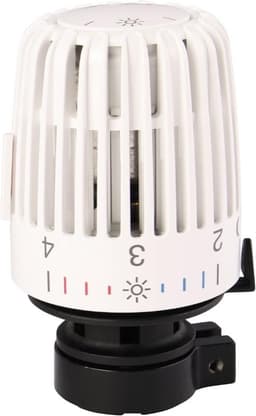
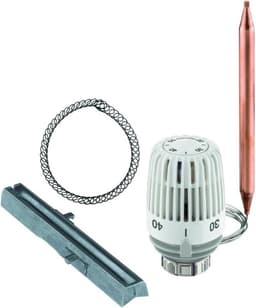
This scrape has two listings, and they are not the same product with two lengths. Article 6402-00.500 is about £58.92. The title is a thermostat head with a heat-conducting base and a hairspring, sold as a 2 m version. The German word on that title, Wärmeleitsockel, means the heat-conducting base. The head is metal, 280 g, and the included-components line says only 1. No thread is printed. There is no review line. The attribute grid adds Alexa, Google Assistant, Zigbee, and 230 V. Those lines conflict with the title. This is not a voice-controlled thermostat. Article 2805-00.500 is about £64.15. The title is a thermostatic head remote adjuster with a capillary tube of 5 m, and the box line says the 5 m tube. Frost protection is named in special features. Materials are metal and plastic, 136 g, silver and white. There is no review line, and the connection is not printed. The page asks whether it fits any radiator and whether instructions are included, and it does not answer. The grid also says Wi-Fi, BACnet, and 230 V. Ignore those. Trade descriptions of the same article number call it thermostatic head F, a remote adjuster, liquid-filled, with frost protection, sometimes 0–27 °C and sometimes 6–27 °C, M30×1.5, and mountable on a switch box. That is a trade description of 2805-00.500. It is not text on this amazon.co.uk page. Do not order it as if the listing had printed M30. The 5 m head is a remote adjuster: the dial that you turn can leave the radiator and sit where you can reach it, with the capillary between. The 2 m listing is a head whose title states a heat-conducting base, a hairspring, and 2 m. It does not say remote adjuster. If you need to set the temperature from a switch box outside a cabinet, the 5 m title is the one that says remote adjuster. If you only need the sensing point out of the curtain and the dial can stay at the radiator, look at whether 2 m is enough before you pay for 5 m. Neither listing proves the thread. Match that yourself on the Heimeier thermostat buying guide before checkout. Measure the route, including skirting, the back of a sofa, and a door frame, before you decide. A straight-line guess of 1.5 m often becomes more than 2 m once the tube is not allowed to kink across a hinge.

Where the sensing end has to sit

The sensing end has to sit in air that stands for the room. That means free air at about sitting height if you can arrange it, not on the radiator casing, not in a patch of afternoon sun, and not in a draught from the letterbox. Danfoss’s sheet and the other UK remote-sensor notes agree on that pattern: uncovered, out of sun, out of draught. IMI’s reason for a remote sensor is the same list of obstructions. Mount the phial where you would be willing to trust a room thermometer, then dress the tube so it cannot be trapped by a window or a vacuum cleaner. Do not cut the tube to tidy a loop. A capillary is a sealed liquid line. Shortening it destroys the sensor, and there is no coupling in either Amazon box line that would make a cut legitimate. Coil the spare neatly, in a radius the tube will accept, and keep the coil off the hot radiator surface. If 5 m is more than the room needs, the spare stays coiled. If 2 m will not reach the free-air spot without crossing a doorway, the 2 m head is the wrong length, not a head you extend with tape. The screw-on step, once the thread is known, is the same dry head swap as any other matching Heimeier head: heating off until the pin is free, ring by hand, stop if water appears. That procedure stays on how to fit a Heimeier thermostat. A remote head does not change the pin test. It changes where the sensor lives after the ring is tight.

When to keep a normal head

Keep a normal head when the radiator is on an open wall and the dial sits in the room air. An about £22.75 RAVL head, or an about £19.00 M30 K-Eco, will track that room better than a capillary you did not need, and both cost less than either remote listing. The K-Eco has no reviews. The RAVL head has 285. Neither fact is a reason to buy a 5 m tube for a radiator under a bare window. A remote head is also not a boiler control and not a substitute for the room thermostat. It still only opens and closes one radiator. Energy Saving Trust’s split still applies: programmer and room thermostat for the system, TRV for the room. Underfloor heating is a different circuit. Nothing in these two titles claims a floor probe or a boiler relay. If the grid says Wi-Fi, it is the same attribute-grid conflict as on the mechanical dials. If you are still unsure whether the enclosure is the problem, try the existing head with the curtains fully open and the cabinet door ajar for an evening. If the room then behaves, the sensor was in the wrong air, and a remote head is worth pricing. If the room stays cold with the head in free air and the pin springs, you do not have a sensor-location fault.

Common questions

When does a normal Heimeier head fail even if the thread is right?
When the built-in sensor cannot see the room. Curtains, a radiator cover, a tight niche, or a vertical valve in rising heat make the head close early. The thread can be a perfect M30 or RAVL match and the room will still stay cool. That is a location fault, not a reason to replace the head with another built-in sensor of the same type.
Is a remote sensor the same as a remote dial?
Not on these two listings. The about £64.15 article 2805-00.500 is titled as a remote adjuster with a 5 m capillary, so the control you turn is the part that leaves the radiator. The about £58.92 article 6402-00.500 is titled as a head with a heat-conducting base, a hairspring, and 2 m. It does not say remote adjuster. Read the title for the job, and do not assume both boxes move the dial to a wall plate.
How do I choose 2 m or 5 m?
Measure the path the tube must take, including skirting and frames, not the straight distance across the carpet. If that path is within 2 m and the dial can stay at the radiator, the 2 m title is the one to compare. If the adjuster must sit well away from the radiator, the 5 m remote adjuster is the listing that states that length. Both lack a printed thread and a review line, so length is not the only check.
Where should the phial sit?
In free air that represents the room, away from the radiator surface, out of direct sun, and out of a draught. About sitting height is the usual aim when the wall allows it. Do not leave it on top of a radiator cover or inside the curtain you were trying to escape. Coil spare tube rather than stretching it tight.
Can I shorten the tube?
No. Do not cut a capillary. The liquid fill is sealed, and neither listing includes a join you could use to shorten it. If the 5 m tube is longer than the run, coil the extra. If the 2 m tube is too short, that head does not reach, and cutting and joining is not a repair.
Will this control underfloor heating or the boiler?
No. These are radiator heads. A TRV, remote or not, does not turn the boiler off, which Danfoss’s UK sheet states for radiator thermostats in general. The wall thermostat and the programmer still do that job. Nothing in the Amazon titles claims underfloor heating, a floor sensor, or a boiler relay. Wi-Fi and 230 V on the grids are conflicts, not features.
Is the dearer head more accurate in an open room?
No. In an open room a built-in sensor is the simpler head, and it is cheaper. The about £64.15 remote adjuster has no reviews and no printed connection. You pay for a 5 m tube and a remote dial, which helps when the radiator is enclosed or out of reach. It does not make the temperature reading better when the ordinary head was already in free air.

Related pages

Sources

Public sources are IMI head data, BS EN 215:2019, Approved Document L, the BEAMA installer factsheet, and Energy Saving Trust. Listings are the amazon.co.uk captures for these eight ASINs on 15 October 2026, not a live reload. Prices on amazon.co.uk move. A KEYMARK line on an IMI datasheet is not a mark on an ASIN that does not print it.

  1. IMI thermostatic head K (retrieved 15 October 2026)
  2. IMI heads for other manufacturers (retrieved 15 October 2026)
  3. IMI UK TRV pack Eclipse (retrieved 15 October 2026)
  4. BSI, BS EN 215:2019 (retrieved 15 October 2026)
  5. Approved Document L Volume 1 (retrieved 15 October 2026)
  6. BEAMA TRV factsheet (retrieved 15 October 2026)
  7. Energy Saving Trust, thermostats and heating controls (retrieved 15 October 2026)
  8. amazon.co.uk listings in this set (retrieved 15 October 2026)