Independent comparisons. We may earn from shop links. More info

Parasol base weight and wind

Updated: 22.10.2026

The canopy leans as soon as the tilt is on, or you are about to buy the lightest base because the photo looked stable. A garden parasol is a sail. UK sellers do not publish one base weight, or one wind speed for closing the cloth. This page is that disagreement. The canopies these examples come from are in the [parasol comparison](/hub/sun-shades/parasols).

The canopy leans as soon as the tilt is on, or you are about to buy the lightest base because the photo looked stable. A garden parasol is a sail.

Our top picks

On this page

There is no single UK base weight

Opal, Ruma, and Plia each publish a guide, and the kilograms are not the same. For a sheltered garden, Opal suggests about 20 kg to 25 kg for a 3 m centre pole through a table, and about 40 kg to 50 kg if that pole stands free. Ruma puts up to 2.5 m centre poles at about 15 kg to 25 kg, and 2.5 m to 3 m centre poles at about 40 kg. A 2.7 m parasol falls in those 2.7 m to 3 m lines, not the bistro band. If a listing prints no wind speed, you do not have a rating. How to spot that blank is the buying guide.

Cantilever bases are a different sum

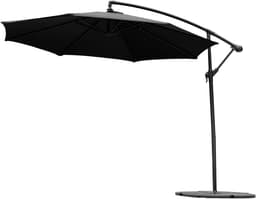
The side arm multiplies the load. Opal's line for a cantilever of about 3 m is 80 kg to 100 kg. Ruma puts a 2.7 m to 3 m cantilever at about 90 kg. Shade Specialists publish about 120 kg for a cantilever around 2.4 m to 3 m. A centre-pole slab, even a heavy one, is the wrong object under that arm. The Harrier 3 m is listed at 14 kg. That is the parasol, not an 80 kg base. The listing does not state a base or a wind speed. The Harrier 2.7 m title says weights are optional. None of these listings prints a wind class. EN 13561 rates awnings, not these canopies.

The printed kilograms are the filled weight

A plastic base that says 20 kg on the label is the filled weight, or the design weight. Water is the convenient fill and the lighter one. Sand is heavier for the same volume, so sand can reach a printed kilogram that water in the same base misses. Every listing here leaves the pole diameter blank. Do not buy a 38 mm collar because it is common. Measure the pole, or wait for the seller.

When to close it

Two instructions both use the number 25, and they are not the same speed. Brollies and Parasols say to close their parasols above 25 km/h, and to store them above 35 km/h. Bolton Council's sheet says to collapse those parasols above 25 mph, printed there as 40 km/h. 25 km/h is not 25 mph. If your listing states no wind speed, it has no wind rating. A Beaufort figure is not a guarantee against gusts. Close the canopy when you leave, when the cloth tugs, and when it is holding rain. The open and close sequence is on the how to put a parasol up page.

If it has already toppled

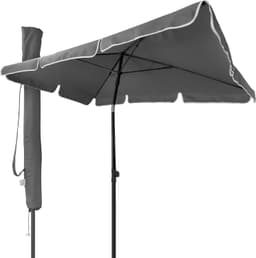
VOUNOT 2.7 m reviews put topples at about 10 kg, call about 11 kg marginal, and say about 20 kg was not enough once the canopy was tilted. That points at ballast and at leaving a tilted sail up. A heavier base is not a storm rating. Keep the tilt off when you are not sitting under it. If it fell on that light foot, change the base before you blame the cloth. Which type you wanted is on the versus page.

Common questions

How heavy a base does a 2.7 m parasol need?
There is no single UK figure. Opal puts a 2.7 m to 3 m centre pole at about 20 kg to 25 kg through a table and about 40 kg to 50 kg freestanding. Ruma uses about 40 kg for a 2.5 m to 3 m centre pole. VOUNOT 2.7 m reviews include topples at about 10 kg, and one complaint that about 20 kg was not enough when tilted.
Does the table count as weight?
Partly. Opal's through-table allowance is lower because the table holds the pole. It does not replace a collar that fits, or closing the canopy. A cantilever mast is not in the hole, so a centre-pole slab under a side arm is the wrong tool.
Sand or water in a fillable base?
Sand is heavier than water in the same base, which is why Opal tells you the fill matters. The kilograms on the product are the filled weight, not the empty shell. A base you leave empty, or only half filled with water, will not match the sticker. Fill it the way the instructions assume before you judge whether the canopy is unstable.
Is 25 mph the UK legal limit?
No. Bolton Council's sheet says to collapse those parasols above 25 mph, printed there as 40 km/h. That is one supplier's instruction, and the warranty note excludes strong-wind damage. It is not a statute. A listing that states nothing has no wind speed.
Why do some guides say 25 km/h?
Because that is a different seller's line. Brollies and Parasols say to close their parasols above 25 km/h and to store them above 35 km/h. 25 km/h is not 25 mph. Follow the sheet you were given. If you were given none, close the canopy when it tugs.
My parasol fell over. Is the canopy faulty or the base light?
Look at the kilograms first. VOUNOT 2.7 m reviews describe topples at about 10 kg to 20 kg, especially tilted. A rib that arrives bent is a point for the seller within 30 days if the goods are not as described. A fall on a light foot is a base problem.

Related pages

Sources

Public UK sources and the amazon.co.uk listings compared on this page. Listings captured 21 October 2026. Updated 22.10.2026.

  1. NHS sun safety (retrieved 22.10.2026)
  2. Met Office UV codes (retrieved 22.10.2026)
  3. GOV.UK ultraviolet FAQ (retrieved 22.10.2026)
  4. BSI BS EN 13758-1:2002 (retrieved 22.10.2026)
  5. General Product Safety Regulations 2005 (retrieved 22.10.2026)
  6. Consumer Rights Act 2015 section 22 (retrieved 22.10.2026)
  7. Opal: parasol base weight (retrieved 22.10.2026)
  8. amazon.co.uk Garden Parasols best sellers (retrieved 22.10.2026)