Independent comparisons. We may earn from shop links. More info

How to put up a garden parasol

Updated: 22.10.2026

The box is open, and the crank, the tilt joint, or the side arm does not match a video for a different brand. Putting a garden parasol up is a sequence for the mechanism you own. Force the wrong one and you bend a rib or strip a crank. The listings behind these examples are in the [parasol comparison](/hub/sun-shades/parasols). What to buy, and when the wind is too strong, are other pages.

The box is open, and the crank, the tilt joint, or the side arm does not match a video for a different brand. Putting a garden parasol up is a sequence for the mechanism you own.

Our top picks

On this page

Put the base on first

Level the base before you think about the canopy. A pole that sits at a slant loads one side of the ribs as soon as you open the cloth, and a cantilever arm makes that lean worse because the weight is already off centre. Seat the pole fully in the collar. Keep fingers off the ribs while the cloth is moving, and do not hang bags on them. Nova's care notes say not to. If the foot feels light, do not open the cloth on a breezy patio. A ground socket is the point where you call a fitter. A household crank on day one is not that job.

A centre-pole crank

Read the arrows on your crank. Do not treat clockwise as a law for every parasol. The SIT sheet says open clockwise until the glider hits the stop, and close anticlockwise. It also says not to crank anticlockwise in an attempt to open. That is that manual. Stop when the cloth snags. Smartwares says to stop at resistance, check the canopy is not wrapped on the ribs, and stop using the parasol if the crank grinds or the frame bends. Free a caught panel with the crank still, then wind again.

Tilt

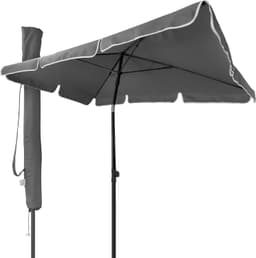
Tilt only after the canopy is fully open and the cloth is clear of the ribs. A button or a joint should move to a stop and stay there. Harbour Lifestyle says a tilt on their own parasols should click. If yours does not click and the listing promised a lock, describe that to the seller. Do not hammer the joint. The rectangular VOUNOT lists a manual tilt, and one review says the tilt went the wrong way. Check the direction on the first move. If the lock will not hold, stop. Lubricant on a stiff tilt is one person's fix, not a method for every joint.

Cantilever and rope parasols

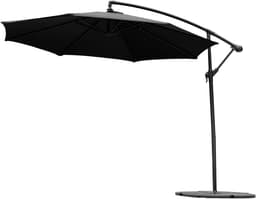
A cantilever does not start at the crank. Suttons' sheet for their offset parasols puts the base down first, then a lock on the arm, then the crank. Just Parasols describes the same order: secure the arm, then open. The longer choice between a side arm and a centre pole is on the versus page. A rope-and-cleat parasol is a third pattern. Bolton Council's sheet for its own parasols says to pull gently, free any rib that sticks, and lock the rope on the cleat without hauling too hard. If you have a rope, you do not look for clockwise.

Close it and store it dry

Closing is the open sequence in reverse. On a crank, wind the way that lowers the runner, and stop if the cloth bunches. Tie the canopy before you walk away, so a gust cannot open a half-closed parasol. The SIT sheet says to close in strong wind, snow, or heavy rain. Nova says to close a parasol when it is unattended, and not to store it damp. The speeds shops publish are on the base and wind page. Holes, a missing crank, or a skirt already coming away are a description problem, not a technique. Section 22 of the Consumer Rights Act 2015 is a 30-day right to reject goods that are not as described.

Common questions

Which way do I turn the crank?
The way the arrow on your handle says, if there is an arrow. One SIT manual says clockwise to open until the glider hits the stop, and anticlockwise to close. That sheet is for that parasol. The VOUNOT reviews describe a crank and do not state a direction. Reverse if the runner moves the wrong way.
What if the canopy is caught?
Stop winding. Check the cloth is not wrapped around a rib, free it with the crank still, then try again. Smartwares says to stop if the crank grinds or the frame starts to bend. Forcing a snag is how a rib takes a set.
How do I tilt it without breaking the joint?
Open the canopy fully first, then move the joint until it holds. One Harrier 2.7 m review describes about 30 degrees, and one VOUNOT review about 45 degrees. Neither figure is a specification. If it will not stay, stop rather than leaning on the joint.
How is a cantilever different to open?
The base is down, the arm is locked, and only then do you crank. That is the order on a Suttons cantilever sheet and on Just Parasols' guide. A centre-pole crank has no arm lock to set first. One Harrier 3 m review says that parasol adjusts and swivels. The specification block does not name the control.
What about a rope and cleat?
Pull gently, free a stuck rib, and lock the rope on the cleat without a hard haul. That is the Bolton Council sequence for the parasols on that sheet. It is not a crank, and it is not a cantilever arm. If your parasol has a handle and no rope, ignore the cleat steps. If it has a rope, ignore clockwise.
The crank will not hold the canopy open. What now?
Stop using it. A crank or lock that will not hold is a fault once the cloth is clear and the runner is rising. If that is true in the first 30 days and the listing described a working crank, section 22 of the Consumer Rights Act 2015 is the short-term right to reject.

Related pages

Sources

Public UK sources and the amazon.co.uk listings compared on this page. Listings captured 21 October 2026. Updated 22.10.2026.

  1. NHS sun safety (retrieved 22.10.2026)
  2. Met Office UV codes (retrieved 22.10.2026)
  3. GOV.UK ultraviolet FAQ (retrieved 22.10.2026)
  4. BSI BS EN 13758-1:2002 (retrieved 22.10.2026)
  5. General Product Safety Regulations 2005 (retrieved 22.10.2026)
  6. Consumer Rights Act 2015 section 22 (retrieved 22.10.2026)
  7. Opal: parasol base weight (retrieved 22.10.2026)
  8. amazon.co.uk Garden Parasols best sellers (retrieved 22.10.2026)