Independent comparisons. We may earn from shop links. More info

Cordless vs air nail gun for second-fix work

Updated: October 2026

You are carrying tools upstairs through a finished house, or standing at a workshop bench with a compressor already running. That setting often decides the cordless vs air nail gun question before brand or battery voltage enters it. Choose cordless when you need to move from room to room without dragging a hose; choose a pneumatic brad nailer when the compressor is already available and a lighter gun will fire repeatedly all day. Our [cordless nailer comparison](/hub/staplers-and-nail-guns/cordless-nailer) covers twelve battery listings, but first make sure the power source suits how and where you work.

You are carrying tools upstairs through a finished house, or standing at a workshop bench with a compressor already running.

Our top picks

On this page

What you are comparing

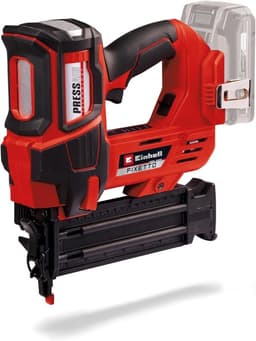
A cordless nailer stores its energy in a battery and an internal drive mechanism. There is no compressor, airline or mains lead running across the floor. Ryobi and Einhell bare tools assume that you already own the correct platform. A pneumatic nailer is the hand-held part of a wider system. Compressed air travels through a hose from a compressor, and the gun converts that air into the driving stroke. The gun can therefore be lighter in the hand because the energy source remains on the floor or bench. Compare like with like. A 4 V craft tacker firing 14–15 mm type 47 nails is not the cordless equivalent of an 18-gauge pneumatic second-fix gun. Decide gauge and fastener length through the cordless brad nailer buying guide, then compare power sources within that class.

When cordless is the better buy

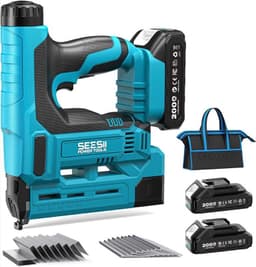
Cordless earns its cost in finished homes. Removing the airline avoids a trip hazard across doorways and finished floors. For one room of trim, a battery tool also avoids owning and storing a compressor that may see little other use. A complete kit such as Seesii or Tacwise includes its own battery and charger, while platform owners can buy a Ryobi or Einhell body. Capacity still overrides convenience. Many kits in this comparison stop around 32 mm, whereas the Ryobi R18GN18-0 and Einhell FIXETTO state 15–50 mm. For skirting, confirm the wall construction and nail length using the cordless nail gun for skirting guide.

When an air nailer is the better tool

Pneumatic makes sense in a workshop where the compressor is already installed and the hose can be routed safely. The gun is usually lighter because it does not carry a battery and internal energy store. An air gun can also continue as long as the compressor supplies the required pressure and duty cycle. Match the gun’s air requirement to the compressor rather than assuming any small unit can keep pace with continuous firing. If you already own a suitable compressor, airline and fittings, a pneumatic brad nailer may be the cheaper addition for occasional bench work. If you own none of them and only need to trim one room, buying the whole air system creates cost and storage for an advantage you may not use. The hose can catch on corners, mark finished surfaces and complicate stairs.

Gas nailers and the final decision

A gas nailer uses a battery for ignition and a fuel cell for the driving cycle. It is cordless in the everyday sense of having no hose, but it is not the battery-only category compared on the main page. Fuel cells create a running consumable. Protrade describes gas impulse tools as the established older route to cordless nailing before battery-only systems became common. Do not add an invented fuel-cell cost to make the comparison look precise. The useful distinction is operational: gas avoids the compressor and hose, but requires fuel as well as charged batteries; battery-only avoids both compressor and fuel cell. For room-to-room second fix with no compressor, choose cordless after confirming gauge and length. For repetitive workshop firing with a suitable compressor already running, choose air for the lighter handpiece and continuous supply. The guide to using a cordless nail gun explains the battery procedure.

Common questions

Is a cordless nailer better than an air nailer?
Cordless is better for mobility through finished rooms and homes without a compressor. Air is better suited to a fixed workshop where the compressor already exists and a lighter gun will fire repeatedly. Neither is universally better; required gauge, nail length and work setting decide.
Do I need a compressor for one room of trim?
Not if a cordless nailer accepts the required fastener. Buying a compressor, hose and gun for one room adds storage and setup that cordless avoids. If you already own a suitable compressor, however, adding an air brad nailer may cost less than joining a battery platform.
Why do pneumatic nailers feel lighter?
The compressor stores and supplies the driving energy away from your hand. A cordless tool carries a battery and internal drive mechanism, adding weight to the body. Exact weights vary, so compare specified tool-only figures rather than package weights.
Is a £30 cordless tacker an air-nailer replacement?
No. The £29.99 BLUEMARS in this set uses short type 47 nails and type 53 staples. It is a craft and upholstery tacker, not the battery counterpart of an 18-gauge pneumatic second-fix nailer. Compare fastener class and capacity first.
What about gas nailers?
Gas tools avoid the hose but use a fuel cell as well as a battery. They remain common in trade contexts, yet have a consumable and their own service considerations. They are a third system, not one of the battery-only amazon.co.uk listings compared here.
Which should I buy if I already own a compressor?
For workshop or bench work, a compatible pneumatic brad nailer is often the sensible addition because the expensive infrastructure is already present. For frequent work across stairs and finished rooms, cordless can still justify its higher hand weight by removing the hose.

Related pages

Sources

Public UK sources and amazon.co.uk listings checked on 15 October 2026. Prices move. No laboratory test.

  1. HSE, nail guns (retrieved 15 October 2026)
  2. HSE, PUWER overview (retrieved 15 October 2026)
  3. Consumer Rights Act 2015 (retrieved 15 October 2026)
  4. Electrical Safety First, nail guns (retrieved 15 October 2026)
  5. GOV.UK, consumer product safety (retrieved 15 October 2026)
  6. Tradefix, skirting board fixings (retrieved 15 October 2026)
  7. Which?, faulty goods (retrieved 15 October 2026)
  8. ITS, brad nailers (retrieved 15 October 2026)