Independent comparisons. We may earn from shop links. More info

Choosing a cordless nail gun for skirting boards

Updated: October 2026

You have cut the skirting, offered it to the wall and now need to know whether the cordless nailer on your bench can hold it. A cordless nail gun for skirting boards works only when the fastener is the right gauge and length and reaches suitable timber; firing a brad into empty plasterboard or brick does not create a sound fixing. Many tools in our [cordless nailer comparison](/hub/staplers-and-nail-guns/cordless-nailer) stop at 32 mm, while UK trade guidance often discusses 38–50 mm fixings. Identify the wall first, then decide whether a nailer belongs in the method at all.

You have cut the skirting, offered it to the wall and now need to know whether the cordless nailer on your bench can hold it.

Our top picks

On this page

Start with the wall construction

On a timber stud wall, the useful target is the stud, not the plasterboard. Howarth Timber’s fitting guidance combines grab adhesive with nails into studs where the wall is not flat. The brad can hold the board while adhesive cures only if it actually enters timber. A solid masonry wall is different. Brads do not gain reliable purchase in brick or block. BuildWiz recommends screws and plugs for masonry rather than treating a nailer as the primary fixing. Dot-and-dab has plasterboard separated from blockwork by adhesive dabs and a variable void. A brad may pass through the skirting and board yet finish in empty space.

Work out the required nail length

There is no single mandatory brad length for every UK skirting job. Tradefix Direct describes adhesive plus 50 mm 16-gauge second-fix nails through skirting and plasterboard into studs. A specialist 18-gauge supplier gives 38–50 mm as a common range for 12–18 mm skirting into timber. The calculation is physical: the fixing passes through the skirting, then any surface layer, and still needs useful penetration into sound timber. A 32 mm brad through 18 mm skirting leaves only 14 mm before accounting for plaster or board. An 18-gauge nailer takes slim brads and cannot accept the 16-gauge nails named by Tradefix. If the job specification calls for 16 gauge, choose a 16-gauge second-fix nailer rather than forcing a similar-length 18-gauge brad into the comparison.

Which compared nailers reach 50 mm?

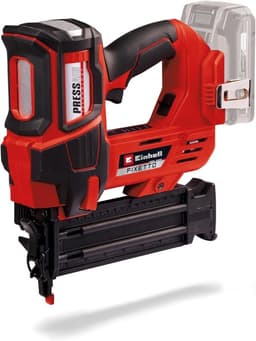
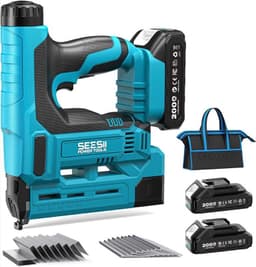
The Ryobi R18GN18-0 and Einhell FIXETTO 18/50 N are the two listings here with a clearly stated 15–50 mm brad range. Both are 18-gauge bare tools, so neither includes a battery or charger. Ryobi suits existing ONE+ owners and adds tool-free depth and jam controls; FIXETTO suits Power X-Change owners and offers depth adjustment plus single or series firing. Capacity is not approval for every wall. You still need a timber target and a fastener gauge appropriate to the job. Their 50 mm maximum also does not accept the 16-gauge nail described in some trade guidance. Seesii, Yofuly, Tacwise and several NEU MASTER 2-in-1 tools state maximum brad lengths around 32 mm. Do not assume missing data means 50 mm. The cordless nailer buying guide explains why body-only prices and platform compatibility matter once the required length is known.

Adhesive, studs and when to use screws

Grab adhesive helps spread the load and holds well where surfaces are clean, sound and reasonably flat. Mechanical fixings may still be needed to pull a bowed board to the wall or hold it while the adhesive sets. On a stud wall, mark studs and place brads into them rather than between them. The safe-use guide covers loading, sequential firing and jam clearing. For masonry or dot-and-dab, choose screws and plugs or a fixing specifically intended for that build-up. Existing Ryobi or Einhell platform owners can consider the respective 50 mm bare tool for 18-gauge fixing into known timber. If you are still choosing a model, the best cordless nailer picks explain who should buy and skip each option.

Common questions

What length brad should I use for skirting on a stud wall?
UK guidance varies: examples include 40 mm lost-head nails, 50 mm 16-gauge nails and 38–50 mm 18-gauge brads. Choose from the actual skirting and wall build-up so the fixing reaches the stud. Gauge and safe penetration matter as well as nominal length.
Can I use a 32 mm brad nailer?
Yes for some thin trim fixed directly to timber, but not as a general skirting answer. A 32 mm brad can leave too little penetration after passing through the board and plasterboard. Measure the layers and compare them with the fixing guidance for your wall.
Will brads hold skirting on dot-and-dab?
Not reliably as a primary fixing. A brad can pass through the plasterboard and end in the void before the masonry. Dot-and-dab normally needs an adhesive strategy and suitable screws or specialist fixings that reach the blockwork without crushing the board.
Do I still need grab adhesive?
Adhesive is commonly used with skirting because it spreads the load and reduces the number of visible fixings. Nails into studs can hold the board while it cures or pull in uneven sections. Use an adhesive suitable for both surfaces and follow its preparation instructions.
Should I choose 18 gauge or 16 gauge?
An 18-gauge brad leaves a smaller hole and suits finer trim, while 16 gauge provides a heavier fixing. Tradefix guidance names 50 mm 16-gauge nails for skirting, whereas specialist suppliers also describe 38–50 mm 18-gauge use. Match the job and buy the corresponding nailer.
Which compared cordless nailers take 50 mm brads?
The Ryobi R18GN18-0 and Einhell FIXETTO 18/50 N state a 15–50 mm 18-gauge range. Both are bare tools without battery or charger. A 50 mm capacity does not make them suitable for masonry or remove the need to locate studs and services.

Related pages

Sources

Public UK sources and amazon.co.uk listings checked on 15 October 2026. Prices move. No laboratory test.

  1. HSE, nail guns (retrieved 15 October 2026)
  2. HSE, PUWER overview (retrieved 15 October 2026)
  3. Consumer Rights Act 2015 (retrieved 15 October 2026)
  4. Electrical Safety First, nail guns (retrieved 15 October 2026)
  5. GOV.UK, consumer product safety (retrieved 15 October 2026)
  6. Tradefix, skirting board fixings (retrieved 15 October 2026)
  7. Which?, faulty goods (retrieved 15 October 2026)
  8. ITS, brad nailers (retrieved 15 October 2026)