Independent comparisons. We may earn from shop links. More info

How to use a cordless nail gun safely

Updated: October 2026

Before you fire the first brad into new skirting or trim, practise on an offcut of the same material. Learning how to use a cordless nail gun starts with matching the fastener, seating the safety nose and making one controlled test shot; speed comes later. Keep safety glasses on, keep your free hand away from the firing line and remove the battery before touching a jammed magazine or nose. Our [cordless nailer comparison](/hub/staplers-and-nail-guns/cordless-nailer) shows which models state sequential firing, depth controls and tool-free jam access, but the exact manual for your model remains the authority.

Before you fire the first brad into new skirting or trim, practise on an offcut of the same material.

Our top picks

On this page

Before you load the nailer

Put on safety glasses even for one nail at home. The Health and Safety Executive’s concern is the projectile and the way it can deflect from timber. Never aim the tool towards yourself or anyone else. Confirm the gauge, crown and length printed in the tool manual. An 18-gauge brad does not belong in a 16-gauge magazine, and type 53 staples are not interchangeable with narrow-crown type 91 staples. Charge with the original compatible charger. Electrical Safety First advises using the correct charger and not leaving charging equipment running overnight. Fit the battery only after the magazine is closed and your hands are clear of the trigger.

Fire one nail in sequential mode

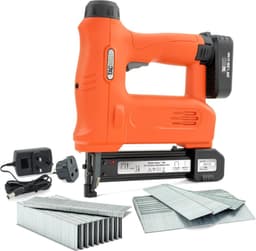
Place scrap of the same thickness and species on a stable surface with safe backing beneath it. Hold the nailer square to the face; an angled nose can leave the head proud or drive the brad towards an edge. With your finger initially outside the trigger, press the contact nose firmly onto the marked point. Then pull the trigger once, release it and lift the nose before repositioning. That nose-then-trigger order is sequential firing. Tacwise states sequential firing only. Never tape, wedge or otherwise defeat the contact trip to make a reluctant tool fire. Keep the other hand well away from the line of the nail. On skirting, first establish that the planned fixing reaches a stud and will not enter a known cable or pipe route; the skirting-board fixing guide covers wall types in detail.

Set depth on matching scrap

The usual finishing aim is a head just below the surface, leaving a small hole for filler without crushing the face. The direction of the dial is model-specific and must not be copied from another tool as a universal rule. If the head stands proud, check the simple causes before increasing depth. Is the battery charged? Is the brad within the stated range? Is the nose held square and fully seated? Do not keep turning the control after two or three consistent failures in representative scrap. The cordless nailer buying guide explains gauge and length trade-offs. An overdriven brad is also a failure. Reduce depth and repeat the test.

Clear a jam or diagnose proud nails

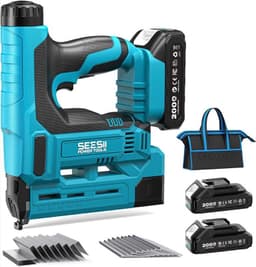
Stop immediately if the sound changes, the magazine stops feeding or a brad is visible at the nose. Engage the trigger lock if fitted, remove the battery and keep the nose pointed in a safe direction. Open the magazine, remove the remaining strip and follow the manual’s jam-release sequence. Ryobi and Seesii state tool-free jam access, but “tool-free” never means “battery attached”. Do not pull at a bent brad while your finger rests on the trigger. If jams recur after a short run, verify the exact gauge, collation and length rather than forcing another strip. A 32 mm DIY 2-in-1 is not made more powerful by selecting contact mode, and a 4 V craft tacker does not become an 18-gauge gun through technique. At work, PUWER duties and employer training apply in addition to the practical precautions described here. See nail gun rules at work.

Common questions

Where should I put my hands?
Keep the hand holding the material away from the nose, the nail’s path and the far side of the work. Clamp narrow trim rather than holding it close to the firing point. A brad can bend with the grain or emerge through an edge, so distance matters even when the intended path looks clear.
How do I know the depth is correct?
Test on matching scrap. For finishing work, the head should normally sit just below the surface without a deep crater or crushed fibres. Adjust one step at a time and follow your model’s manual, because control direction and scale are not universal.
Why will the nailer not fire?
Check that the battery is charged and fully seated, the trigger lock is released, the magazine contains the correct fasteners and the contact nose is firmly pressed down. If it still fails, remove the battery and inspect for a jam according to the manual. Never bypass the safety nose.
How do I clear a jam safely?
Lock the trigger if possible, remove the battery and unload the magazine first. Open the authorised nose or jam-release mechanism, remove the bent fastener and check for fragments. Reassemble before refitting the battery. If the same jam returns, stop and verify fastener compatibility.
Should I use bump mode?
Use sequential mode as the default. HSE guidance treats repeat-fire systems cautiously and limits their suitability to particular short-fastener and thin-material applications. Bump mode is not appropriate for learning, ladders or careful trim placement, and some tools such as the Tacwise are sequential only.
When should I stop and call a professional?
Stop when the fixing is structural, you cannot identify safe backing, hidden pipes or cables may be present, or the chosen nail will not provide a sound hold. At work, an employee also needs proper instruction and the employer’s safe system, rather than learning from a consumer guide.

Related pages

Sources

Public UK sources and amazon.co.uk listings checked on 15 October 2026. Prices move. No laboratory test.

  1. HSE, nail guns (retrieved 15 October 2026)
  2. HSE, PUWER overview (retrieved 15 October 2026)
  3. Consumer Rights Act 2015 (retrieved 15 October 2026)
  4. Electrical Safety First, nail guns (retrieved 15 October 2026)
  5. GOV.UK, consumer product safety (retrieved 15 October 2026)
  6. Tradefix, skirting board fixings (retrieved 15 October 2026)
  7. Which?, faulty goods (retrieved 15 October 2026)
  8. ITS, brad nailers (retrieved 15 October 2026)