Independent comparisons. We may earn from shop links. More info

Welding helmet or goggles for arc work?

Updated: 18 October 2026

You are about to make a short MIG repair, and welding goggles seem cooler and lighter than a full shell. The choice between a welding helmet or goggles is not mainly about comfort. Goggles protect the eyes. A helmet or welding shield covers the face against the arc and spatter. For MIG, TIG and stick, goggles alone are the wrong primary protection. Our [welding helmet comparison](/hub/soldering-and-welding/welding-helmet) covers head-worn auto-darkening shields. This page is about when goggles still have a job, and why neither option controls welding fume.

You are about to make a short MIG repair, and welding goggles seem cooler and lighter than a full shell. The choice between a welding helmet or goggles is not mainly about comfort. Goggles protect the eyes.

Our top picks

YESWELDER YESWELDER LYG-L600A

Best overall

YESWELDER YESWELDER LYG-L600A
8.6/10about £37.04
TOOLIOM TOOLIOM TL-31800H

Rank 2

TOOLIOM TOOLIOM TL-31800H
9.0/10about £54.14
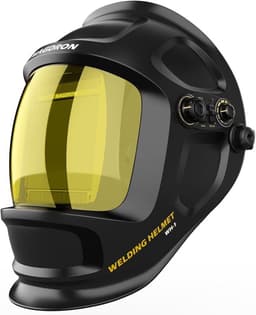
Magdron Magdron WH-1

Alternative

Magdron Magdron WH-1
8.5/10about £79.98
On this page

What goggles cover and what they leave open

Welding goggles put a filtered lens around the eyes. A marked shade can suit some gas-welding or cutting tasks where the risk assessment does not require a face shield, and clear safety goggles are right for chipping slag or wire-brushing after the arc. A shade-5 product can be marked to EN 166 and EN 169 and still be eye protection, not an arc-welding face shield. Shade does not cover your cheeks, forehead and neck. That open skin matters during arc welding. MIG and stick can throw hot spatter, and the arc exposes skin as well as eyes. HSE-linked PPE selection guidance says that arc-welding goggles do not give adequate protection without a face shield or welding shield. For MIG, TIG or stick, use a suitable helmet or shield over the face. Goggles still belong near welding. HSE advises eye protection when you chip slag or wire-brush with the filter raised, because welding shade is too dark for that task. Overhead work can also justify goggles behind the shield, where particles may enter around the shell. Those uses supplement the shield. They do not replace it while the arc is live.

What a helmet changes

A welding helmet holds the filter in a shell that covers eyes and face and leaves both hands free. BS EN 175 is the standard for welding shields. An auto-darkening filter is associated with BS EN 379, and a passive fixed filter with EN 169. Look for the markings, instructions and declaration. The welding helmet buying guide explains the marks and the four optical digits. Auto-darkening changes the sequence, not the need for face cover. In the light state you can see the joint. The filter goes dark when the sensors see the arc, so the shell can stay down. You then have to check battery, sensors, sensitivity and grind mode. If the filter does not darken, stop. The shell alone is not enough. A passive helmet still covers the face. Its shade is already dark, so you usually line up with the helmet raised and nod it down before you strike. That can be simple, and it is easy to move the torch while you nod. Passive does not mean goggles, and auto-darkening is not automatically safer. A hand shield also covers the face and occupies one hand. It is not the same as the head-worn helmets in this comparison. For setting an auto-darkening model, follow the how to use a welding helmet guide.
YESWELDER YESWELDER LYG-L600A

Testsieger

YESWELDER YESWELDER LYG-L600A
8.6/10about £37.04

Chipping and bystanders

After the arc, the protection may need to change. A dark shade makes chipping and inspection difficult, so raise the filter as intended and wear clear eye protection for flying fragments. Do not leave the shell halfway up and assume it will catch every chip. If hot material can fall from above, goggles under the shield can cover particles that pass the edges. Your helmet protects only you. Spare goggles do not contain the arc for everyone else. Use welding screens so bystanders cannot view the arc or walk into the zone. Anyone assisting close to the process needs PPE selected for their own exposure.

Fume is a separate hazard

A standard helmet does not filter the air, and goggles do not either. HSE’s order is to avoid or reduce the fume, use effective local exhaust, then suitable respiratory protective equipment where exposure remains. An air-fed welding visor is a different category. None of the twelve standard auto-darkening helmets here is one. In a small garage, a helmet can make smoke less obvious while the plume still enters from below. For coated or unknown metal, confined work or long exposure, complete a risk assessment rather than choosing a tighter-looking shell. Product choices inside the standard-helmet category are in the best auto-darkening welding helmet guide.

Common questions

Can I arc-weld with welding goggles?
Goggles alone are not adequate primary face protection for MIG, TIG or stick welding. They cover the eyes but leave skin exposed to the arc and spatter. Use a suitable welding helmet or shield for the arc, with the filter and shell marked for their intended purpose.
When are welding goggles the right tool?
Filtered goggles can suit some gas-welding or cutting work where the risk assessment permits them. Clear safety goggles are also appropriate when chipping slag or wire-brushing after welding, and may supplement a shield during overhead work. Their correct use does not make them a replacement for an arc-welding shield.
Is a hand shield the same as a helmet?
Both can cover the face and hold a welding filter, but a hand shield occupies one hand while a head-worn helmet leaves both hands available. The selection depends on the task and risk assessment. Neither should be confused with goggles, which do not provide equivalent face coverage.
Do I still need eye protection under a helmet?
It depends on the task. Suitable goggles under the shield can add protection during overhead work, and clear eye protection is needed for hazards such as slag chipping when the dark filter is raised. Follow the workplace assessment and the instructions rather than adding incompatible eyewear indiscriminately.
Is a passive helmet the same idea as goggles?
No. A passive helmet uses a fixed dark filter but still covers the face. Goggles place filtered lenses around the eyes and leave much more skin exposed. Passive and auto-darkening are two filter approaches within helmets; they are not alternative names for goggles.
Does a welding helmet stop fume better than goggles?
A standard welding helmet is not respiratory protective equipment, so it should not be selected as a fume control. Use source reduction and local exhaust first, then suitable RPE where the risk assessment requires it. An air-fed welding visor is a separate integrated system.
What protection do bystanders need?
Use suitable welding screens to prevent other people from viewing the arc or entering the work area. Anyone who must assist nearby needs protection chosen for their own exposure. Your helmet protects only you, and ordinary clear glasses elsewhere in the room do not control arc radiation.

Related pages

Sources

Public UK sources and the amazon.co.uk listings in this set, checked on 16 October 2026.

  1. HSE, welding and flamecutting (retrieved 16 October 2026)
  2. HSE, health risks from welding (retrieved 16 October 2026)
  3. HSE, avoid and reduce welding fume (retrieved 16 October 2026)
  4. HSE WL3, welding fume (retrieved 16 October 2026)
  5. BS EN 379:2003+A1:2009, automatic welding filters (retrieved 16 October 2026)
  6. BS EN 175:1997, welding shields (retrieved 16 October 2026)
  7. GOV.UK, PPE enforcement in Great Britain (retrieved 16 October 2026)
  8. 3M UK, welding eye and face protection (retrieved 16 October 2026)