Independent comparisons. We may earn from shop links. More info

Choosing a welding helmet for TIG

Updated: 18 October 2026

You are TIG-welding a thin stainless edge at low current, and the helmet that behaved on stick begins to flicker between light and dark. A credible welding helmet for TIG needs more than the word TIG in an amazon.co.uk title: a published minimum current, a useful lower shade band, sensor coverage and reviews that do not describe missed darkening. None of the twelve products in our [welding helmet comparison](/hub/soldering-and-welding/welding-helmet) states a minimum TIG ampere. The notes here are conditional, not proof that any model will detect your smallest arc.

You are TIG-welding a thin stainless edge at low current, and the helmet that behaved on stick begins to flicker between light and dark.

Our top picks

TOOLIOM TOOLIOM TL-31800H

Best overall

TOOLIOM TOOLIOM TL-31800H
9.0/10about £54.14
YESWELDER YESWELDER LYG-M800H

Alternative

YESWELDER YESWELDER LYG-M800H
8.8/10about £58.89
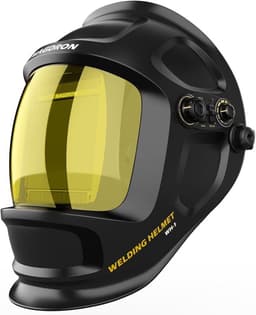
Magdron Magdron WH-1

Alternative

Magdron Magdron WH-1
8.5/10about £79.98
On this page

Why low-current TIG can miss the filter

An auto-darkening filter darkens when its sensors see the arc. Low-current TIG is a weaker signal than many MIG or stick jobs, and the torch, filler hand or workpiece can hide it. A helmet can be steady on stick and still flicker on TIG. Smoke, a dirty cover and an oblique angle make that worse. Four sensors add sight lines. They do not guarantee detection below a stated current. Shade is a separate limit. DIN 9–13 only can be too dark for a low-current puddle even when the filter switches. A 5–9 band gives more adjustment inside the marked range. It does not make the sensors more sensitive. Shade 5–13 and works from 5 A are different claims. UK trade listings sometimes state floors such as 2 A, 5 A or above 20 A for those named helmets. Those numbers do not transfer to an amazon.co.uk model because it also has four sensors. If a listing gives no floor, record it as n/a. The auto-darkening welding helmet buying guide covers the wider standard and optical-class checks.

What to look for in these listings

Inside this set, the less weak plan is four sensors plus both 5–9 and 9–13. TOOLIOM TL-31800H, YESWELDER LYG-M800H, Magdron WH-1 and ATOMPLAN AP-100L fit that description. TOOLIOM and the M800H claim 1/1/1/2. ATOMPLAN claims 1/1/1/1. Magdron prints an EN379 CE line and no four-digit class. None states the missing minimum current. One M800H review reports flashing on TIG stainless unless sensitivity was fully up. That is operational evidence, not a measured floor. ATOMPLAN’s captured 4.7 average rests on 46 reviews, and its DIN 6 side screens are fixed, not auto-darkening. Magdron and TOOLIOM do not show a string of TIG flashes in the sampled comments. Absence from those comments is not a laboratory pass.
TOOLIOM TOOLIOM TL-31800H

Testsieger

TOOLIOM TOOLIOM TL-31800H
9.0/10about £54.14

Listings to treat with caution

The weaker group has fewer stated sensors or no lower dark band. YESWELDER LYG-L600A, LESOLEIL and the unbranded kit state two sensors and start at DIN 9. The two DEKO listings also use 9–13 and do not state a sensor count. Their shared reviews mix one very-low-current success with a report that mild-steel TIG was dimmer than aluminium TIG. A single success is not an ampere limit. Two products need particular caution. A HITBOX Planet review says the filter failed to darken twice during TIG, and the listing gives no sensor count. MIGVAN H-22 states four sensors and a 5–9 band, yet one reviewer returned it after it flashed on TIG. Neither the process name nor four sensors outweighs that report. We would not choose either as a TIG top pick from the title and the bullets.

Set it correctly, then know when to stop

Before you blame TIG detection, set the helmet away from the arc. Confirm weld mode rather than grind, clean covers and sensors, a ready battery and a passed pre-use test. Raise sensitivity for the small arc and aim the sensors at the work. Delay only changes how long the lens stays dark afterwards. If the filter has a low band, stay inside it. Do not borrow one number from a US chart and treat it as UK law. If the puddle disappears at DIN 9 and there is no lower band, that is a product limit, not a reason to weld in grind mode. The fitting sequence is in the how to use a welding helmet guide. If the lens flashes on the real arc, stop. Recheck mode, obstruction, cleanliness, battery and the permitted sensitivity, then use the manual’s non-arc test. If it still flickers, change helmet or have it assessed. Do not keep exposing your eyes while you hunt for a knob position. HSE notes that arc-eye pain and redness may start hours later. The shell is also not respiratory protection. For captured price and window size, use the best auto-darkening welding helmet guide.

Common questions

Will any auto-darkening helmet marked TIG work at low current?
No. Suitable for TIG does not state the minimum current at which the sensors reliably detect an arc. Look for a published ampere floor, an appropriate shade range and relevant review evidence. None of the twelve amazon.co.uk files in this comparison publishes a minimum TIG current.
What shade should I start with for TIG?
Use the process guidance and the range marked on your filter. A 5–9 band offers adjustment for lower-intensity work that a 9–13-only filter lacks, but the exact setting depends on current and conditions. Never use grind mode as a lighter welding shade.
Do I need four sensors for TIG?
Four sensors are preferable because they provide more chances to see an arc when the torch or workpiece blocks one direction. They are not a guarantee: the MIGVAN has four stated sensors and still has a TIG flashing report. A published low-current floor remains stronger evidence.
Why does the lens flash on TIG but not stick?
The TIG arc may be smaller or less intense, particularly at low current, so the optical sensors can lose it. Torch angle, a hand, smoke or a dirty cover can also obscure the signal. Stop, make the permitted checks and change helmet if reliable darkening does not return.
Is a 9–13-only helmet a TIG helmet?
It may work for TIG at currents and conditions the manufacturer supports, but the range gives no lower dark band for a dim puddle. Require a stated minimum TIG current rather than relying on the process name. Several entry helmets here combine 9–13 with only two stated sensors.
Which listings have TIG flash reports?
The research records missed or unstable darkening on TIG for HITBOX Planet and MIGVAN H-22, plus sensitivity-dependent flashing for YESWELDER M800H. LYG-L600A has a broader cutting-out complaint. These are review signals, not controlled tests, but they matter when assessing the same intended process.
When should I stop adjusting and change helmet?
Stop immediately after a flash. Check weld mode, clean and uncovered sensors, battery, approved test and permitted sensitivity settings. If the filter still flickers or fails to darken, do not strike another diagnostic arc. Replace it or use a helmet with a documented TIG capability.

Related pages

Sources

Public UK sources and the amazon.co.uk listings in this set, checked on 16 October 2026.

  1. HSE, welding and flamecutting (retrieved 16 October 2026)
  2. HSE, health risks from welding (retrieved 16 October 2026)
  3. HSE, avoid and reduce welding fume (retrieved 16 October 2026)
  4. HSE WL3, welding fume (retrieved 16 October 2026)
  5. BS EN 379:2003+A1:2009, automatic welding filters (retrieved 16 October 2026)
  6. BS EN 175:1997, welding shields (retrieved 16 October 2026)
  7. GOV.UK, PPE enforcement in Great Britain (retrieved 16 October 2026)
  8. 3M UK, welding eye and face protection (retrieved 16 October 2026)