Independent comparisons. We may earn from shop links. More info

Auto-darkening welding helmet buying guide

Updated: October 2026

You are standing in a garage with a MIG set, and the listings lead with true colour, solar power and fractions of a second. An auto-darkening welding helmet should be judged in a plainer order: reliable darkening, the right shade range, sensor coverage, a useful window and clearly stated standards. Our [welding helmet comparison](/hub/soldering-and-welding/welding-helmet) puts those details beside current amazon.co.uk prices in GBP. This guide explains what the specifications mean and where a missing line should stay n/a. Listings were checked on 16 October 2026. We did not time the filters in a lab. A qualifying purchase through our links can earn a commission at no extra cost to you.

You are standing in a garage with a MIG set, and the listings lead with true colour, solar power and fractions of a second.

Our top picks

YESWELDER YESWELDER LYG-L600A

Best overall

YESWELDER YESWELDER LYG-L600A
8.6/10about £37.04
TOOLIOM TOOLIOM TL-31800H

Rank 2

TOOLIOM TOOLIOM TL-31800H
9.0/10about £54.14
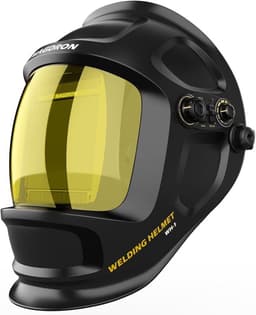
Magdron Magdron WH-1

Alternative

Magdron Magdron WH-1
8.5/10about £79.98
On this page

What to check before the brand name

Start with evidence that the filter and shell are appropriate for welding. For an auto-darkening filter, BS EN 379 is the relevant British and European standard. BS EN 175 covers welding shields and related face protection. HSE advises using welding filters that meet British and European standards. A listing that prints only welding helmet, CE or ANSI Z87.1 has not, on that wording alone, shown you an EN 379 filter and an EN 175 shell. Look for the identifiers, instructions and a declaration from the supplier. Treat anything omitted as unknown. Next read the darkening specification and the recurring review pattern. A maker’s claim such as 1/30,000 second is not an independent laboratory result. Reviews that describe a filter staying light or flashing deserve attention even when the average rating is high. Check weld mode rather than grind mode, unobstructed sensors and a workable battery. If those reports remain after ordinary checks, a low price is a poor exchange for uncertainty around the filter.

Shade range and sensor coverage

Shade numbers tell you whether the filter can suit the process. They are not a quality score. Many helmets in this set have a light state around DIN 3 or 4 and a dark band of DIN 9–13, which covers common MIG and stick settings. A second 5–9 band gives more adjustment for lower-current TIG, cutting and other lower-intensity work. That does not make every 5–13 helmet suitable for very low-current TIG. The maker should state a minimum TIG current, and none of these twelve listings does so. The welding helmet for TIG guide explains that limit. Sensor count affects the chance that the helmet can still see the arc when your torch, hand or workpiece masks one direction. Four sensors are a sensible preference for awkward positions and TIG. Two can work for straightforward bench welding. Four do not guarantee reliable low-current detection. Read the count together with any published minimum current and the relevant reviews. If the listing states neither a sensor count nor a TIG floor, a broad suitable-for-TIG phrase carries little weight.
YESWELDER YESWELDER LYG-L600A

Testsieger

YESWELDER YESWELDER LYG-L600A
8.6/10about £37.04

Window size and side screens

Window size is a comfort and positioning trade-off. A narrow opening around 92 × 42 mm can be adequate for occasional bench work and keeps entry prices down. Larger windows in this set are around 100 × 93 mm, or 3.94 × 3.66 inches, giving more peripheral context without turning the helmet into a panoramic visor. Fixed side windows broaden awareness. They do not necessarily darken with the main filter. One YESWELDER side-view model uses fixed DIN 5 sides, while the ATOMPLAN uses fixed DIN 6 sides. You still need to position the main filter towards the arc.

Power, grind mode and fume

Solar commonly means that a solar cell assists an internal or replaceable battery. It does not mean the helmet has no battery. A replaceable CR2032 or CR2450 is easier to service than a sealed cell. The exact battery should match the instructions. LESOLEIL states that its cell is not removable. Before welding, inspect the cover lenses, confirm the power state and use the maker’s pre-use test. The sequence is in our how to use a welding helmet guide. Grind mode keeps the lens light while you prepare a joint. It is a serious failure mode if you forget to return to weld mode. Sensitivity controls how readily the sensors react. Delay controls how long the lens remains dark after the arc stops. Labels vary between external knobs, internal switches and digital panels. A standard welding helmet does not filter welding fume. HSE’s approach is to avoid or reduce exposure, use local exhaust ventilation, then select respiratory protective equipment where exposure remains. That boundary matters if you weld coated metal, work in a confined area or spend long periods over the plume.

Common questions

What should I read first on an auto-darkening welding helmet listing?
Read the darkening reliability evidence, shade range, sensor count, viewing area and printed standards in that order. Then consider comfort features, true-colour claims and star ratings. A high rating cannot fill in a missing sensor count or prove that the filter and shell meet the relevant standards.
What do the four numbers after EN 379 mean?
They describe optical class, light diffusion, variation in luminous transmittance and angular dependence. Each position is graded from 1 to 3, with 1 the best. Therefore 1/1/1/2 has class 2 in the fourth measure. It is not identical to 1/1/1/1. In this set some listings print 1/1/1/1, several print 1/1/1/2, DEKO prints 1/2/1/2, and others give no four-digit class.
Is shade 9–13 enough?
Shade 9–13 is a common dark range for ordinary MIG and stick work. A lower 5–9 band gives more scope for low-current TIG or cutting, but it does not prove the filter detects a very small arc. For TIG, also require a stated minimum current and credible detection evidence.
Are two arc sensors a problem?
Not necessarily. Two sensors can be sufficient when both maintain a clear view of a stable arc. Four offer more coverage when the torch or workpiece can block one sensor, but sensor count alone does not guarantee low-current TIG performance. Relevant reviews and a published ampere floor matter too.
Does true colour mean optical class 1/1/1/1?
No. True colour describes the colour cast of the view, while the four optical digits grade separate optical characteristics. A listing can claim true colour without printing any four-digit class. Record the optical class as n/a unless the digits are actually stated.
Is ANSI Z87.1 enough for a UK welding helmet?
ANSI Z87.1 is a US eye-and-face protection standard. It is not a substitute for evidence relating to the UK product, such as EN 379 for the auto-darkening filter and EN 175 for the shield. Ask the seller for the applicable declaration and instructions if the listing is vague.
Does a welding helmet stop welding fume?
No. The shell and filter protect the eyes and face from optical radiation and physical hazards within their marked scope. They are not respiratory protection. HSE puts source control and local exhaust first, followed by suitable RPE where the risk assessment shows it is needed.

Related pages

Sources

Public UK sources and the amazon.co.uk listings in this set, checked on 16 October 2026.

  1. HSE, welding and flamecutting (retrieved 16 October 2026)
  2. HSE, health risks from welding (retrieved 16 October 2026)
  3. HSE, avoid and reduce welding fume (retrieved 16 October 2026)
  4. HSE WL3, welding fume (retrieved 16 October 2026)
  5. BS EN 379:2003+A1:2009, automatic welding filters (retrieved 16 October 2026)
  6. BS EN 175:1997, welding shields (retrieved 16 October 2026)
  7. GOV.UK, PPE enforcement in Great Britain (retrieved 16 October 2026)
  8. 3M UK, welding eye and face protection (retrieved 16 October 2026)