Independent comparisons. We may earn from shop links. More info

Welding goggles versus a helmet

Updated: October 2026

You are choosing between welding goggles and a helmet, and the goggles look simpler because they sit close to the eyes. They can filter those eyes and still leave the cheeks, neck and ears open to ultraviolet light and spatter. Gas work with little spatter can be a goggle with the right shade. Arc work on an open bench is a helmet or a proper welding shield. This page does not review helmet models. Those listings are on our [welding helmet comparison](/hub/soldering-and-welding/welding-helmet). The goggle listings are on the [welding goggles comparison](/hub/soldering-and-welding/welding-goggles). A qualifying purchase through our links can earn a commission at no extra cost to you.

You are choosing between welding goggles and a helmet, and the goggles look simpler because they sit close to the eyes.

Our top picks

Laser Laser 6724

Best overall

Laser Laser 6724
9.2/10about £16.75
YESWELDER YESWELDER LYG-R100A

Alternative

YESWELDER YESWELDER LYG-R100A
9.0/10about £37.99
XLTXWD XLTXWD solar glasses

Alternative

XLTXWD XLTXWD solar glasses
8.6/10about £8.99
On this page

What each one actually covers

Welding goggles are a filter and a seal around the eyes. A helmet or welding shield adds a shell over the face and reaches toward the ears and neck. HSE's welding PPE note draws that line by the hazard. Where gas welding does not throw sparks or spatter, goggles with a suitable filter can be enough. A welding shield is named for molten metal and hot particles, and it should meet BS EN 175. Overhead work may also need goggles behind the shield, because spatter can fall past a visor you have tilted to see. 3M's UK page describes arc eye as an arc struck with the helmet up, or with the eyes otherwise bare. HSE notes that the pain can arrive hours later, and it links ocular melanoma with welding ultraviolet light. A dark lens over the pupils does not cover the skin beside the strap. An XLTXWD buyer in this set reported a red face after longer welds, and UNISOPH feedback includes light from above.

When goggles are the usual choice

Use goggles for gas welding, brazing or cutting when the job is not throwing spatter and the lens is a marked gas shade. The UK trade default is shade 5. BOC sells shade 5 for gas welding, and SGS Gases says that shade is for oxy-fuel, not MIG or TIG. An HSE note then allows one step lighter or darker with acetylene flow. That table lives on the gas welding goggles guide. Here the point is the format: a passive gas goggle can be the right object when sparks are not the hazard. A passive shade does not wait on a sensor. You still lower a flip-up before the flame is working. At work, the PPE at Work Regulations 1992 leave the choice to the employer's assessment, and an amazon.co.uk pair does not replace it or stop fume. If the gas job becomes overhead cutting, the shield requirement returns. For a bench torch, a marked shade 5 lens and a seal that meets your face are the usual case.
Laser Laser 6724

Testsieger

Laser Laser 6724
9.2/10about £16.75

When a helmet is the usual choice

MIG, TIG and MMA produce an arc, ultraviolet light that reflects off the metal, and often spatter. JSP's UK answer for MIG on steel puts the filter at about shade 10 from roughly 80 to 100 amps upward, on a welding face shield. Shade 5 is the gas number. It is too light for that arc in a goggle or in a helmet fitted with the wrong glass. HSE's motor-vehicle page says to limit ultraviolet and infrared exposure with clothing and screens, to wear goggles when chipping slag, and to use filters that meet British and European standards. It does not say a goggle replaces a helmet for MIG. Chipping needs an impact-rated pair, not a dark lens you grind through. Auto-darkening, as 3M describes it, is a reason to keep a helmet down. Goggles are not illegal for MIG. They are the wrong default when the bench is open and a helmet fits.

Goggles with a face shield are not a helmet

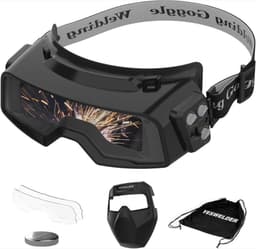
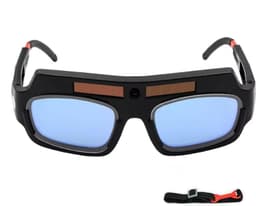
The YESWELDER LYG-R100A, at about £37.99, claims a dark range of 4/5-9/9-13 and includes a face shield. Reviewers use it under cars, where a helmet shell will not go. A UK reviewer reported facial sunburn, with a white patch where the shield would have sat, after leaving that shield off. The shell can press, the clips can feel fragile, and one unit reportedly stopped darkening within a week. Check the switch first, as set out in how to use welding goggles. A clip-on shield is not a helmet. It can cover the cheeks if it stays on, and it can still leave the neck and the gap above the frame open. Cheaper auto-darkening glasses here often have no shield and no shade. DNTHYRIN is about £7.99 and XLTXWD is about £8.99, and one XLTXWD pair slid off when the wearer looked down. Two YESWELDER helmets were removed from this goggle set. Compare helmets on the helmet page rather than treating those models as goggles.

A clear answer with a condition

For a gas torch with little spatter, choose welding goggles with a marked gas shade, usually shade 5, and confirm the seal. For open-bench arc work, use a helmet or welding shield with a dark range matched to the current, and keep it down. Where a helmet will not fit, such as a wheel arch, a goggle is a compromise. It needs a stated dark range, a face shield that stays on, and a test that the filter darkens before you strike. If one of those is missing, move the job to a bench or do not weld. Products Compared used amazon.co.uk listings and public UK sources, including HSE, and did not lab-test these products.

Common questions

Are welding goggles enough for MIG?
Not on an open bench. MIG on steel needs about shade 10 or darker in JSP's UK guidance, on a face shield, because of the arc, reflected ultraviolet light and spatter. Goggles can filter the eyes and still leave the cheeks and neck bare. Use a helmet unless the space will not take one. In that tight case you still need a stated dark range, a face shield that stays on, and a filter you have seen darken.
When are goggles the right format?
Goggles suit gas welding, brazing or cutting that does not throw sparks or spatter, with a filter marked for that process. HSE's PPE note allows suitable filter goggles for that gas case and points to a welding shield when hot particles are the hazard. Shade 5 is the UK trade default for oxy-fuel. A green lens with no shade number is not the same thing, however dark it looks in the photo.
Do auto-darkening goggles replace a helmet?
They remove the need to flip a passive lens. They do not cover the face and neck. Auto-darkening is useful because you can leave protection in place and still see the joint, which is why 3M treats it as a reason to keep a helmet down. A sensing goggle still leaves skin exposed unless a separate shield stays fitted. Test the darkening before you strike, because a failed sensor is an open eye.
Why did my face burn around the goggles?
The lens covered your eyes and ultraviolet light reached the skin around the frame. A YESWELDER user reported sunburn with the face shield left off, an XLTXWD user reported a red face on longer welds, and a UNISOPH user reported light from above. The shade can be right and the skin still burns. Fit the shield or change to a helmet before you carry on.
What shade is shade 5 actually for?
Shade 5 is the usual UK lens for oxy-fuel welding, not for MIG, TIG or MMA. BOC sells it for gas welding, and SGS Gases says it is not a MIG or TIG filter. Arc work on steel starts nearer shade 10 on a face shield in JSP's guide. Fitting shade 5 inside a helmet does not turn it into an arc filter. Match the number to the process, then pick the format.
Should I wear clear goggles under a helmet?
HSE says overhead work may need goggles behind the shield, because spatter can pass a tilted visor. That second layer is for particles, not a replacement for the welding filter. After the arc is out, chipping calls for impact goggles rather than the dark lens. Do not grind through the welding filter, and do not lift the helmet while someone nearby is still welding.
Is a clip-on face shield the same as a helmet?
No. A clip-on can cover the cheeks in front of a goggle if it stays attached, and it is still smaller than a welding helmet. The YESWELDER shield belongs to a tight-access setup, and a review records sunburn when it is left off. It does not turn every goggle into face protection. If you have room on the bench, compare a helmet on its own page.

Related pages

Sources

Public UK sources named in the research digest, plus the amazon.co.uk listings in this set. BOC UK goggle prices were noted on 16 October 2026. No laboratory test was run.

  1. HSE, Controlling the risks from welding (retrieved 16 October 2026)
  2. HSE, Health risks from welding (retrieved 16 October 2026)
  3. NHS 111 Wales, arc eye (retrieved 16 October 2026)
  4. PPE at Work Regulations 1992 (retrieved 16 October 2026)
  5. BSI, EN ISO 16321 eye protection (retrieved 16 October 2026)
  6. BOC UK, safety specs and goggles (retrieved 16 October 2026)
  7. JSP Safety UK, MIG shade on steel (retrieved 16 October 2026)
  8. 3M UK, welding eye and face protection (retrieved 16 October 2026)